 Add to Chrome
 Add to Firefox
 Add to Edge
HypEMBER: Hypernetwork-based Ensemble for Robust Policy Learning of Parametrized Dynamical Systems
Jul 21, 2026
In this work we investigate reinforcement learning (RL) as a framework for the robust control of parametrized dynamical systems in presence of measurements and model uncertainties. High-dimensional state spaces, expensive numerical solvers, the partial knowledge of the governing equations, and the dependence on physical parameters that may be uncertain or difficult to estimate accurately, make the use of standard RL approaches computationally unfeasible. Indeed, lack of robustness and poor generalization across parameter variations are further amplified in presence of noisy or incomplete measurements, ultimately hampering control performance. To address these challenges, we introduce HypEMBER, a novel RL framework based on the combination of hypernetworks and ensemble learning. In the proposed approach, both the policy and value functions are represented through hypernetworks that generate the weights of the underlying models conditioned on the physical parameters of the system, thereby enabling parametric generalization across different dynamical regimes. In addition, an ensemble of policy and value approximators is employed to quantify epistemic uncertainty, leading to improved exploration strategies and enhanced robustness during and after training. The performance of the proposed framework is assessed on two representative parametrized control problems: (i) the one-dimensional Kuramoto-Sivashinsky equation and (ii) a particle-navigation task in a two-dimensional time-dependent gyre flow, focusing on robustness with respect to measurement noise and parameter misspecification. Numerical results demonstrate that HypEMBER consistently improves training stability and sample efficiency, while achieving superior robustness to uncertainties affecting both the system dynamics and the available observations, in comparison with state-of-the-art RL methods.

An Introduction to Sparse Identification of Nonlinear Dynamics for Engineering Applications
Jul 16, 2026Many engineering problems involve phenomena whose governing equations are poorly characterized or only partially known. Surrogate modeling techniques such as neural networks can capture the behavior of these systems, but they typically demand large training datasets that are difficult to obtain in engineering contexts and yield models with limited physical interpretability. The Sparse Identification of Nonlinear Dynamics (SINDy) method addresses both limitations by performing sparse regression over libraries of candidate nonlinear terms, recovering interpretable governing equations from comparatively small datasets. Although SINDy has been demonstrated extensively on canonical benchmark systems, its application to practical engineering problems is less widely documented. This tutorial introduces the SINDy method and progressively builds toward its main extensions, from noise-robust weak-form and ensembling-based variants to constrained and parametrizable formulations. The paper and the accompanying tutorial (available at https://github.com/paullililili/SINDy4Engineers) is organized in three parts: the first introduces the standard SINDy algorithm and progressively extends it, inviting readers without prior knowledge to follow each step and adapt the methods to their own problems; the remaining two parts present detailed case studies on (1) the system identification of an unmanned aerial vehicle and (2) a chaotic thermosyphon heat exchanger. Through these examples, we aim to demonstrate that SINDy is simple to implement yet flexible enough to serve as a valuable identification tool for advanced engineering applications.
How Low Can You Go? Active Learning for Sparse Model Discovery in the Ultra-Low-Data Limit
Jun 10, 2026Identifying the governing equations of complex dynamical systems remains a fundamental challenge across science and engineering. While early approaches relied on empirical data and heuristics, modern data-driven methods offer greater flexibility and fewer assumptions. However, data acquisition in real-world settings is often expensive. This work addresses this challenge by introducing an active learning strategy for dynamics discovery in the ultra-low data limit. Rather than sampling randomly, our method iteratively prioritizes regions that are most informative for model identification. This approach builds on Sparse Identification of Nonlinear Dynamics (SINDy), and utilizes an ensemble extension, E-SINDy, to estimate epistemic uncertainty and guide the sampling for both ordinary and partial differential equations (ODEs/PDEs). For ODEs, an exhaustive analysis is conducted on the Lorenz system across varying data budgets and noise levels. For PDEs, two systems with contrasting dynamical characteristics are examined: the Burgers' equation, where a sharp shock front creates a distinction between informative and uninformative regions, and the Kuramoto-Sivashinsky equation, which presents a more spatially complex sampling landscape. Across all scenarios, the proposed method accurately identifies the governing dynamics with significantly fewer data samples than random sampling.
Fourier Weak SINDy: Spectral Test Function Selection for Robust Model Identification
Apr 22, 2026We introduce Fourier Weak SINDy, a minimal noise-robust and interpretable derivative-free equation learning method that combines weak-form sparse equation learning with spectral density estimation for data-driven test function selection. By using orthogonal sinusoidal test functions inspired by their prevalence in Modulating Function-based system identification, the weak-form sparse regression problem reduces to a regression over Fourier coefficients. Dominant frequencies are then selected via multitaper estimation of the frequency spectrum of the data. This formulation unifies weak-form learning and spectral estimation within a compact and flexible framework. We illustrate the effectiveness of this approach in numerical experiments across multiple chaotic and hyperchaotic ODE benchmarks.
Robust Co-design Optimisation for Agile Fixed-Wing UAVs
Mar 11, 2026Co-design optimisation of autonomous systems has emerged as a powerful alternative to sequential approaches by jointly optimising physical design and control strategies. However, existing frameworks often neglect the robustness required for autonomous systems navigating unstructured, real-world environments. For agile Unmanned Aerial Vehicles (UAVs) operating at the edge of the flight envelope, this lack of robustness yields designs that are sensitive to perturbations and model mismatch. To address this, we propose a robust co-design framework for agile fixed-wing UAVs that integrates parametric uncertainty and wind disturbances directly into the concurrent optimisation process. Our bi-level approach optimises physical design in a high-level loop while discovering nominal solutions via a constrained trajectory planner and evaluating performance across a stochastic Monte Carlo ensemble using feedback LQR control. Validated across three agile flight missions, our strategy consistently outperforms deterministic baselines. The results demonstrate that our robust co-design strategy inherently tailors aerodynamic features, such as wing placement and aspect ratio, to achieve an optimal trade-off between mission performance and disturbance rejection.
Interpretable and Efficient Data-driven Discovery and Control of Distributed Systems
Nov 06, 2024Effectively controlling systems governed by Partial Differential Equations (PDEs) is crucial in several fields of Applied Sciences and Engineering. These systems usually yield significant challenges to conventional control schemes due to their nonlinear dynamics, partial observability, high-dimensionality once discretized, distributed nature, and the requirement for low-latency feedback control. Reinforcement Learning (RL), particularly Deep RL (DRL), has recently emerged as a promising control paradigm for such systems, demonstrating exceptional capabilities in managing high-dimensional, nonlinear dynamics. However, DRL faces challenges including sample inefficiency, robustness issues, and an overall lack of interpretability. To address these issues, we propose a data-efficient, interpretable, and scalable Dyna-style Model-Based RL framework for PDE control, combining the Sparse Identification of Nonlinear Dynamics with Control (SINDy-C) algorithm and an autoencoder (AE) framework for the sake of dimensionality reduction of PDE states and actions. This novel approach enables fast rollouts, reducing the need for extensive environment interactions, and provides an interpretable latent space representation of the PDE forward dynamics. We validate our method on two PDE problems describing fluid flows - namely, the 1D Burgers equation and 2D Navier-Stokes equations - comparing it against a model-free baseline, and carrying out an extensive analysis of the learned dynamics.
Sparsifying Parametric Models with L0 Regularization
Sep 05, 2024This document contains an educational introduction to the problem of sparsifying parametric models with L0 regularization. We utilize this approach together with dictionary learning to learn sparse polynomial policies for deep reinforcement learning to control parametric partial differential equations. The code and a tutorial are provided here: https://github.com/nicob15/Sparsifying-Parametric-Models-with-L0.
Parametric PDE Control with Deep Reinforcement Learning and Differentiable L0-Sparse Polynomial Policies
Mar 22, 2024Optimal control of parametric partial differential equations (PDEs) is crucial in many applications in engineering and science. In recent years, the progress in scientific machine learning has opened up new frontiers for the control of parametric PDEs. In particular, deep reinforcement learning (DRL) has the potential to solve high-dimensional and complex control problems in a large variety of applications. Most DRL methods rely on deep neural network (DNN) control policies. However, for many dynamical systems, DNN-based control policies tend to be over-parametrized, which means they need large amounts of training data, show limited robustness, and lack interpretability. In this work, we leverage dictionary learning and differentiable L$_0$ regularization to learn sparse, robust, and interpretable control policies for parametric PDEs. Our sparse policy architecture is agnostic to the DRL method and can be used in different policy-gradient and actor-critic DRL algorithms without changing their policy-optimization procedure. We test our approach on the challenging tasks of controlling parametric Kuramoto-Sivashinsky and convection-diffusion-reaction PDEs. We show that our method (1) outperforms baseline DNN-based DRL policies, (2) allows for the derivation of interpretable equations of the learned optimal control laws, and (3) generalizes to unseen parameters of the PDE without retraining the policies.
SINDy-RL: Interpretable and Efficient Model-Based Reinforcement Learning
Mar 14, 2024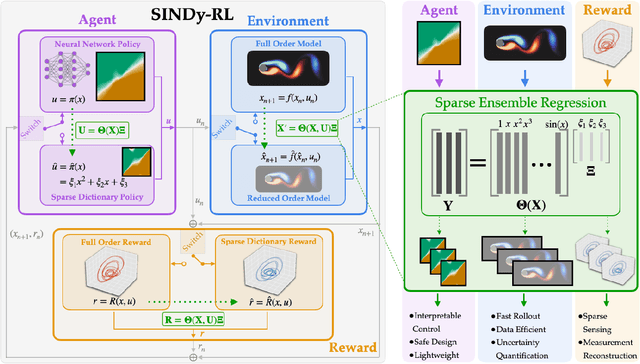


Deep reinforcement learning (DRL) has shown significant promise for uncovering sophisticated control policies that interact in environments with complicated dynamics, such as stabilizing the magnetohydrodynamics of a tokamak fusion reactor or minimizing the drag force exerted on an object in a fluid flow. However, these algorithms require an abundance of training examples and may become prohibitively expensive for many applications. In addition, the reliance on deep neural networks often results in an uninterpretable, black-box policy that may be too computationally expensive to use with certain embedded systems. Recent advances in sparse dictionary learning, such as the sparse identification of nonlinear dynamics (SINDy), have shown promise for creating efficient and interpretable data-driven models in the low-data regime. In this work we introduce SINDy-RL, a unifying framework for combining SINDy and DRL to create efficient, interpretable, and trustworthy representations of the dynamics model, reward function, and control policy. We demonstrate the effectiveness of our approaches on benchmark control environments and challenging fluids problems. SINDy-RL achieves comparable performance to state-of-the-art DRL algorithms using significantly fewer interactions in the environment and results in an interpretable control policy orders of magnitude smaller than a deep neural network policy.
Rapid Bayesian identification of sparse nonlinear dynamics from scarce and noisy data
Feb 23, 2024We propose a fast probabilistic framework for identifying differential equations governing the dynamics of observed data. We recast the SINDy method within a Bayesian framework and use Gaussian approximations for the prior and likelihood to speed up computation. The resulting method, Bayesian-SINDy, not only quantifies uncertainty in the parameters estimated but also is more robust when learning the correct model from limited and noisy data. Using both synthetic and real-life examples such as Lynx-Hare population dynamics, we demonstrate the effectiveness of the new framework in learning correct model equations and compare its computational and data efficiency with existing methods. Because Bayesian-SINDy can quickly assimilate data and is robust against noise, it is particularly suitable for biological data and real-time system identification in control. Its probabilistic framework also enables the calculation of information entropy, laying the foundation for an active learning strategy.