 Add to Chrome
 Add to Firefox
 Add to Edge
Inference-time optimization for experiment-grounded protein ensemble generation
Mar 04, 2026
Protein function relies on dynamic conformational ensembles, yet current generative models like AlphaFold3 often fail to produce ensembles that match experimental data. Recent experiment-guided generators attempt to address this by steering the reverse diffusion process. However, these methods are limited by fixed sampling horizons and sensitivity to initialization, often yielding thermodynamically implausible results. We introduce a general inference-time optimization framework to solve these challenges. First, we optimize over latent representations to maximize ensemble log-likelihood, rather than perturbing structures post hoc. This approach eliminates dependence on diffusion length, removes initialization bias, and easily incorporates external constraints. Second, we present novel sampling schemes for drawing Boltzmann-weighted ensembles. By combining structural priors from AlphaFold3 with force-field-based priors, we sample from their product distribution while balancing experimental likelihoods. Our results show that this framework consistently outperforms state-of-the-art guidance, improving diversity, physical energy, and agreement with data in X-ray crystallography and NMR, often fitting the experimental data better than deposited PDB structures. Finally, inference-time optimization experiments maximizing ipTM scores reveal that perturbing AlphaFold3 embeddings can artificially inflate model confidence. This exposes a vulnerability in current design metrics, whose mitigation could offer a pathway to reduce false discovery rates in binder engineering.

WorldCuisines: A Massive-Scale Benchmark for Multilingual and Multicultural Visual Question Answering on Global Cuisines
Oct 16, 2024

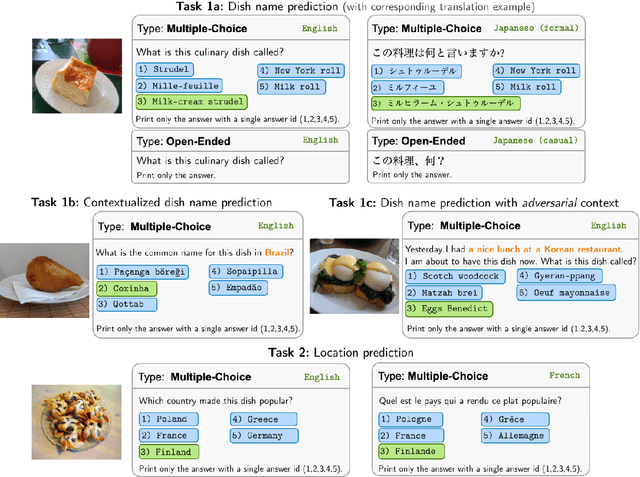

Vision Language Models (VLMs) often struggle with culture-specific knowledge, particularly in languages other than English and in underrepresented cultural contexts. To evaluate their understanding of such knowledge, we introduce WorldCuisines, a massive-scale benchmark for multilingual and multicultural, visually grounded language understanding. This benchmark includes a visual question answering (VQA) dataset with text-image pairs across 30 languages and dialects, spanning 9 language families and featuring over 1 million data points, making it the largest multicultural VQA benchmark to date. It includes tasks for identifying dish names and their origins. We provide evaluation datasets in two sizes (12k and 60k instances) alongside a training dataset (1 million instances). Our findings show that while VLMs perform better with correct location context, they struggle with adversarial contexts and predicting specific regional cuisines and languages. To support future research, we release a knowledge base with annotated food entries and images along with the VQA data.