 Add to Chrome
 Add to Firefox
 Add to Edge
Inference-time optimization for experiment-grounded protein ensemble generation
Mar 04, 2026
Protein function relies on dynamic conformational ensembles, yet current generative models like AlphaFold3 often fail to produce ensembles that match experimental data. Recent experiment-guided generators attempt to address this by steering the reverse diffusion process. However, these methods are limited by fixed sampling horizons and sensitivity to initialization, often yielding thermodynamically implausible results. We introduce a general inference-time optimization framework to solve these challenges. First, we optimize over latent representations to maximize ensemble log-likelihood, rather than perturbing structures post hoc. This approach eliminates dependence on diffusion length, removes initialization bias, and easily incorporates external constraints. Second, we present novel sampling schemes for drawing Boltzmann-weighted ensembles. By combining structural priors from AlphaFold3 with force-field-based priors, we sample from their product distribution while balancing experimental likelihoods. Our results show that this framework consistently outperforms state-of-the-art guidance, improving diversity, physical energy, and agreement with data in X-ray crystallography and NMR, often fitting the experimental data better than deposited PDB structures. Finally, inference-time optimization experiments maximizing ipTM scores reveal that perturbing AlphaFold3 embeddings can artificially inflate model confidence. This exposes a vulnerability in current design metrics, whose mitigation could offer a pathway to reduce false discovery rates in binder engineering.

Representing local protein environments with atomistic foundation models
May 29, 2025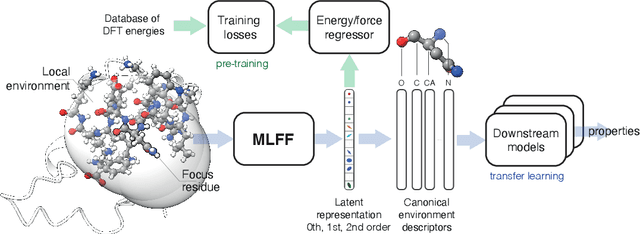


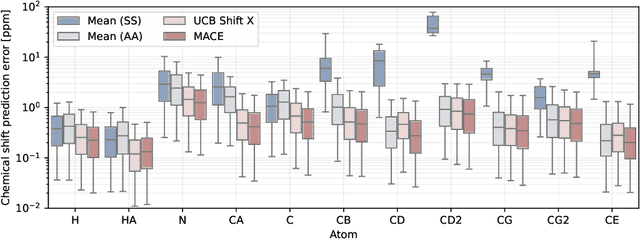
The local structure of a protein strongly impacts its function and interactions with other molecules. Therefore, a concise, informative representation of a local protein environment is essential for modeling and designing proteins and biomolecular interactions. However, these environments' extensive structural and chemical variability makes them challenging to model, and such representations remain under-explored. In this work, we propose a novel representation for a local protein environment derived from the intermediate features of atomistic foundation models (AFMs). We demonstrate that this embedding effectively captures both local structure (e.g., secondary motifs), and chemical features (e.g., amino-acid identity and protonation state). We further show that the AFM-derived representation space exhibits meaningful structure, enabling the construction of data-driven priors over the distribution of biomolecular environments. Finally, in the context of biomolecular NMR spectroscopy, we demonstrate that the proposed representations enable a first-of-its-kind physics-informed chemical shift predictor that achieves state-of-the-art accuracy. Our results demonstrate the surprising effectiveness of atomistic foundation models and their emergent representations for protein modeling beyond traditional molecular simulations. We believe this will open new lines of work in constructing effective functional representations for protein environments.