 Add to Chrome
 Add to Firefox
 Add to Edge
SonoRank: Towards Calibration-Free Real-Time Finger Flexion Detection from Forearm Ultrasound Sequences
Jul 08, 2026
Powered prosthetic hands are frequently abandoned, largely due to the limited functionality of current devices that rely on surface electromyography (sEMG). Sonomyography (ultrasound) has emerged as a promising alternative, owing to its ability to observe muscle activity in real time and control a greater number of degrees of freedom. Yet, existing ultrasound-based methods require per-user fine-tuning, limiting their commercialization. We propose SonoRank, an important step towards calibration-free finger flexion detection from forearm ultrasound video. SonoRank first learns to rank pairs of ultrasound sequences by their relative motion magnitude for each of the five fingers. The learned representations are then fine-tuned to classify whether each finger is actively flexing, using a rest reference that is captured at the beginning of the operation. Under 12-fold leave-one-subject-out cross-validation on a dataset of twelve subjects with synchronized kinematics, SonoRank achieves a 28% improvement in F1 score over direct classification baselines that skip the ranking stage. These results establish pairwise ranking as an effective pretraining signal for subject-independent control, bringing ultrasound-based prosthetics closer to practical, calibration-free deployment.

Coupled Query-Key Dynamics for Attention
Apr 02, 2026Standard scaled dot-product attention computes scores from static, independent projections of the input. We show that evolving queries and keys \emph{jointly} through shared learned dynamics before scoring - which we call \textbf{coupled QK dynamics} - improves language modeling perplexity and training stability. On WikiText-103 at 60M parameters, coupled dynamics achieves 22.55--22.62 perplexity vs.\ 24.22 for standard attention ($-$6.6--6.9\%), with only 0.11\% additional parameters (shared across both instantiations). A structural ablation isolates coupling as the active ingredient: a symplectic (Hamiltonian) and a non-symplectic (Euler) integrator perform identically when both couple Q and K, while an uncoupled MLP baseline of matched capacity reaches only 23.81 with 8$\times$ higher seed variance. The integration step count (1--7) is similarly irrelevant - a single coupled step suffices. A compute-matched comparison reveals that coupling is a \emph{sample-efficiency} mechanism: standard attention trained for 2.4$\times$ longer (matching wall-clock) reaches the same perplexity, but requires 2.4$\times$ more tokens. The advantage scales to 150M ($-$6.7\%) but narrows at 350M ($-$1.0\%), where Differential Attention (18.93) overtakes coupled dynamics (19.35). The benefit is corpus-dependent: coupling helps on domain-coherent text (WikiText-103 $-$6.6\%, PubMed $-$4.5\%) but degrades on heterogeneous web text ($+$10.3\%) and shows no benefit on GLUE. We characterize when coupling helps and when it does not, providing practical guidelines.
Inference-time optimization for experiment-grounded protein ensemble generation
Mar 04, 2026Protein function relies on dynamic conformational ensembles, yet current generative models like AlphaFold3 often fail to produce ensembles that match experimental data. Recent experiment-guided generators attempt to address this by steering the reverse diffusion process. However, these methods are limited by fixed sampling horizons and sensitivity to initialization, often yielding thermodynamically implausible results. We introduce a general inference-time optimization framework to solve these challenges. First, we optimize over latent representations to maximize ensemble log-likelihood, rather than perturbing structures post hoc. This approach eliminates dependence on diffusion length, removes initialization bias, and easily incorporates external constraints. Second, we present novel sampling schemes for drawing Boltzmann-weighted ensembles. By combining structural priors from AlphaFold3 with force-field-based priors, we sample from their product distribution while balancing experimental likelihoods. Our results show that this framework consistently outperforms state-of-the-art guidance, improving diversity, physical energy, and agreement with data in X-ray crystallography and NMR, often fitting the experimental data better than deposited PDB structures. Finally, inference-time optimization experiments maximizing ipTM scores reveal that perturbing AlphaFold3 embeddings can artificially inflate model confidence. This exposes a vulnerability in current design metrics, whose mitigation could offer a pathway to reduce false discovery rates in binder engineering.
DigiArm: An Anthropomorphic 3D-Printed Prosthetic Hand with Enhanced Dexterity for Typing Tasks
Feb 26, 2026Despite recent advancements, existing prosthetic limbs are unable to replicate the dexterity and intuitive control of the human hand. Current control systems for prosthetic hands are often limited to grasping, and commercial prosthetic hands lack the precision needed for dexterous manipulation or applications that require fine finger motions. Thus, there is a critical need for accessible and replicable prosthetic designs that enable individuals to interact with electronic devices and perform precise finger pressing, such as keyboard typing or piano playing, while preserving current prosthetic capabilities. This paper presents a low-cost, lightweight, 3D-printed robotic prosthetic hand, specifically engineered for enhanced dexterity with electronic devices such as a computer keyboard or piano, as well as general object manipulation. The robotic hand features a mechanism to adjust finger abduction/adduction spacing, a 2-D wrist with the inclusion of controlled ulnar/radial deviation optimized for typing, and control of independent finger pressing. We conducted a study to demonstrate how participants can use the robotic hand to perform keyboard typing and piano playing in real time, with different levels of finger and wrist motion. This supports the notion that our proposed design can allow for the execution of key typing motions more effectively than before, aiming to enhance the functionality of prosthetic hands.
Architecture-Aware Generalization Bounds for Temporal Networks: Theory and Fair Comparison Methodology
Aug 08, 2025Deep temporal architectures such as Temporal Convolutional Networks (TCNs) achieve strong predictive performance on sequential data, yet theoretical understanding of their generalization remains limited. We address this gap by providing both the first non-vacuous, architecture-aware generalization bounds for deep temporal models and a principled evaluation methodology. For exponentially $\beta$-mixing sequences, we derive bounds scaling as $ O\!\Bigl(R\,\sqrt{\tfrac{D\,p\,n\,\log N}{N}}\Bigr), $ where $D$ is network depth, $p$ kernel size, $n$ input dimension, and $R$ weight norm. Our delayed-feedback blocking mechanism transforms dependent samples into effectively independent ones while discarding only $O(1/\log N)$ of the data, yielding $\sqrt{D}$ scaling instead of exponential, implying that doubling depth requires approximately quadrupling the training data. We also introduce a fair-comparison methodology that fixes the effective sample size to isolate the effect of temporal structure from information content. Under $N_{\text{eff}}=2{,}000$, strongly dependent sequences ($\rho=0.8$) exhibit $\approx76\%$ smaller generalization gaps than weakly dependent ones ($\rho=0.2$), challenging the intuition that dependence is purely detrimental. Yet convergence rates diverge from theory: weak dependencies follow $N_{\text{eff}}^{-1.21}$ scaling and strong dependencies follow $N_{\text{eff}}^{-0.89}$, both steeper than the predicted $N^{-0.5}$. These findings reveal that temporal dependence can enhance learning under fixed information budgets, while highlighting gaps between theory and practice that motivate future research.
Representing local protein environments with atomistic foundation models
May 29, 2025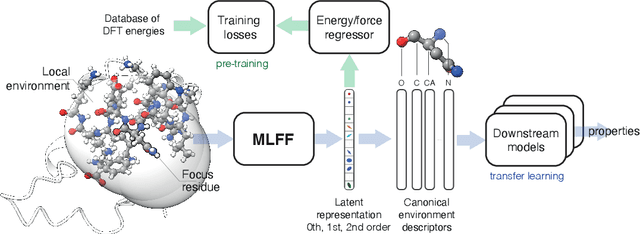


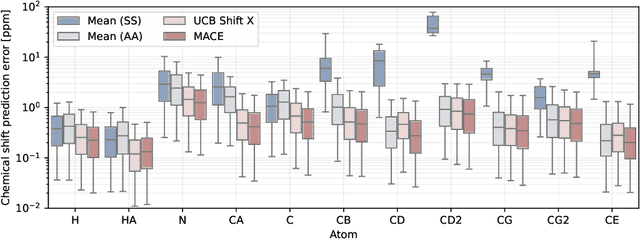
The local structure of a protein strongly impacts its function and interactions with other molecules. Therefore, a concise, informative representation of a local protein environment is essential for modeling and designing proteins and biomolecular interactions. However, these environments' extensive structural and chemical variability makes them challenging to model, and such representations remain under-explored. In this work, we propose a novel representation for a local protein environment derived from the intermediate features of atomistic foundation models (AFMs). We demonstrate that this embedding effectively captures both local structure (e.g., secondary motifs), and chemical features (e.g., amino-acid identity and protonation state). We further show that the AFM-derived representation space exhibits meaningful structure, enabling the construction of data-driven priors over the distribution of biomolecular environments. Finally, in the context of biomolecular NMR spectroscopy, we demonstrate that the proposed representations enable a first-of-its-kind physics-informed chemical shift predictor that achieves state-of-the-art accuracy. Our results demonstrate the surprising effectiveness of atomistic foundation models and their emergent representations for protein modeling beyond traditional molecular simulations. We believe this will open new lines of work in constructing effective functional representations for protein environments.
From Lab to Wrist: Bridging Metabolic Monitoring and Consumer Wearables for Heart Rate and Oxygen Consumption Modeling
Apr 30, 2025Understanding physiological responses during running is critical for performance optimization, tailored training prescriptions, and athlete health management. We introduce a comprehensive framework -- what we believe to be the first capable of predicting instantaneous oxygen consumption (VO$_{2}$) trajectories exclusively from consumer-grade wearable data. Our approach employs two complementary physiological models: (1) accurate modeling of heart rate (HR) dynamics via a physiologically constrained ordinary differential equation (ODE) and neural Kalman filter, trained on over 3 million HR observations, achieving 1-second interval predictions with mean absolute errors as low as 2.81\,bpm (correlation 0.87); and (2) leveraging the principles of precise HR modeling, a novel VO$_{2}$ prediction architecture requiring only the initial second of VO$_{2}$ data for calibration, enabling robust, sequence-to-sequence metabolic demand estimation. Despite relying solely on smartwatch and chest-strap data, our method achieves mean absolute percentage errors of approximately 13\%, effectively capturing rapid physiological transitions and steady-state conditions across diverse running intensities. Our synchronized dataset, complemented by blood lactate measurements, further lays the foundation for future noninvasive metabolic zone identification. By embedding physiological constraints within modern machine learning, this framework democratizes advanced metabolic monitoring, bridging laboratory-grade accuracy and everyday accessibility, thus empowering both elite athletes and recreational fitness enthusiasts.
Estimating the Number of HTTP/3 Responses in QUIC Using Deep Learning
Oct 08, 2024QUIC, a new and increasingly used transport protocol, enhances TCP by providing better security, performance, and features like stream multiplexing. These features, however, also impose challenges for network middle-boxes that need to monitor and analyze web traffic. This paper proposes a novel solution for estimating the number of HTTP/3 responses in a given QUIC connection by an observer. This estimation reveals server behavior, client-server interactions, and data transmission efficiency, which is crucial for various applications such as designing a load balancing solution and detecting HTTP/3 flood attacks. The proposed scheme transforms QUIC connection traces into a sequence of images and trains machine learning (ML) models to predict the number of responses. Then, by aggregating images of a QUIC connection, an observer can estimate the total number of responses. As the problem is formulated as a discrete regression problem, we introduce a dedicated loss function. The proposed scheme is evaluated on a dataset of over seven million images, generated from $100,000$ traces collected from over $44,000$ websites over a four-month period, from various vantage points. The scheme achieves up to 97\% cumulative accuracy in both known and unknown web server settings and 92\% accuracy in estimating the total number of responses in unseen QUIC traces.
Beyond the Alphabet: Deep Signal Embedding for Enhanced DNA Clustering
Oct 08, 2024



The emerging field of DNA storage employs strands of DNA bases (A/T/C/G) as a storage medium for digital information to enable massive density and durability. The DNA storage pipeline includes: (1) encoding the raw data into sequences of DNA bases; (2) synthesizing the sequences as DNA \textit{strands} that are stored over time as an unordered set; (3) sequencing the DNA strands to generate DNA \textit{reads}; and (4) deducing the original data. The DNA synthesis and sequencing stages each generate several independent error-prone duplicates of each strand which are then utilized in the final stage to reconstruct the best estimate for the original strand. Specifically, the reads are first \textit{clustered} into groups likely originating from the same strand (based on their similarity to each other), and then each group approximates the strand that led to the reads of that group. This work improves the DNA clustering stage by embedding it as part of the DNA sequencing. Traditional DNA storage solutions begin after the DNA sequencing process generates discrete DNA reads (A/T/C/G), yet we identify that there is untapped potential in using the raw signals generated by the Nanopore DNA sequencing machine before they are discretized into bases, a process known as \textit{basecalling}, which is done using a deep neural network. We propose a deep neural network that clusters these signals directly, demonstrating superior accuracy, and reduced computation times compared to current approaches that cluster after basecalling.
Automatic Identification and Visualization of Group Training Activities Using Wearable Data
Oct 07, 2024Human Activity Recognition (HAR) identifies daily activities from time-series data collected by wearable devices like smartwatches. Recent advancements in Internet of Things (IoT), cloud computing, and low-cost sensors have broadened HAR applications across fields like healthcare, biometrics, sports, and personal fitness. However, challenges remain in efficiently processing the vast amounts of data generated by these devices and developing models that can accurately recognize a wide range of activities from continuous recordings, without relying on predefined activity training sessions. This paper presents a comprehensive framework for imputing, analyzing, and identifying activities from wearable data, specifically targeting group training scenarios without explicit activity sessions. Our approach is based on data collected from 135 soldiers wearing Garmin 55 smartwatches over six months. The framework integrates multiple data streams, handles missing data through cross-domain statistical methods, and identifies activities with high accuracy using machine learning (ML). Additionally, we utilized statistical analysis techniques to evaluate the performance of each individual within the group, providing valuable insights into their respective positions in the group in an easy-to-understand visualization. These visualizations facilitate easy understanding of performance metrics, enhancing group interactions and informing individualized training programs. We evaluate our framework through traditional train-test splits and out-of-sample scenarios, focusing on the model's generalization capabilities. Additionally, we address sleep data imputation without relying on ML, improving recovery analysis. Our findings demonstrate the potential of wearable data for accurately identifying group activities, paving the way for intelligent, data-driven training solutions.