 Add to Chrome
 Add to Firefox
 Add to Edge
CogniRoute: Learning to Route Social Evidence in Omni-Modal Models
Jun 18, 2026
Omni-modal models can ingest video, audio, and text, but unified access to multiple modalities does not guarantee that a model uses the right evidence. This gap is especially pronounced in social video question answering, where the answer may hinge on a gesture, vocal tone, temporal cue, or mismatch between what is said and what is visually expressed. We introduce CogniRoute, a schema-guided Mixture-of-Experts framework for social omni reasoning. CogniRoute uses a training-only cognitive schema that factorizes each example by cross-modal relation, reasoning demand, and temporal scope, and aligns global routing signatures with this structure during supervised fine-tuning. We further introduce route-aware reinforcement learning, which jointly optimizes token generation and expert allocation using rewards for answer correctness, modality-consistent reasoning, and cognitive temporal grounding. To support training and evaluation, we construct OmniSocialBench, a diagnostic social video QA resource with 118K structured training examples, grounded reasoning traces, schema labels, temporal evidence spans, and a manually verified evaluation split. CogniRoute achieves 59.38\% average accuracy on OmniSocialBench, improving over the strongest proprietary baseline by 15.33 percentage points and the strongest open-source omni baseline by 26.77 points, with the largest gains on questions requiring audio-visual coordination, conflict resolution, and temporally grounded social inference.

GPT is becoming a Turing machine: Here are some ways to program it
Mar 25, 2023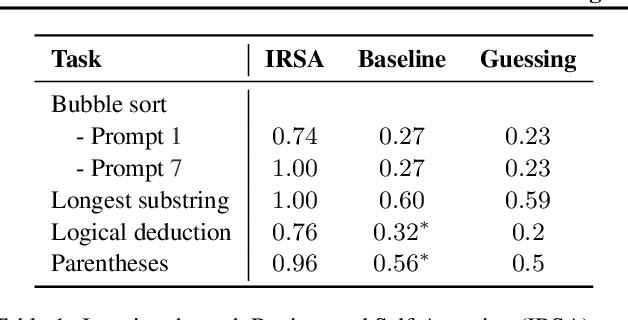
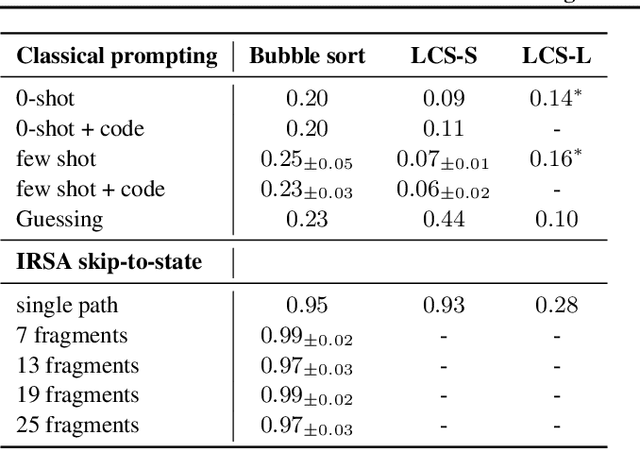
We demonstrate that, through appropriate prompting, GPT-3 family of models can be triggered to perform iterative behaviours necessary to execute (rather than just write or recall) programs that involve loops, including several popular algorithms found in computer science curricula or software developer interviews. We trigger execution and description of Iterations by Regimenting Self-Attention (IRSA) in one (or a combination) of three ways: 1) Using strong repetitive structure in an example of an execution path of a target program for one particular input, 2) Prompting with fragments of execution paths, and 3) Explicitly forbidding (skipping) self-attention to parts of the generated text. On a dynamic program execution, IRSA leads to larger accuracy gains than replacing the model with the much more powerful GPT-4. IRSA has promising applications in education, as the prompts and responses resemble student assignments in data structures and algorithms classes. Our findings hold implications for evaluating LLMs, which typically target the in-context learning: We show that prompts that may not even cover one full task example can trigger algorithmic behaviour, allowing solving problems previously thought of as hard for LLMs, such as logical puzzles. Consequently, prompt design plays an even more critical role in LLM performance than previously recognized.
Resolving label uncertainty with implicit posterior models
Feb 28, 2022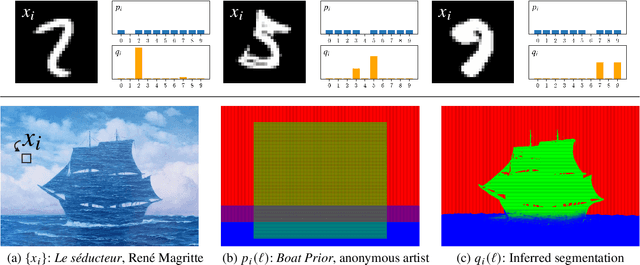
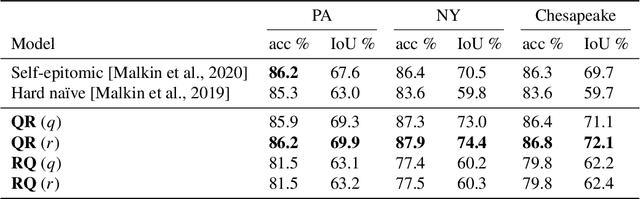
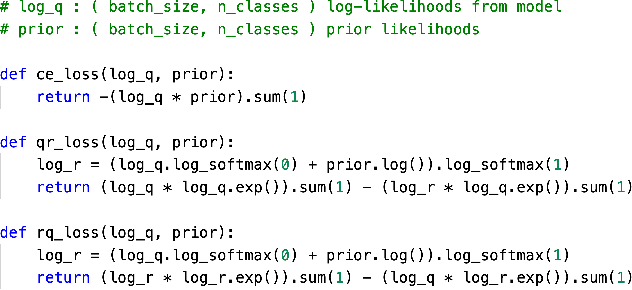
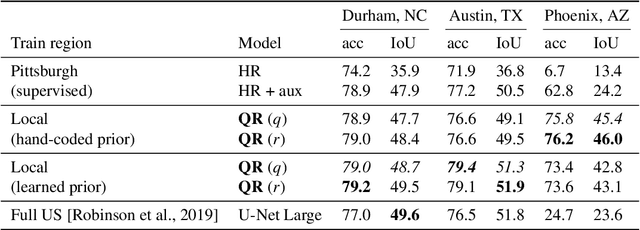
We propose a method for jointly inferring labels across a collection of data samples, where each sample consists of an observation and a prior belief about the label. By implicitly assuming the existence of a generative model for which a differentiable predictor is the posterior, we derive a training objective that allows learning under weak beliefs. This formulation unifies various machine learning settings; the weak beliefs can come in the form of noisy or incomplete labels, likelihoods given by a different prediction mechanism on auxiliary input, or common-sense priors reflecting knowledge about the structure of the problem at hand. We demonstrate the proposed algorithms on diverse problems: classification with negative training examples, learning from rankings, weakly and self-supervised aerial imagery segmentation, co-segmentation of video frames, and coarsely supervised text classification.