 Add to Chrome
 Add to Firefox
 Add to Edge
CogniRoute: Learning to Route Social Evidence in Omni-Modal Models
Jun 18, 2026
Omni-modal models can ingest video, audio, and text, but unified access to multiple modalities does not guarantee that a model uses the right evidence. This gap is especially pronounced in social video question answering, where the answer may hinge on a gesture, vocal tone, temporal cue, or mismatch between what is said and what is visually expressed. We introduce CogniRoute, a schema-guided Mixture-of-Experts framework for social omni reasoning. CogniRoute uses a training-only cognitive schema that factorizes each example by cross-modal relation, reasoning demand, and temporal scope, and aligns global routing signatures with this structure during supervised fine-tuning. We further introduce route-aware reinforcement learning, which jointly optimizes token generation and expert allocation using rewards for answer correctness, modality-consistent reasoning, and cognitive temporal grounding. To support training and evaluation, we construct OmniSocialBench, a diagnostic social video QA resource with 118K structured training examples, grounded reasoning traces, schema labels, temporal evidence spans, and a manually verified evaluation split. CogniRoute achieves 59.38\% average accuracy on OmniSocialBench, improving over the strongest proprietary baseline by 15.33 percentage points and the strongest open-source omni baseline by 26.77 points, with the largest gains on questions requiring audio-visual coordination, conflict resolution, and temporally grounded social inference.

Gemma 2: Improving Open Language Models at a Practical Size
Aug 02, 2024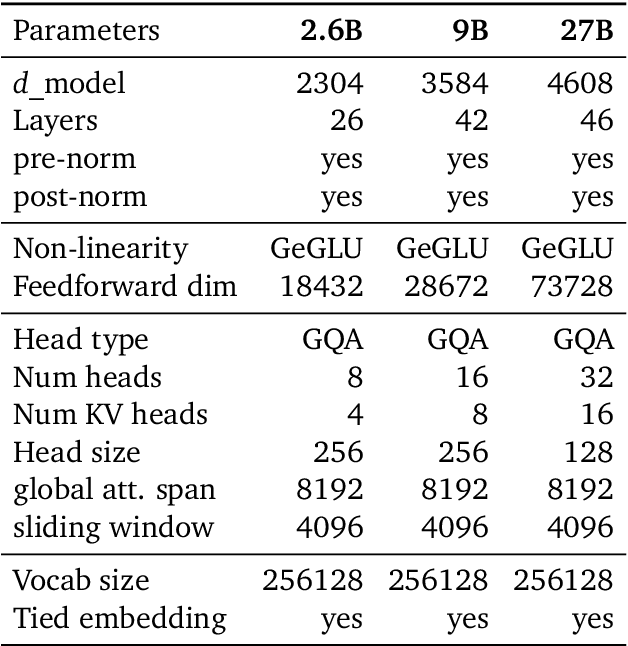
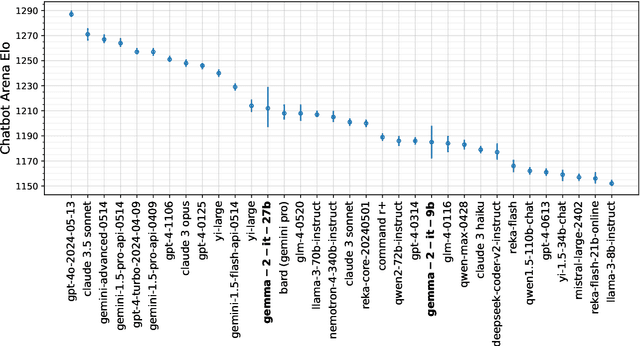
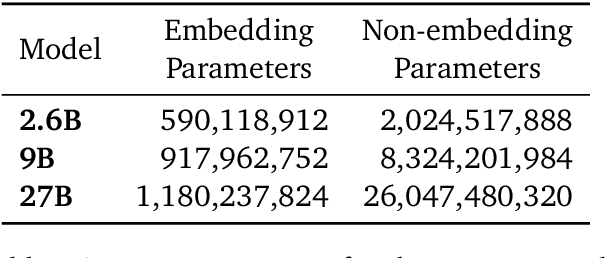
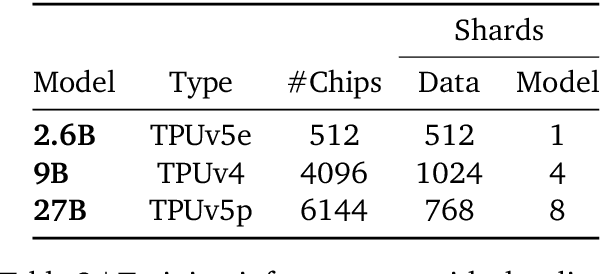
In this work, we introduce Gemma 2, a new addition to the Gemma family of lightweight, state-of-the-art open models, ranging in scale from 2 billion to 27 billion parameters. In this new version, we apply several known technical modifications to the Transformer architecture, such as interleaving local-global attentions (Beltagy et al., 2020a) and group-query attention (Ainslie et al., 2023). We also train the 2B and 9B models with knowledge distillation (Hinton et al., 2015) instead of next token prediction. The resulting models deliver the best performance for their size, and even offer competitive alternatives to models that are 2-3 times bigger. We release all our models to the community.
In-Context Learning with Iterative Demonstration Selection
Oct 22, 2023


Spurred by advancements in scale, large language models (LLMs) have demonstrated strong few-shot learning ability via in-context learning (ICL). However, the performance of ICL has been shown to be highly sensitive to the selection of few-shot demonstrations. Selecting the most suitable examples as context remains an ongoing challenge and an open problem. Existing literature has highlighted the importance of selecting examples that are diverse or semantically similar to the test sample while ignoring the fact that the optimal selection dimension, i.e., diversity or similarity, is task-specific. Leveraging the merits of both dimensions, we propose Iterative Demonstration Selection (IDS). Using zero-shot chain-of-thought reasoning (Zero-shot-CoT), IDS iteratively selects examples that are diverse but still strongly correlated with the test sample as ICL demonstrations. Specifically, IDS applies Zero-shot-CoT to the test sample before demonstration selection. The output reasoning path is then used to choose demonstrations that are prepended to the test sample for inference. The generated answer is accompanied by its corresponding reasoning path for extracting a new set of demonstrations in the next iteration. After several iterations, IDS adopts majority voting to obtain the final result. Through extensive experiments on tasks including commonsense reasoning, question answering, topic classification, and sentiment analysis, we demonstrate that IDS can consistently outperform existing ICL demonstration selection methods.