 Add to Chrome
 Add to Firefox
 Add to Edge
HubScan: Detecting Hubness Poisoning in Retrieval-Augmented Generation Systems
Feb 25, 2026
Retrieval-Augmented Generation (RAG) systems are essential to contemporary AI applications, allowing large language models to obtain external knowledge via vector similarity search. Nevertheless, these systems encounter a significant security flaw: hubness - items that frequently appear in the top-k retrieval results for a disproportionately high number of varied queries. These hubs can be exploited to introduce harmful content, alter search rankings, bypass content filtering, and decrease system performance. We introduce hubscan, an open-source security scanner that evaluates vector indices and embeddings to identify hubs in RAG systems. Hubscan presents a multi-detector architecture that integrates: (1) robust statistical hubness detection utilizing median/MAD-based z-scores, (2) cluster spread analysis to assess cross-cluster retrieval patterns, (3) stability testing under query perturbations, and (4) domain-aware and modality-aware detection for category-specific and cross-modal attacks. Our solution accommodates several vector databases (FAISS, Pinecone, Qdrant, Weaviate) and offers versatile retrieval techniques, including vector similarity, hybrid search, and lexical matching with reranking capabilities. We evaluate hubscan on Food-101, MS-COCO, and FiQA adversarial hubness benchmarks constructed using state-of-the-art gradient-optimized and centroid-based hub generation methods. hubscan achieves 90% recall at a 0.2% alert budget and 100% recall at 0.4%, with adversarial hubs ranking above the 99.8th percentile. Domain-scoped scanning recovers 100% of targeted attacks that evade global detection. Production validation on 1M real web documents from MS MARCO demonstrates significant score separation between clean documents and adversarial content. Our work provides a practical, extensible framework for detecting hubness threats in production RAG systems.

Cisco Integrated AI Security and Safety Framework Report
Dec 15, 2025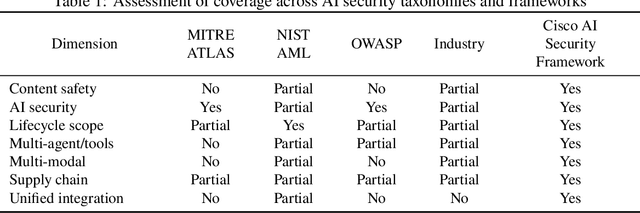
Artificial intelligence (AI) systems are being readily and rapidly adopted, increasingly permeating critical domains: from consumer platforms and enterprise software to networked systems with embedded agents. While this has unlocked potential for human productivity gains, the attack surface has expanded accordingly: threats now span content safety failures (e.g., harmful or deceptive outputs), model and data integrity compromise (e.g., poisoning, supply-chain tampering), runtime manipulations (e.g., prompt injection, tool and agent misuse), and ecosystem risks (e.g., orchestration abuse, multi-agent collusion). Existing frameworks such as MITRE ATLAS, National Institute of Standards and Technology (NIST) AI 100-2 Adversarial Machine Learning (AML) taxonomy, and OWASP Top 10s for Large Language Models (LLMs) and Agentic AI Applications provide valuable viewpoints, but each covers only slices of this multi-dimensional space. This paper presents Cisco's Integrated AI Security and Safety Framework ("AI Security Framework"), a unified, lifecycle-aware taxonomy and operationalization framework that can be used to classify, integrate, and operationalize the full range of AI risks. It integrates AI security and AI safety across modalities, agents, pipelines, and the broader ecosystem. The AI Security Framework is designed to be practical for threat identification, red-teaming, risk prioritization, and it is comprehensive in scope and can be extensible to emerging deployments in multimodal contexts, humanoids, wearables, and sensory infrastructures. We analyze gaps in prevailing frameworks, discuss design principles for our framework, and demonstrate how the taxonomy provides structure for understanding how modern AI systems fail, how adversaries exploit these failures, and how organizations can build defenses across the AI lifecycle that evolve alongside capability advancements.
Llama-3.1-FoundationAI-SecurityLLM-Base-8B Technical Report
Apr 28, 2025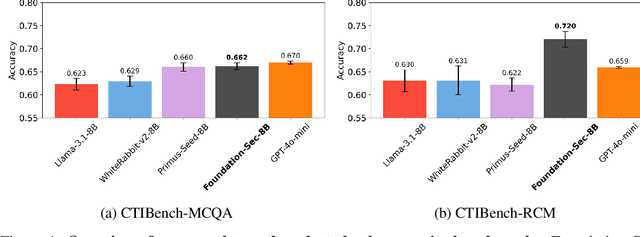
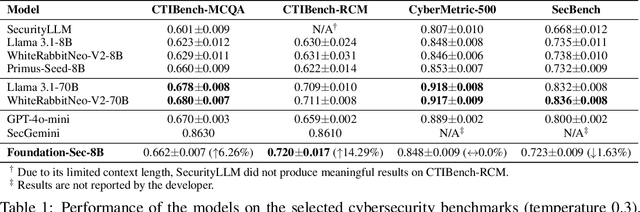
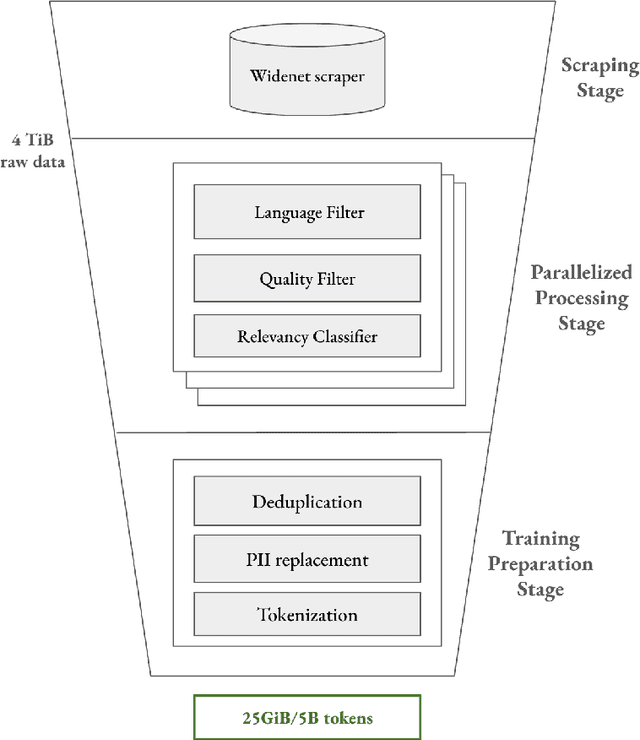

As transformer-based large language models (LLMs) increasingly permeate society, they have revolutionized domains such as software engineering, creative writing, and digital arts. However, their adoption in cybersecurity remains limited due to challenges like scarcity of specialized training data and complexity of representing cybersecurity-specific knowledge. To address these gaps, we present Foundation-Sec-8B, a cybersecurity-focused LLM built on the Llama 3.1 architecture and enhanced through continued pretraining on a carefully curated cybersecurity corpus. We evaluate Foundation-Sec-8B across both established and new cybersecurity benchmarks, showing that it matches Llama 3.1-70B and GPT-4o-mini in certain cybersecurity-specific tasks. By releasing our model to the public, we aim to accelerate progress and adoption of AI-driven tools in both public and private cybersecurity contexts.
A Multi-Phase Analysis of Blood Culture Stewardship: Machine Learning Prediction, Expert Recommendation Assessment, and LLM Automation
Apr 09, 2025Blood cultures are often over ordered without clear justification, straining healthcare resources and contributing to inappropriate antibiotic use pressures worsened by the global shortage. In study of 135483 emergency department (ED) blood culture orders, we developed machine learning (ML) models to predict the risk of bacteremia using structured electronic health record (EHR) data and provider notes via a large language model (LLM). The structured models AUC improved from 0.76 to 0.79 with note embeddings and reached 0.81 with added diagnosis codes. Compared to an expert recommendation framework applied by human reviewers and an LLM-based pipeline, our ML approach offered higher specificity without compromising sensitivity. The recommendation framework achieved sensitivity 86%, specificity 57%, while the LLM maintained high sensitivity (96%) but over classified negatives, reducing specificity (16%). These findings demonstrate that ML models integrating structured and unstructured data can outperform consensus recommendations, enhancing diagnostic stewardship beyond existing standards of care.
Antibiotic Resistance Microbiology Dataset (ARMD): A De-identified Resource for Studying Antimicrobial Resistance Using Electronic Health Records
Mar 08, 2025The Antibiotic Resistance Microbiology Dataset (ARMD) is a de-identified resource derived from electronic health records (EHR) that facilitates research into antimicrobial resistance (AMR). ARMD encompasses data from adult patients, focusing on microbiological cultures, antibiotic susceptibilities, and associated clinical and demographic features. Key attributes include organism identification, susceptibility patterns for 55 antibiotics, implied susceptibility rules, and de-identified patient information. This dataset supports studies on antimicrobial stewardship, causal inference, and clinical decision-making. ARMD is designed to be reusable and interoperable, promoting collaboration and innovation in combating AMR. This paper describes the dataset's acquisition, structure, and utility while detailing its de-identification process.