 Add to Chrome
 Add to Firefox
 Add to Edge
Improving Labeling Consistency with Detailed Constitutional Definitions and AI-Driven Evaluation
May 22, 2026
Many automated labeling pipelines classify inputs into categories defined by a written specification, content moderation being a prominent use case. Simple category definitions are not detailed enough for labelers to produce the accurate, consistent golden labels these pipelines require. One solution is to write a prescriptive definition that settles enough real boundary cases that labelers cannot disagree with the written interpretation. In practice, definitions at that level of detail exceed what a human annotator can hold in working memory, so annotators fall back on intuition and the labels drift from the written rules, regressing on accuracy and consistency. We propose and demonstrate the efficacy of an AI-driven workflow in which AI helps write a per-category constitution that defines the label in enough detail to cover edge cases, and a frontier LLM interprets it on each input to produce the golden label more consistently and accurately than humans reading the same document. We evaluate on three content moderation categories (harassment, hate speech, non-violent crime) and show that the approach reduces cross-model inconsistency by up to 57x compared to paragraph definitions, with cross-model disagreement diagnosing specification gaps and the human responsible for high-level decisions about what each category should mean rather than individual labeling calls. For the safety evaluation, we introduce a dual-axis formulation scoring intent and content independently over the full conversation, so downstream consumers can act on either axis or both.

Cisco Integrated AI Security and Safety Framework Report
Dec 15, 2025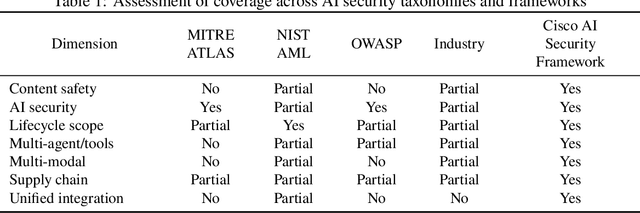
Artificial intelligence (AI) systems are being readily and rapidly adopted, increasingly permeating critical domains: from consumer platforms and enterprise software to networked systems with embedded agents. While this has unlocked potential for human productivity gains, the attack surface has expanded accordingly: threats now span content safety failures (e.g., harmful or deceptive outputs), model and data integrity compromise (e.g., poisoning, supply-chain tampering), runtime manipulations (e.g., prompt injection, tool and agent misuse), and ecosystem risks (e.g., orchestration abuse, multi-agent collusion). Existing frameworks such as MITRE ATLAS, National Institute of Standards and Technology (NIST) AI 100-2 Adversarial Machine Learning (AML) taxonomy, and OWASP Top 10s for Large Language Models (LLMs) and Agentic AI Applications provide valuable viewpoints, but each covers only slices of this multi-dimensional space. This paper presents Cisco's Integrated AI Security and Safety Framework ("AI Security Framework"), a unified, lifecycle-aware taxonomy and operationalization framework that can be used to classify, integrate, and operationalize the full range of AI risks. It integrates AI security and AI safety across modalities, agents, pipelines, and the broader ecosystem. The AI Security Framework is designed to be practical for threat identification, red-teaming, risk prioritization, and it is comprehensive in scope and can be extensible to emerging deployments in multimodal contexts, humanoids, wearables, and sensory infrastructures. We analyze gaps in prevailing frameworks, discuss design principles for our framework, and demonstrate how the taxonomy provides structure for understanding how modern AI systems fail, how adversaries exploit these failures, and how organizations can build defenses across the AI lifecycle that evolve alongside capability advancements.
Llama-3.1-FoundationAI-SecurityLLM-Base-8B Technical Report
Apr 28, 2025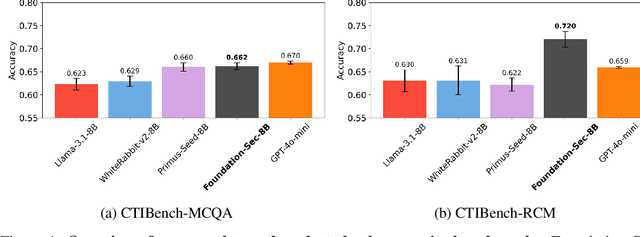
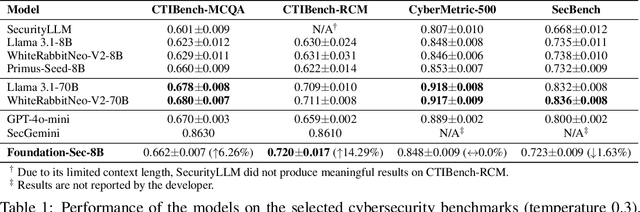
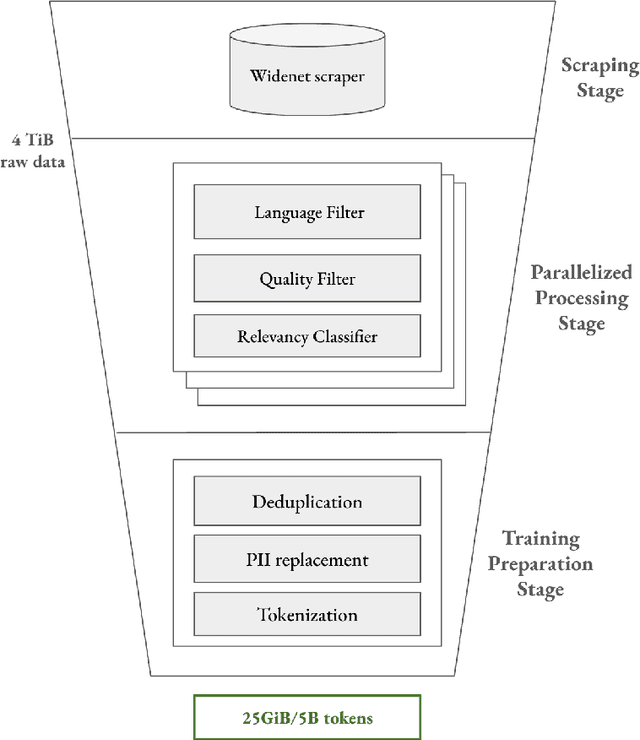

As transformer-based large language models (LLMs) increasingly permeate society, they have revolutionized domains such as software engineering, creative writing, and digital arts. However, their adoption in cybersecurity remains limited due to challenges like scarcity of specialized training data and complexity of representing cybersecurity-specific knowledge. To address these gaps, we present Foundation-Sec-8B, a cybersecurity-focused LLM built on the Llama 3.1 architecture and enhanced through continued pretraining on a carefully curated cybersecurity corpus. We evaluate Foundation-Sec-8B across both established and new cybersecurity benchmarks, showing that it matches Llama 3.1-70B and GPT-4o-mini in certain cybersecurity-specific tasks. By releasing our model to the public, we aim to accelerate progress and adoption of AI-driven tools in both public and private cybersecurity contexts.