 Add to Chrome
 Add to Firefox
 Add to Edge
Antares: Foundation Models for Agentic Vulnerability Localization
Aug 03, 2026
Vulnerability localization is a fundamental step in software security, requiring models to reason over large codebases and iteratively identify vulnerable implementations. We present Antares, a family of compact language models (350M, 1B, and 3B parameters) for agentic vulnerability localization. Based on IBM Granite base models, Antares is trained through a two-stage pipeline that combines supervised fine-tuning on cybersecurity reasoning and repository exploration data with reinforcement learning from verifiable rewards over vulnerable repositories. Across extensive evaluations, Antares-3B approaches GPT-5.5 while outperforming open-weight models over 200x larger in size. The Antares family further enables fast, low-cost local inference, completing a full 500-task evaluation sweep in approximately 15 minutes on a single H100 GPU, corresponding to an amortized evaluation time of under 2 seconds and less than $0.002 per task.

Llama-3.1-FoundationAI-SecurityLLM-Reasoning-8B Technical Report
Jan 28, 2026We present Foundation-Sec-8B-Reasoning, the first open-source native reasoning model for cybersecurity. Built upon our previously released Foundation-Sec-8B base model (derived from Llama-3.1-8B-Base), the model is trained through a two-stage process combining supervised fine-tuning (SFT) and reinforcement learning from verifiable rewards (RLVR). Our training leverages proprietary reasoning data spanning cybersecurity analysis, instruction-following, and mathematical reasoning. Evaluation across 10 cybersecurity benchmarks and 10 general-purpose benchmarks demonstrates performance competitive with significantly larger models on cybersecurity tasks while maintaining strong general capabilities. The model shows effective generalization on multi-hop reasoning tasks and strong safety performance when deployed with appropriate system prompts and guardrails. This work demonstrates that domain-specialized reasoning models can achieve strong performance on specialized tasks while maintaining broad general capabilities. We release the model publicly at https://huggingface.co/fdtn-ai/Foundation-Sec-8B-Reasoning.
Llama-3.1-FoundationAI-SecurityLLM-Base-8B Technical Report
Apr 28, 2025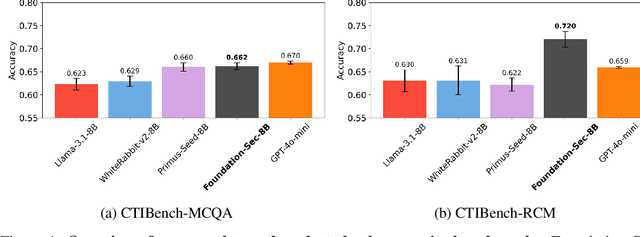
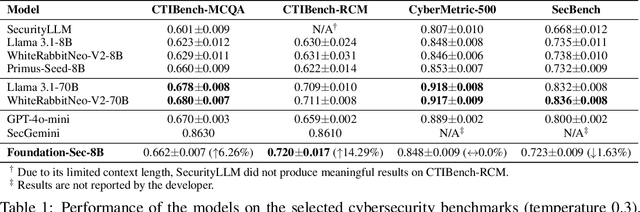
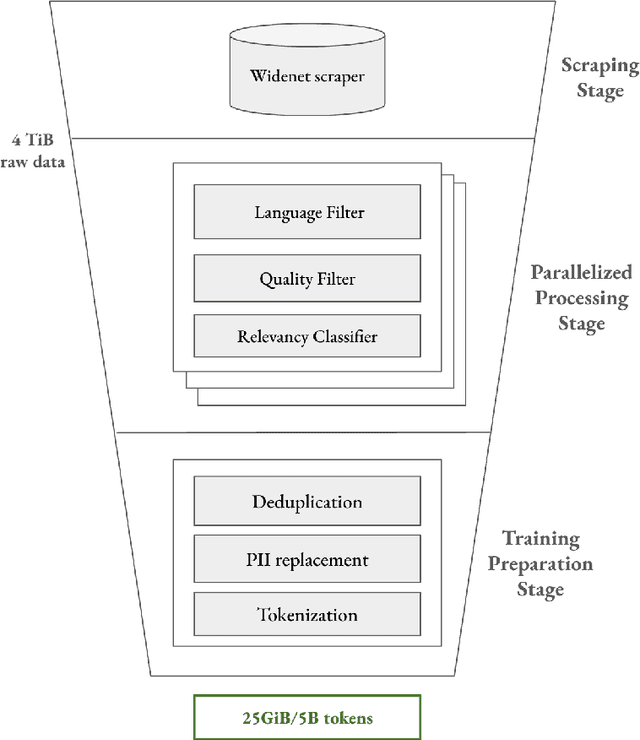

As transformer-based large language models (LLMs) increasingly permeate society, they have revolutionized domains such as software engineering, creative writing, and digital arts. However, their adoption in cybersecurity remains limited due to challenges like scarcity of specialized training data and complexity of representing cybersecurity-specific knowledge. To address these gaps, we present Foundation-Sec-8B, a cybersecurity-focused LLM built on the Llama 3.1 architecture and enhanced through continued pretraining on a carefully curated cybersecurity corpus. We evaluate Foundation-Sec-8B across both established and new cybersecurity benchmarks, showing that it matches Llama 3.1-70B and GPT-4o-mini in certain cybersecurity-specific tasks. By releasing our model to the public, we aim to accelerate progress and adoption of AI-driven tools in both public and private cybersecurity contexts.