 Add to Chrome
 Add to Firefox
 Add to Edge
HubScan: Detecting Hubness Poisoning in Retrieval-Augmented Generation Systems
Feb 25, 2026
Retrieval-Augmented Generation (RAG) systems are essential to contemporary AI applications, allowing large language models to obtain external knowledge via vector similarity search. Nevertheless, these systems encounter a significant security flaw: hubness - items that frequently appear in the top-k retrieval results for a disproportionately high number of varied queries. These hubs can be exploited to introduce harmful content, alter search rankings, bypass content filtering, and decrease system performance. We introduce hubscan, an open-source security scanner that evaluates vector indices and embeddings to identify hubs in RAG systems. Hubscan presents a multi-detector architecture that integrates: (1) robust statistical hubness detection utilizing median/MAD-based z-scores, (2) cluster spread analysis to assess cross-cluster retrieval patterns, (3) stability testing under query perturbations, and (4) domain-aware and modality-aware detection for category-specific and cross-modal attacks. Our solution accommodates several vector databases (FAISS, Pinecone, Qdrant, Weaviate) and offers versatile retrieval techniques, including vector similarity, hybrid search, and lexical matching with reranking capabilities. We evaluate hubscan on Food-101, MS-COCO, and FiQA adversarial hubness benchmarks constructed using state-of-the-art gradient-optimized and centroid-based hub generation methods. hubscan achieves 90% recall at a 0.2% alert budget and 100% recall at 0.4%, with adversarial hubs ranking above the 99.8th percentile. Domain-scoped scanning recovers 100% of targeted attacks that evade global detection. Production validation on 1M real web documents from MS MARCO demonstrates significant score separation between clean documents and adversarial content. Our work provides a practical, extensible framework for detecting hubness threats in production RAG systems.

CoPE: A Small Language Model for Steerable and Scalable Content Labeling
Dec 19, 2025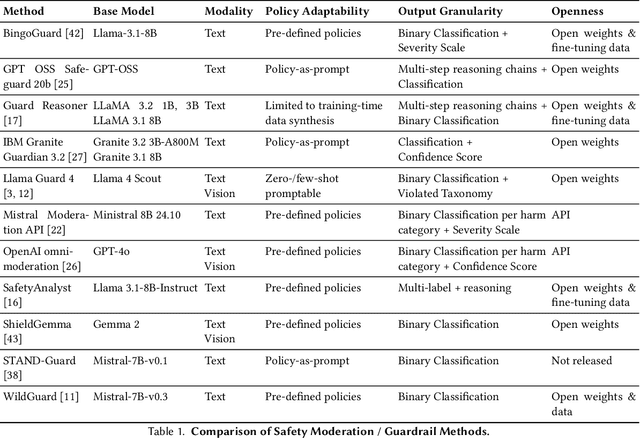
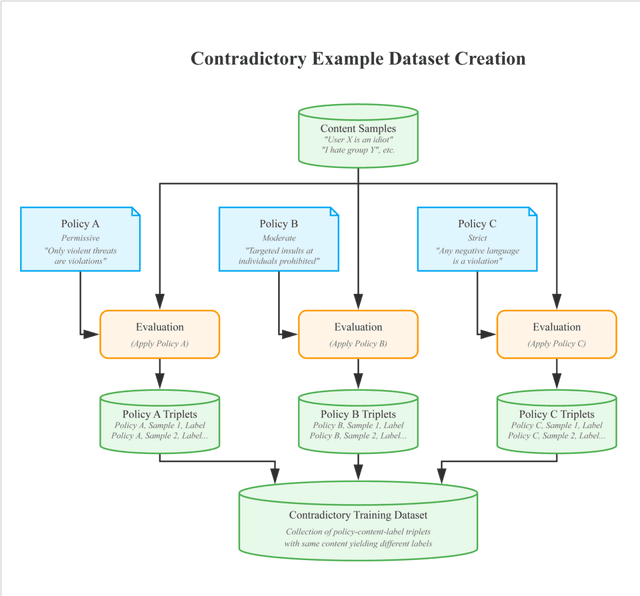
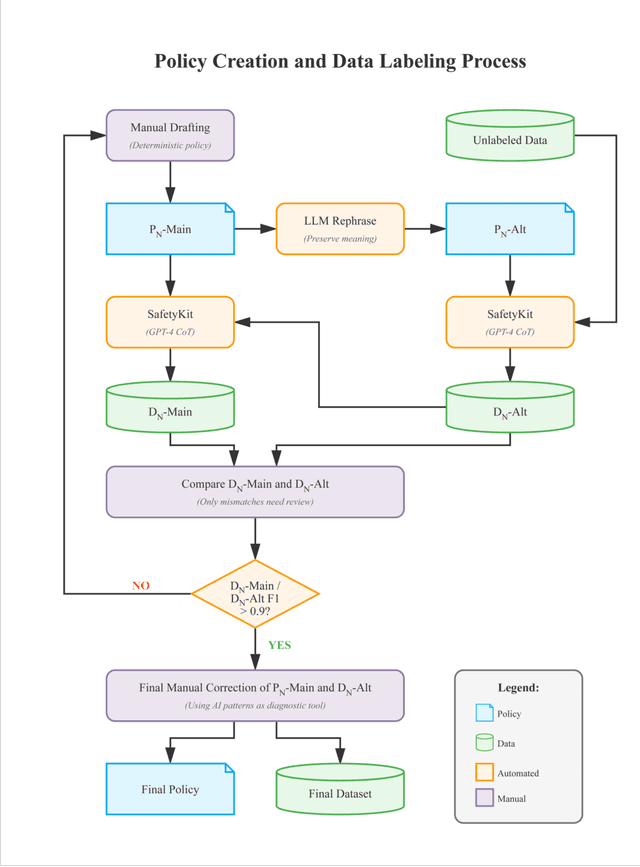
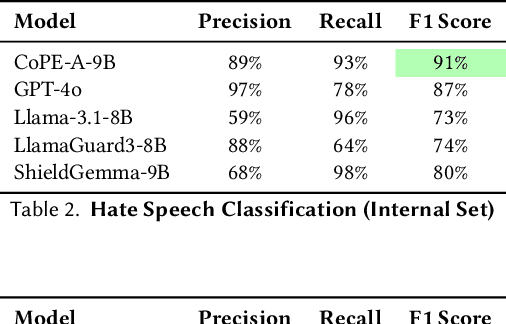
This paper details the methodology behind CoPE, a policy-steerable small language model capable of fast and accurate content labeling. We present a novel training curricula called Contradictory Example Training that enables the model to learn policy interpretation rather than mere policy memorization. We also present a novel method for generating content policies, called Binocular Labeling, which enables rapid construction of unambiguous training datasets. When evaluated across seven different harm areas, CoPE exhibits equal or superior accuracy to frontier models at only 1% of their size. We openly release a 9 billion parameter version of the model that can be run on a single consumer-grade GPU. Models like CoPE represent a paradigm shift for classifier systems. By turning an ML task into a policy writing task, CoPE opens up new design possibilities for the governance of online platforms.
Cisco Integrated AI Security and Safety Framework Report
Dec 15, 2025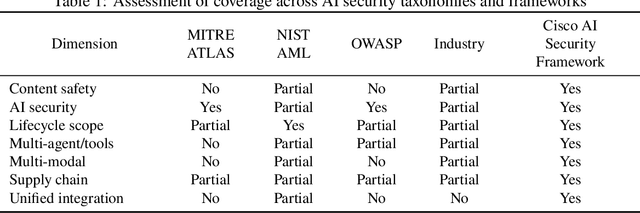
Artificial intelligence (AI) systems are being readily and rapidly adopted, increasingly permeating critical domains: from consumer platforms and enterprise software to networked systems with embedded agents. While this has unlocked potential for human productivity gains, the attack surface has expanded accordingly: threats now span content safety failures (e.g., harmful or deceptive outputs), model and data integrity compromise (e.g., poisoning, supply-chain tampering), runtime manipulations (e.g., prompt injection, tool and agent misuse), and ecosystem risks (e.g., orchestration abuse, multi-agent collusion). Existing frameworks such as MITRE ATLAS, National Institute of Standards and Technology (NIST) AI 100-2 Adversarial Machine Learning (AML) taxonomy, and OWASP Top 10s for Large Language Models (LLMs) and Agentic AI Applications provide valuable viewpoints, but each covers only slices of this multi-dimensional space. This paper presents Cisco's Integrated AI Security and Safety Framework ("AI Security Framework"), a unified, lifecycle-aware taxonomy and operationalization framework that can be used to classify, integrate, and operationalize the full range of AI risks. It integrates AI security and AI safety across modalities, agents, pipelines, and the broader ecosystem. The AI Security Framework is designed to be practical for threat identification, red-teaming, risk prioritization, and it is comprehensive in scope and can be extensible to emerging deployments in multimodal contexts, humanoids, wearables, and sensory infrastructures. We analyze gaps in prevailing frameworks, discuss design principles for our framework, and demonstrate how the taxonomy provides structure for understanding how modern AI systems fail, how adversaries exploit these failures, and how organizations can build defenses across the AI lifecycle that evolve alongside capability advancements.