 Add to Chrome
 Add to Firefox
 Add to Edge
One Perturbation, Two Failure Modes: Probing VLM Safety via Embedding-Guided Typographic Perturbations
Apr 28, 2026
Typographic prompt injection exploits vision language models' (VLMs) ability to read text rendered in images, posing a growing threat as VLMs power autonomous agents. Prior work typically focus on maximizing attack success rate (ASR) but does not explain \emph{why} certain renderings bypass safety alignment. We make two contributions. First, an empirical study across four VLMs including GPT-4o and Claude, twelve font sizes, and ten transformations reveals that multimodal embedding distance strongly predicts ASR ($r{=}{-}0.71$ to ${-}0.93$, $p{<}0.01$), providing an interpretable, model agnostic proxy. Since embedding distance predicts ASR, reducing it should improve attack success, but the relationship is mediated by two factors: perceptual readability (whether the VLM can parse the text) and safety alignment (whether it refuses to comply). Second, we use this as a red teaming tool: we directly maximize image text embedding similarity under bounded $\ell_\infty$ perturbations via CWA-SSA across four surrogate embedding models, stress testing both factors without access to the target model. Experiments across five degradation settings on GPT-4o, Claude Sonnet 4.5, Mistral-Large-3, and Qwen3-VL confirm that optimization recovers readability and reduces safety aligned refusals as two co-occurring effects, with the dominant mechanism depending on the model's safety filter strength and the degree of visual degradation.

Reading Between the Pixels: Linking Text-Image Embedding Alignment to Typographic Attack Success on Vision-Language Models
Apr 14, 2026We study typographic prompt injection attacks on vision-language models (VLMs), where adversarial text is rendered as images to bypass safety mechanisms, posing a growing threat as VLMs serve as the perceptual backbone of autonomous agents, from browser automation and computer-use systems to camera-equipped embodied agents. In practice, the attack surface is heterogeneous: adversarial text appears at varying font sizes and under diverse visual conditions, while the growing ecosystem of VLMs exhibits substantial variation in vulnerability, complicating defensive approaches. Evaluating 1,000 prompts from SALAD-Bench across four VLMs, namely, GPT-4o, Claude Sonnet 4.5, Mistral-Large-3, and Qwen3-VL-4B-Instruct under varying font sizes (6--28px) and visual transformations (rotation, blur, noise, contrast changes), we find: (1) font size significantly affects attack success rate (ASR), with very small fonts (6px) yielding near-zero ASR while mid-range fonts achieve peak effectiveness; (2) text attacks are more effective than image attacks for GPT-4o (36% vs 8%) and Claude (47% vs 22%), while Qwen3-VL and Mistral show comparable ASR across modalities; (3) text-image embedding distance from two multimodal embedding models (JinaCLIP and Qwen3-VL-Embedding) shows strong negative correlation with ASR across all four models (r = -0.71 to -0.93, p < 0.01); (4) heavy degradations increase embedding distance by 10--12% and reduce ASR by 34--96%, while rotation asymmetrically affects models (Mistral drops 50%, GPT-4o unchanged). These findings highlight that model-specific robustness patterns preclude one-size-fits-all defenses and offer empirical guidance for practitioners selecting VLM backbones for agentic systems operating in adversarial environments.
Cisco Integrated AI Security and Safety Framework Report
Dec 15, 2025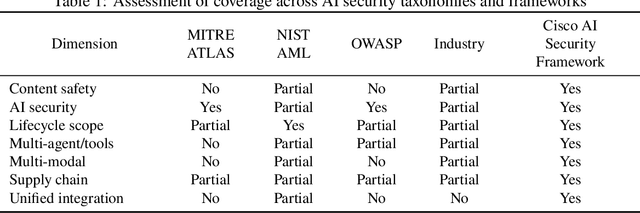
Artificial intelligence (AI) systems are being readily and rapidly adopted, increasingly permeating critical domains: from consumer platforms and enterprise software to networked systems with embedded agents. While this has unlocked potential for human productivity gains, the attack surface has expanded accordingly: threats now span content safety failures (e.g., harmful or deceptive outputs), model and data integrity compromise (e.g., poisoning, supply-chain tampering), runtime manipulations (e.g., prompt injection, tool and agent misuse), and ecosystem risks (e.g., orchestration abuse, multi-agent collusion). Existing frameworks such as MITRE ATLAS, National Institute of Standards and Technology (NIST) AI 100-2 Adversarial Machine Learning (AML) taxonomy, and OWASP Top 10s for Large Language Models (LLMs) and Agentic AI Applications provide valuable viewpoints, but each covers only slices of this multi-dimensional space. This paper presents Cisco's Integrated AI Security and Safety Framework ("AI Security Framework"), a unified, lifecycle-aware taxonomy and operationalization framework that can be used to classify, integrate, and operationalize the full range of AI risks. It integrates AI security and AI safety across modalities, agents, pipelines, and the broader ecosystem. The AI Security Framework is designed to be practical for threat identification, red-teaming, risk prioritization, and it is comprehensive in scope and can be extensible to emerging deployments in multimodal contexts, humanoids, wearables, and sensory infrastructures. We analyze gaps in prevailing frameworks, discuss design principles for our framework, and demonstrate how the taxonomy provides structure for understanding how modern AI systems fail, how adversaries exploit these failures, and how organizations can build defenses across the AI lifecycle that evolve alongside capability advancements.