 Add to Chrome
 Add to Firefox
 Add to Edge
MAEB: Massive Audio Embedding Benchmark
Feb 17, 2026
We introduce the Massive Audio Embedding Benchmark (MAEB), a large-scale benchmark covering 30 tasks across speech, music, environmental sounds, and cross-modal audio-text reasoning in 100+ languages. We evaluate 50+ models and find that no single model dominates across all tasks: contrastive audio-text models excel at environmental sound classification (e.g., ESC50) but score near random on multilingual speech tasks (e.g., SIB-FLEURS), while speech-pretrained models show the opposite pattern. Clustering remains challenging for all models, with even the best-performing model achieving only modest results. We observe that models excelling on acoustic understanding often perform poorly on linguistic tasks, and vice versa. We also show that the performance of audio encoders on MAEB correlates highly with their performance when used in audio large language models. MAEB is derived from MAEB+, a collection of 98 tasks. MAEB is designed to maintain task diversity while reducing evaluation cost, and it integrates into the MTEB ecosystem for unified evaluation across text, image, and audio modalities. We release MAEB and all 98 tasks along with code and a leaderboard at https://github.com/embeddings-benchmark/mteb.

ViBES: A Conversational Agent with Behaviorally-Intelligent 3D Virtual Body
Dec 16, 2025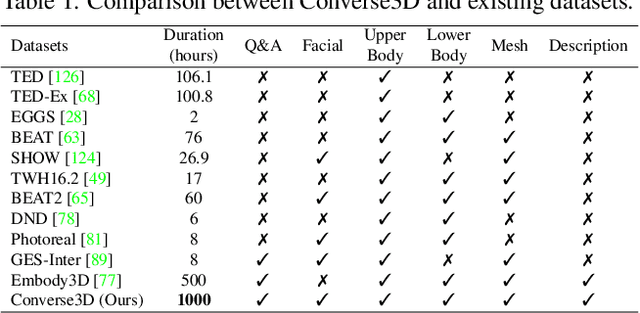
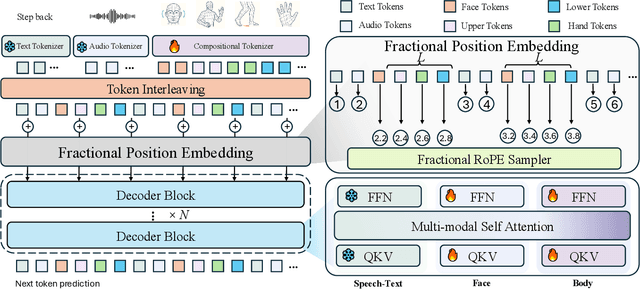
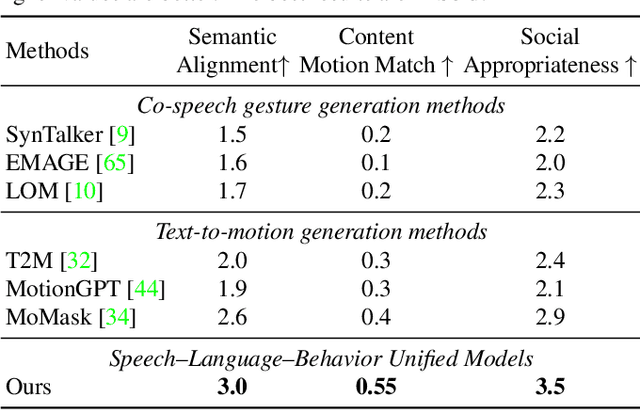
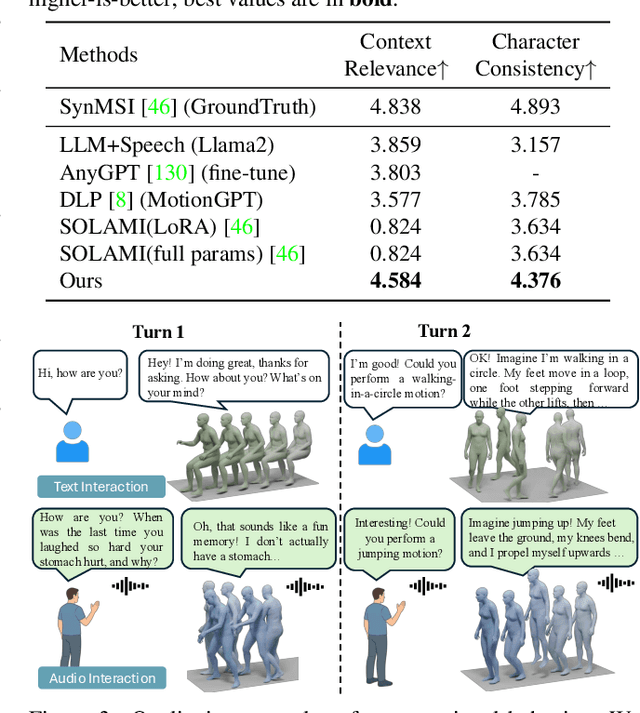
Human communication is inherently multimodal and social: words, prosody, and body language jointly carry intent. Yet most prior systems model human behavior as a translation task co-speech gesture or text-to-motion that maps a fixed utterance to motion clips-without requiring agentic decision-making about when to move, what to do, or how to adapt across multi-turn dialogue. This leads to brittle timing, weak social grounding, and fragmented stacks where speech, text, and motion are trained or inferred in isolation. We introduce ViBES (Voice in Behavioral Expression and Synchrony), a conversational 3D agent that jointly plans language and movement and executes dialogue-conditioned body actions. Concretely, ViBES is a speech-language-behavior (SLB) model with a mixture-of-modality-experts (MoME) backbone: modality-partitioned transformer experts for speech, facial expression, and body motion. The model processes interleaved multimodal token streams with hard routing by modality (parameters are split per expert), while sharing information through cross-expert attention. By leveraging strong pretrained speech-language models, the agent supports mixed-initiative interaction: users can speak, type, or issue body-action directives mid-conversation, and the system exposes controllable behavior hooks for streaming responses. We further benchmark on multi-turn conversation with automatic metrics of dialogue-motion alignment and behavior quality, and observe consistent gains over strong co-speech and text-to-motion baselines. ViBES goes beyond "speech-conditioned motion generation" toward agentic virtual bodies where language, prosody, and movement are jointly generated, enabling controllable, socially competent 3D interaction. Code and data will be made available at: ai.stanford.edu/~juze/ViBES/
Multi-Stage Speaker Diarization for Noisy Classrooms
May 16, 2025Speaker diarization, the process of identifying "who spoke when" in audio recordings, is essential for understanding classroom dynamics. However, classroom settings present distinct challenges, including poor recording quality, high levels of background noise, overlapping speech, and the difficulty of accurately capturing children's voices. This study investigates the effectiveness of multi-stage diarization models using Nvidia's NeMo diarization pipeline. We assess the impact of denoising on diarization accuracy and compare various voice activity detection (VAD) models, including self-supervised transformer-based frame-wise VAD models. We also explore a hybrid VAD approach that integrates Automatic Speech Recognition (ASR) word-level timestamps with frame-level VAD predictions. We conduct experiments using two datasets from English speaking classrooms to separate teacher vs. student speech and to separate all speakers. Our results show that denoising significantly improves the Diarization Error Rate (DER) by reducing the rate of missed speech. Additionally, training on both denoised and noisy datasets leads to substantial performance gains in noisy conditions. The hybrid VAD model leads to further improvements in speech detection, achieving a DER as low as 17% in teacher-student experiments and 45% in all-speaker experiments. However, we also identified trade-offs between voice activity detection and speaker confusion. Overall, our study highlights the effectiveness of multi-stage diarization models and integrating ASR-based information for enhancing speaker diarization in noisy classroom environments.