 Add to Chrome
 Add to Firefox
 Add to Edge
Efficient and Principled Scientific Discovery through Bayesian Optimization: A Tutorial
Apr 01, 2026
Traditional scientific discovery relies on an iterative hypothesise-experiment-refine cycle that has driven progress for centuries, but its intuitive, ad-hoc implementation often wastes resources, yields inefficient designs, and misses critical insights. This tutorial presents Bayesian Optimisation (BO), a principled probability-driven framework that formalises and automates this core scientific cycle. BO uses surrogate models (e.g., Gaussian processes) to model empirical observations as evolving hypotheses, and acquisition functions to guide experiment selection, balancing exploitation of known knowledge and exploration of uncharted domains to eliminate guesswork and manual trial-and-error. We first frame scientific discovery as an optimisation problem, then unpack BO's core components, end-to-end workflows, and real-world efficacy via case studies in catalysis, materials science, organic synthesis, and molecule discovery. We also cover critical technical extensions for scientific applications, including batched experimentation, heteroscedasticity, contextual optimisation, and human-in-the-loop integration. Tailored for a broad audience, this tutorial bridges AI advances in BO with practical natural science applications, offering tiered content to empower cross-disciplinary researchers to design more efficient experiments and accelerate principled scientific discovery.

High-Dimensional Bayesian Optimisation with Variational Autoencoders and Deep Metric Learning
Jun 16, 2021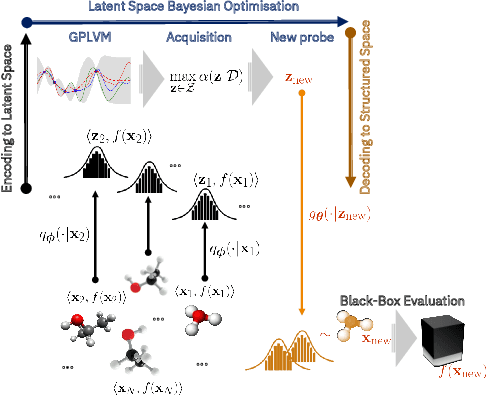

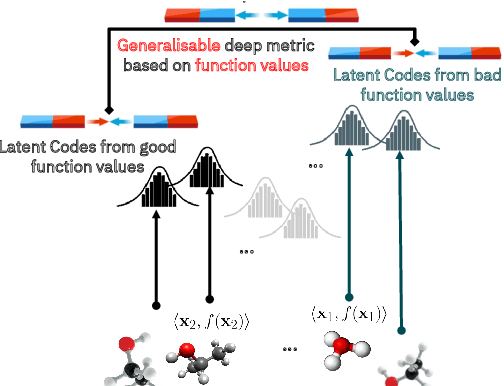
We introduce a method based on deep metric learning to perform Bayesian optimisation over high-dimensional, structured input spaces using variational autoencoders (VAEs). By extending ideas from supervised deep metric learning, we address a longstanding problem in high-dimensional VAE Bayesian optimisation, namely how to enforce a discriminative latent space as an inductive bias. Importantly, we achieve such an inductive bias using just 1% of the available labelled data relative to previous work, highlighting the sample efficiency of our approach. As a theoretical contribution, we present a proof of vanishing regret for our method. As an empirical contribution, we present state-of-the-art results on real-world high-dimensional black-box optimisation problems including property-guided molecule generation. It is the hope that the results presented in this paper can act as a guiding principle for realising effective high-dimensional Bayesian optimisation.