 Add to Chrome
 Add to Firefox
 Add to Edge
Exploring New Frontiers in Vertical Federated Learning: the Role of Saddle Point Reformulation
Feb 17, 2026
The objective of Vertical Federated Learning (VFL) is to collectively train a model using features available on different devices while sharing the same users. This paper focuses on the saddle point reformulation of the VFL problem via the classical Lagrangian function. We first demonstrate how this formulation can be solved using deterministic methods. More importantly, we explore various stochastic modifications to adapt to practical scenarios, such as employing compression techniques for efficient information transmission, enabling partial participation for asynchronous communication, and utilizing coordinate selection for faster local computation. We show that the saddle point reformulation plays a key role and opens up possibilities to use mentioned extension that seem to be impossible in the standard minimization formulation. Convergence estimates are provided for each algorithm, demonstrating their effectiveness in addressing the VFL problem. Additionally, alternative reformulations are investigated, and numerical experiments are conducted to validate performance and effectiveness of the proposed approach.

Distributed Saddle-Point Problems Under Similarity
Jul 22, 2021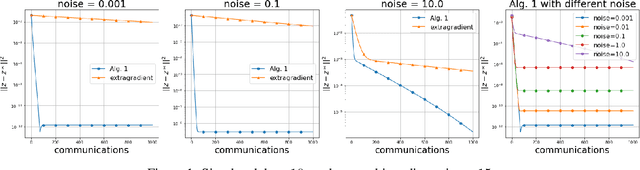
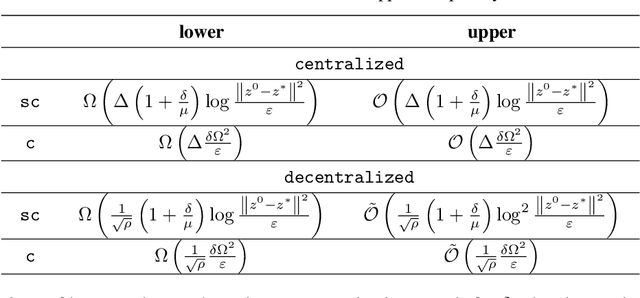
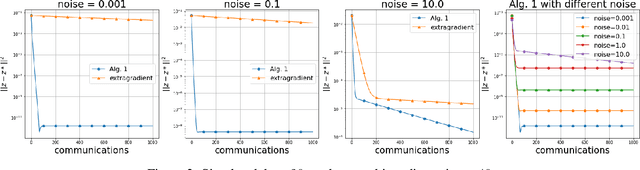
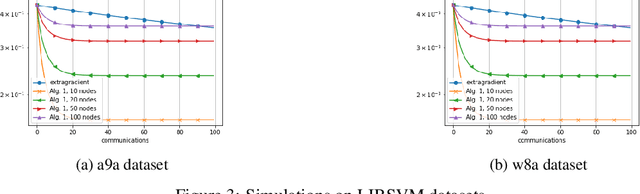
We study solution methods for (strongly-)convex-(strongly)-concave Saddle-Point Problems (SPPs) over networks of two type - master/workers (thus centralized) architectures and meshed (thus decentralized) networks. The local functions at each node are assumed to be similar, due to statistical data similarity or otherwise. We establish lower complexity bounds for a fairly general class of algorithms solving the SPP. We show that a given suboptimality $\epsilon>0$ is achieved over master/workers networks in $\Omega\big(\Delta\cdot \delta/\mu\cdot \log (1/\varepsilon)\big)$ rounds of communications, where $\delta>0$ measures the degree of similarity of the local functions, $\mu$ is their strong convexity constant, and $\Delta$ is the diameter of the network. The lower communication complexity bound over meshed networks reads $\Omega\big(1/{\sqrt{\rho}} \cdot {\delta}/{\mu}\cdot\log (1/\varepsilon)\big)$, where $\rho$ is the (normalized) eigengap of the gossip matrix used for the communication between neighbouring nodes. We then propose algorithms matching the lower bounds over either types of networks (up to log-factors). We assess the effectiveness of the proposed algorithms on a robust logistic regression problem.
ADOM: Accelerated Decentralized Optimization Method for Time-Varying Networks
Feb 18, 2021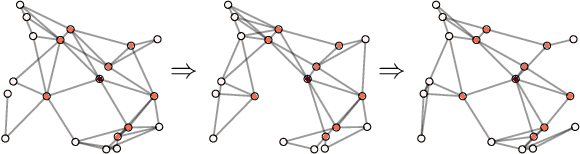
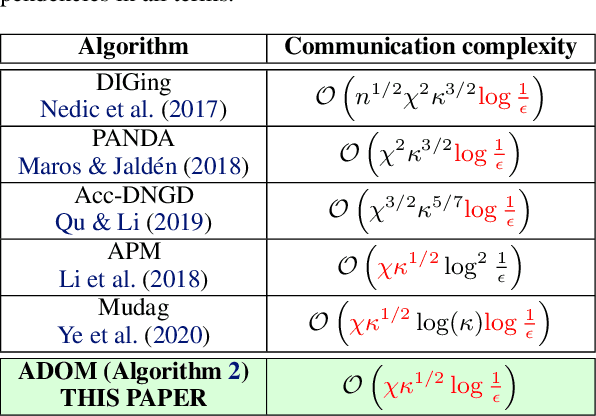
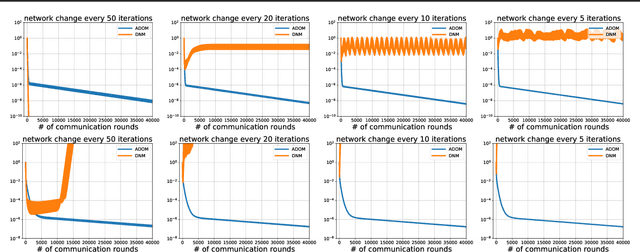
We propose ADOM - an accelerated method for smooth and strongly convex decentralized optimization over time-varying networks. ADOM uses a dual oracle, i.e., we assume access to the gradient of the Fenchel conjugate of the individual loss functions. Up to a constant factor, which depends on the network structure only, its communication complexity is the same as that of accelerated Nesterov gradient method (Nesterov, 2003). To the best of our knowledge, only the algorithm of Rogozin et al. (2019) has a convergence rate with similar properties. However, their algorithm converges under the very restrictive assumption that the number of network changes can not be greater than a tiny percentage of the number of iterations. This assumption is hard to satisfy in practice, as the network topology changes usually can not be controlled. In contrast, ADOM merely requires the network to stay connected throughout time.