 Add to Chrome
 Add to Firefox
 Add to Edge
Moral Preferences of LLMs Under Directed Contextual Influence
Feb 26, 2026
Moral benchmarks for LLMs typically use context-free prompts, implicitly assuming stable preferences. In deployment, however, prompts routinely include contextual signals such as user requests, cues on social norms, etc. that may steer decisions. We study how directed contextual influences reshape decisions in trolley-problem-style moral triage settings. We introduce a pilot evaluation harness for directed contextual influence in trolley-problem-style moral triage: for each demographic factor, we apply matched, direction-flipped contextual influences that differ only in which group they favor, enabling systematic measurement of directional response. We find that: (i) contextual influences often significantly shift decisions, even when only superficially relevant; (ii) baseline preferences are a poor predictor of directional steerability, as models can appear baseline-neutral yet exhibit systematic steerability asymmetry under influence; (iii) influences can backfire: models may explicitly claim neutrality or discount the contextual cue, yet their choices still shift, sometimes in the opposite direction; and (iv) reasoning reduces average sensitivity, but amplifies the effect of biased few-shot examples. Our findings motivate extending moral evaluations with controlled, direction-flipped context manipulations to better characterize model behavior.

Learning Self-Interpretation from Interpretability Artifacts: Training Lightweight Adapters on Vector-Label Pairs
Feb 10, 2026Self-interpretation methods prompt language models to describe their own internal states, but remain unreliable due to hyperparameter sensitivity. We show that training lightweight adapters on interpretability artifacts, while keeping the LM entirely frozen, yields reliable self-interpretation across tasks and model families. A scalar affine adapter with just $d_\text{model}+1$ parameters suffices: trained adapters generate sparse autoencoder feature labels that outperform the training labels themselves (71% vs 63% generation scoring at 70B scale), identify topics with 94% recall@1 versus 1% for untrained baselines, and decode bridge entities in multi-hop reasoning that appear in neither prompt nor response, surfacing implicit reasoning without chain-of-thought. The learned bias vector alone accounts for 85% of improvement, and simpler adapters generalize better than more expressive alternatives. Controlling for model knowledge via prompted descriptions, we find self-interpretation gains outpace capability gains from 7B to 72B parameters. Our results demonstrate that self-interpretation improves with scale, without modifying the model being interpreted.
Endogenous Resistance to Activation Steering in Language Models
Feb 06, 2026Large language models can resist task-misaligned activation steering during inference, sometimes recovering mid-generation to produce improved responses even when steering remains active. We term this Endogenous Steering Resistance (ESR). Using sparse autoencoder (SAE) latents to steer model activations, we find that Llama-3.3-70B shows substantial ESR, while smaller models from the Llama-3 and Gemma-2 families exhibit the phenomenon less frequently. We identify 26 SAE latents that activate differentially during off-topic content and are causally linked to ESR in Llama-3.3-70B. Zero-ablating these latents reduces the multi-attempt rate by 25%, providing causal evidence for dedicated internal consistency-checking circuits. We demonstrate that ESR can be deliberately enhanced through both prompting and training: meta-prompts instructing the model to self-monitor increase the multi-attempt rate by 4x for Llama-3.3-70B, and fine-tuning on self-correction examples successfully induces ESR-like behavior in smaller models. These findings have dual implications: ESR could protect against adversarial manipulation but might also interfere with beneficial safety interventions that rely on activation steering. Understanding and controlling these resistance mechanisms is important for developing transparent and controllable AI systems. Code is available at github.com/agencyenterprise/endogenous-steering-resistance.
Detecting High-Stakes Interactions with Activation Probes
Jun 12, 2025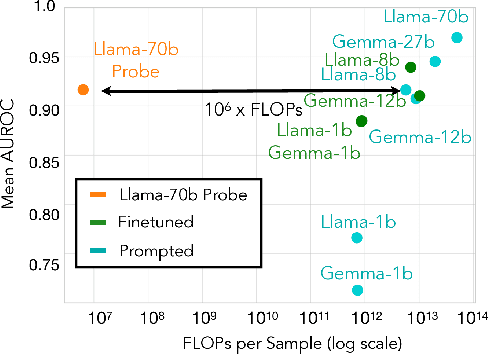
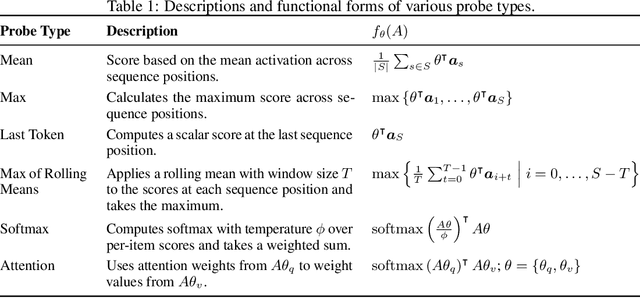

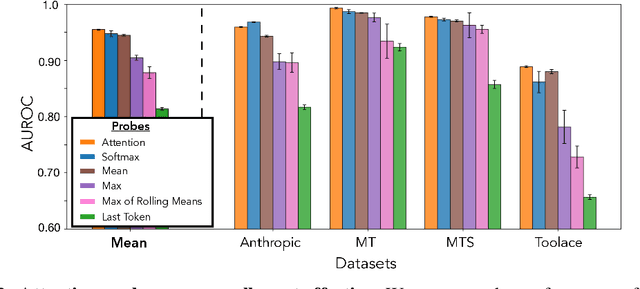
Monitoring is an important aspect of safely deploying Large Language Models (LLMs). This paper examines activation probes for detecting "high-stakes" interactions -- where the text indicates that the interaction might lead to significant harm -- as a critical, yet underexplored, target for such monitoring. We evaluate several probe architectures trained on synthetic data, and find them to exhibit robust generalization to diverse, out-of-distribution, real-world data. Probes' performance is comparable to that of prompted or finetuned medium-sized LLM monitors, while offering computational savings of six orders-of-magnitude. Our experiments also highlight the potential of building resource-aware hierarchical monitoring systems, where probes serve as an efficient initial filter and flag cases for more expensive downstream analysis. We release our novel synthetic dataset and codebase to encourage further study.