 Add to Chrome
 Add to Firefox
 Add to Edge
Moral Preferences of LLMs Under Directed Contextual Influence
Feb 26, 2026
Moral benchmarks for LLMs typically use context-free prompts, implicitly assuming stable preferences. In deployment, however, prompts routinely include contextual signals such as user requests, cues on social norms, etc. that may steer decisions. We study how directed contextual influences reshape decisions in trolley-problem-style moral triage settings. We introduce a pilot evaluation harness for directed contextual influence in trolley-problem-style moral triage: for each demographic factor, we apply matched, direction-flipped contextual influences that differ only in which group they favor, enabling systematic measurement of directional response. We find that: (i) contextual influences often significantly shift decisions, even when only superficially relevant; (ii) baseline preferences are a poor predictor of directional steerability, as models can appear baseline-neutral yet exhibit systematic steerability asymmetry under influence; (iii) influences can backfire: models may explicitly claim neutrality or discount the contextual cue, yet their choices still shift, sometimes in the opposite direction; and (iv) reasoning reduces average sensitivity, but amplifies the effect of biased few-shot examples. Our findings motivate extending moral evaluations with controlled, direction-flipped context manipulations to better characterize model behavior.

Detecting High-Stakes Interactions with Activation Probes
Jun 12, 2025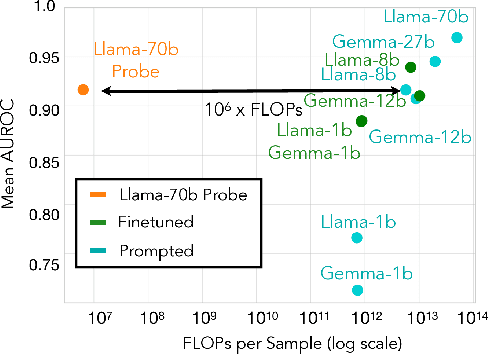
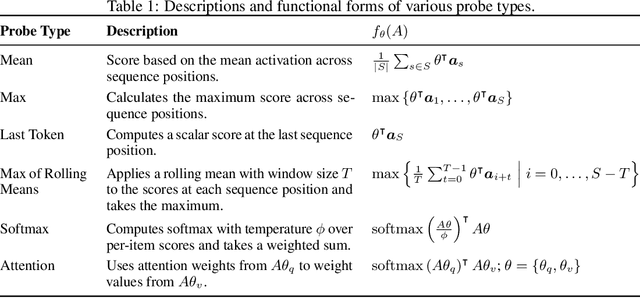

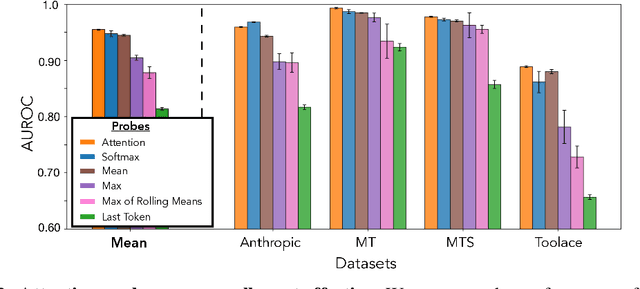
Monitoring is an important aspect of safely deploying Large Language Models (LLMs). This paper examines activation probes for detecting "high-stakes" interactions -- where the text indicates that the interaction might lead to significant harm -- as a critical, yet underexplored, target for such monitoring. We evaluate several probe architectures trained on synthetic data, and find them to exhibit robust generalization to diverse, out-of-distribution, real-world data. Probes' performance is comparable to that of prompted or finetuned medium-sized LLM monitors, while offering computational savings of six orders-of-magnitude. Our experiments also highlight the potential of building resource-aware hierarchical monitoring systems, where probes serve as an efficient initial filter and flag cases for more expensive downstream analysis. We release our novel synthetic dataset and codebase to encourage further study.