 Add to Chrome
 Add to Firefox
 Add to Edge
REFRAMED: Towards Realistic Audio Description Generation for Movies
Aug 10, 2026
Audio Description (AD) is a verbal narration of key visual content in videos, enabling access for visually impaired audiences. Unlike standard video captioning, AD is a structured editorial task: descriptions must be inserted into gaps in dialogue and must convey only what is needed to understand the narrative being told. However, existing approaches formulate AD generation in an artificial setting where both the content and timing of descriptions are pre-specified, reducing the task to clip-level captioning. They further rely on noisy transcription and alignment pipelines, and lack the rich parallel data required for modeling narrative context. We introduce a new formulation of AD generation in which models must jointly decide what to describe and when to do it. To support this, we present REFRAMED, a high-quality dataset of 2,023 videos that span 3,302 scenes from 206 movies, with professional AD transcripts (both American and British versions), professional subtitles and aligned screenplays. We also provide a manually curated challenge set that pairs full movies with multiple AD references, together with evaluation protocols that leverage dialogue gaps and multi-reference comparisons. Experiments with state-of-the-art AD systems and multimodal LLMs show that they outperform trivial baselines but fall far short of expert human performance. Our dataset and benchmark establish a new foundation for research on video understanding.

Comparing British and American Audio Description of Movies
Aug 10, 2026Narrating the visual component of movies is known as audio description. It is a narrative technique designed to enable blind and visually impaired individuals to follow the story. However, it is far more constrained than most narratives: the descriptions not only need to convey the story in the movie, but they must also fit into gaps between dialogue and they need to conform to guidelines that exist in each region. In this work, we compare audio description created in the United Kingdom against audio description created in the United States. We use guidelines written for these two regions, alongside the impressions from a practitioner in the field, to motivate specific hypotheses about the differences. We test these hypotheses against our pre-existing corpus, which provides both human-authored American and British audio description for each of 206 movies. Results provide quantitative evidence to uphold all tested hypotheses, including differences in lexicon, the use of the progressive aspect, the use of passive constructions, the use of subjective adjectives and modifiers, when characters are named, how scenes are cued, and degree of overlap with movie dialogue and music. Our work offers a quantitative lens into the narrative technique of audio description.
Contrastive Learning with Narrative Twins for Modeling Story Salience
Jan 12, 2026Understanding narratives requires identifying which events are most salient for a story's progression. We present a contrastive learning framework for modeling narrative salience that learns story embeddings from narrative twins: stories that share the same plot but differ in surface form. Our model is trained to distinguish a story from both its narrative twin and a distractor with similar surface features but different plot. Using the resulting embeddings, we evaluate four narratologically motivated operations for inferring salience (deletion, shifting, disruption, and summarization). Experiments on short narratives from the ROCStories corpus and longer Wikipedia plot summaries show that contrastively learned story embeddings outperform a masked-language-model baseline, and that summarization is the most reliable operation for identifying salient sentences. If narrative twins are not available, random dropout can be used to generate the twins from a single story. Effective distractors can be obtained either by prompting LLMs or, in long-form narratives, by using different parts of the same story.
Commute-Time-Optimised Graphs for GNNs
Jul 09, 2024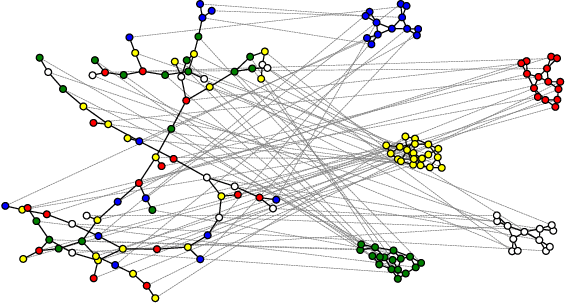
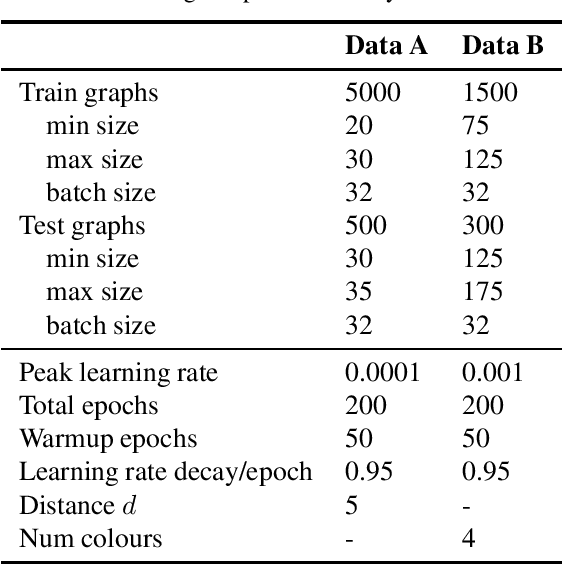
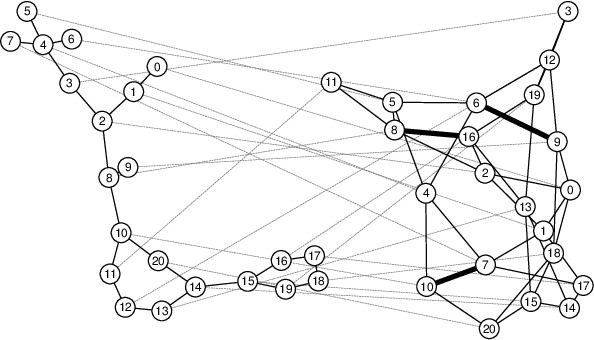
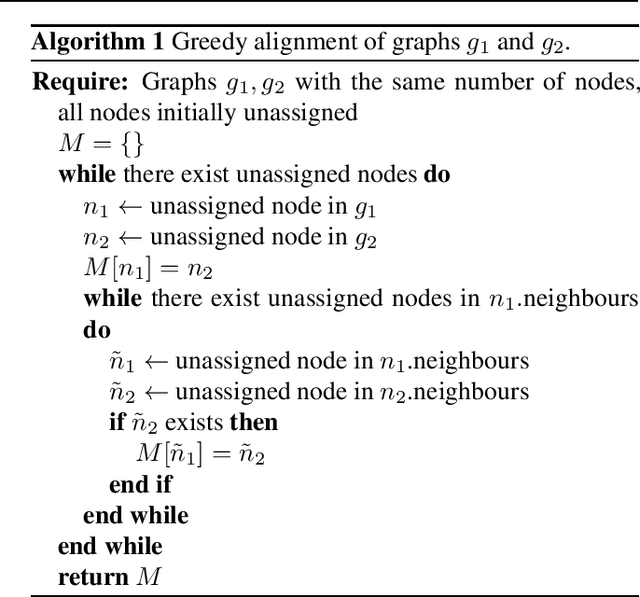
We explore graph rewiring methods that optimise commute time. Recent graph rewiring approaches facilitate long-range interactions in sparse graphs, making such rewirings commute-time-optimal $\textit{on average}$. However, when an expert prior exists on which node pairs should or should not interact, a superior rewiring would favour short commute times between these privileged node pairs. We construct two synthetic datasets with known priors reflecting realistic settings, and use these to motivate two bespoke rewiring methods that incorporate the known prior. We investigate the regimes where our rewiring improves test performance on the synthetic datasets. Finally, we perform a case study on a real-world citation graph to investigate the practical implications of our work.
Segment Any Text: A Universal Approach for Robust, Efficient and Adaptable Sentence Segmentation
Jun 24, 2024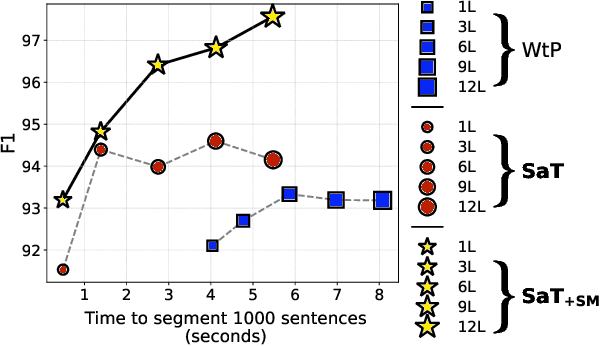
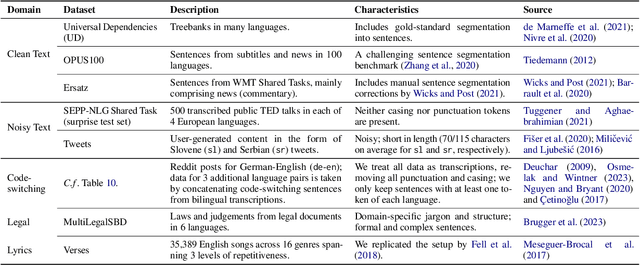
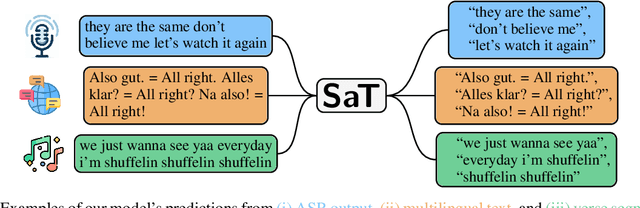
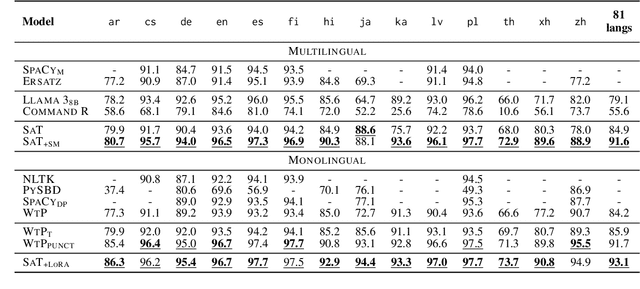
Segmenting text into sentences plays an early and crucial role in many NLP systems. This is commonly achieved by using rule-based or statistical methods relying on lexical features such as punctuation. Although some recent works no longer exclusively rely on punctuation, we find that no prior method achieves all of (i) robustness to missing punctuation, (ii) effective adaptability to new domains, and (iii) high efficiency. We introduce a new model - Segment any Text (SaT) - to solve this problem. To enhance robustness, we propose a new pretraining scheme that ensures less reliance on punctuation. To address adaptability, we introduce an extra stage of parameter-efficient fine-tuning, establishing state-of-the-art performance in distinct domains such as verses from lyrics and legal documents. Along the way, we introduce architectural modifications that result in a threefold gain in speed over the previous state of the art and solve spurious reliance on context far in the future. Finally, we introduce a variant of our model with fine-tuning on a diverse, multilingual mixture of sentence-segmented data, acting as a drop-in replacement and enhancement for existing segmentation tools. Overall, our contributions provide a universal approach for segmenting any text. Our method outperforms all baselines - including strong LLMs - across 8 corpora spanning diverse domains and languages, especially in practically relevant situations where text is poorly formatted. Our models and code, including documentation, are available at https://huggingface.co/segment-any-text under the MIT license.
Few-Shot VQA with Frozen LLMs: A Tale of Two Approaches
Mar 17, 2024Two approaches have emerged to input images into large language models (LLMs). The first is to caption images into natural language. The second is to map image feature embeddings into the domain of the LLM and pass the mapped embeddings directly to the LLM. The majority of recent few-shot multimodal work reports performance using architectures that employ variations of one of these two approaches. But they overlook an important comparison between them. We design a controlled and focused experiment to compare these two approaches to few-shot visual question answering (VQA) with LLMs. Our findings indicate that for Flan-T5 XL, a 3B parameter LLM, connecting visual embeddings directly to the LLM embedding space does not guarantee improved performance over using image captions. In the zero-shot regime, we find using textual image captions is better. In the few-shot regimes, how the in-context examples are selected determines which is better.