 Add to Chrome
 Add to Firefox
 Add to Edge
High-Cardinality Hybrid Shaping for 4D Modulation Formats in Optical Communications Optimized via End-to-End Learning
Dec 20, 2021
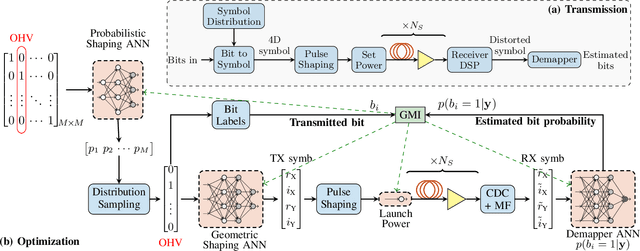
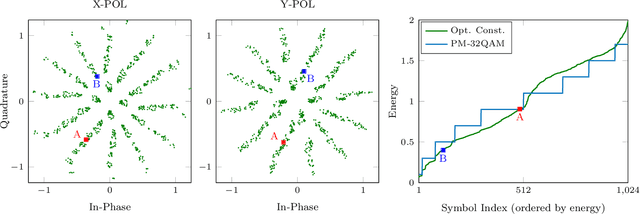
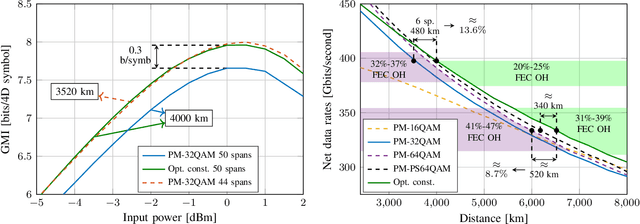
In this paper we carry out a joint optimization of probabilistic (PS) and geometric shaping (GS) for four-dimensional (4D) modulation formats in long-haul coherent wavelength division multiplexed (WDM) optical fiber communications using an auto-encoder framework. We propose a 4D 10 bits/symbol constellation which we obtained via end-to-end deep learning over the split-step Fourier model of the fiber channel. The constellation achieved 13.6% reach increase at a data rate of approximately 400 Gbits/second in comparison to the ubiquitously employed polarization multiplexed 32-QAM format at a forward error correction overhead of 20%.

Low-Complexity Geometrical Shaping for 4D Modulation Formats via Amplitude Coding
Oct 29, 2021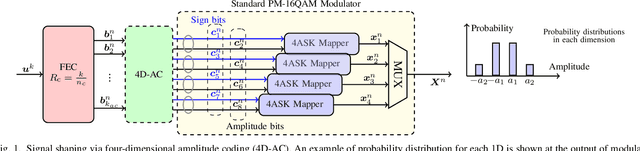
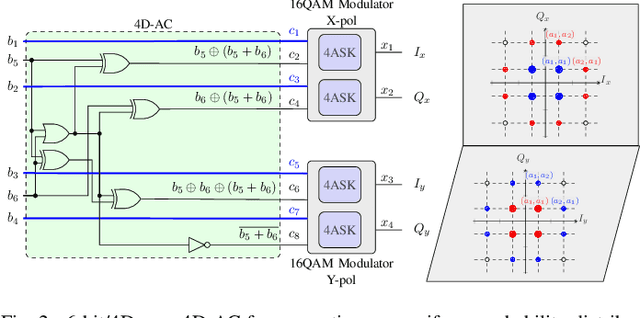
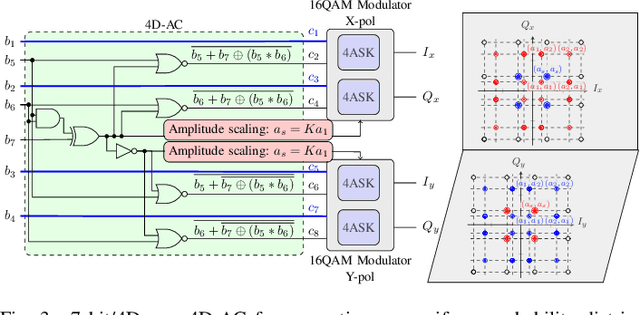
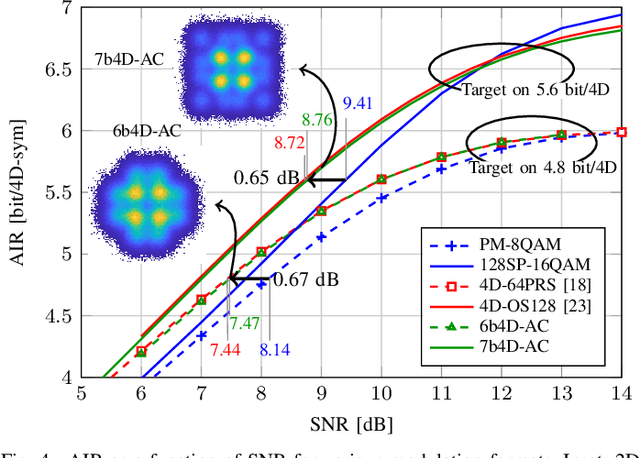
Signal shaping is vital to approach Shannon's capacity, yet it is challenging to implement at very high speeds. For example, probabilistic shaping often requires arithmetic coding to realize the target distribution. Geometric shaping requires look-up tables to store the constellation points. In this paper, we propose a four-dimensional amplitude coding (4D-AC) geometrical shaper architecture. The proposed architecture can generate in real time geometrically shaped 4D formats via simple logic circuit operations and two conventional quadrature amplitude modulation (QAM) modulators. This paper describes the 4D-AC used in generating approximated versions of two recently proposed 4D orthant symmetric modulation formats with spectral efficiencies of 6 bit/4D-sym and 7 bit/4D-sym, respectively. Numerical results show losses below 0.05 dB when compared against the baseline formats.
Model-aided Geometrical Shaping of Dual-polarization 4D Formats in the Nonlinear Fiber Channel
Oct 22, 2021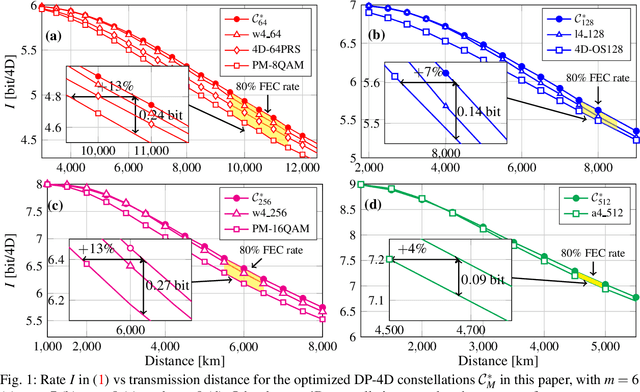
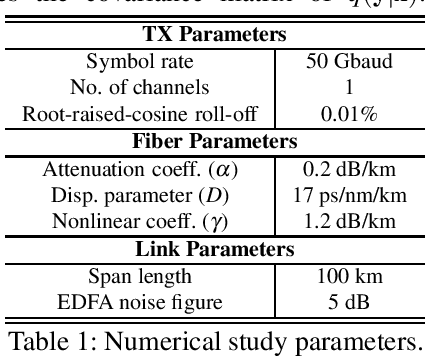
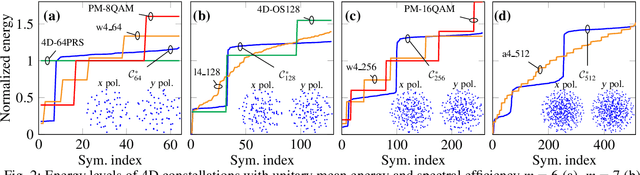
The geometry of dual-polarization four-dimensional constellations is optimized in the optical fiber channel using a recent nonlinear interference model. A 0.27 bit/4D rate gain and 13% reach increase are attained compared to polarization-multiplexed formats.
List-encoding CCDM: A Nonlinearity-tolerant Shaper Aided by Energy Dispersion Index
Sep 13, 2021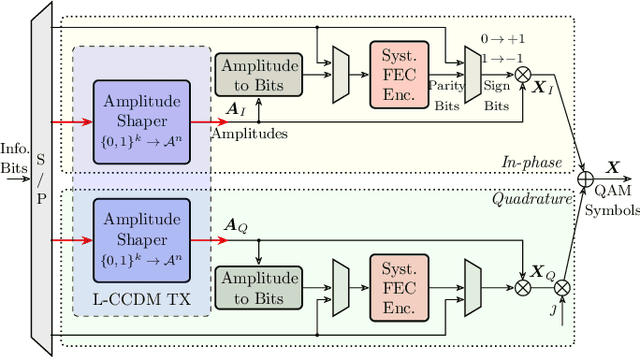
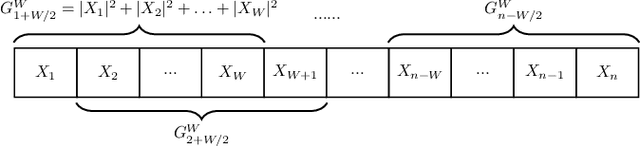
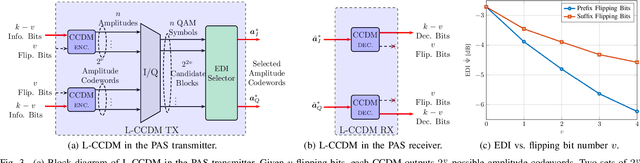
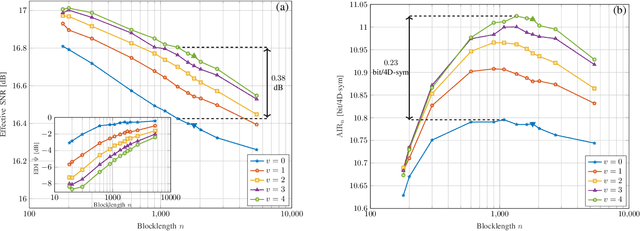
Recently, a metric called energy dispersion index (EDI) was proposed to indicate the nonlinear interference (NLI) induced by correlated symbols during optical transmission. In this paper, we propose a new shaper architecture to decrease the EDI of transmitted symbols and thus, increase the signal-to-noise ratio (SNR). We call this shaper the list-encoding constant-composition distribution matcher (L-CCDM). L-CCDM consists of an additional EDI selecting module, which is compatible with standard probabilistic amplitude shaping (PAS) architecture. Numerical results obtained from a multi-span multi-channel system show that when compared to standard CCDM with 256-ary quadrature amplitude modulation (256QAM), the proposed architecture offers an effective SNR gain of 0.35 dB, an achievable information rate gain of 0.22 bit/4D-symbol, or equivalently an 8% reach extension.
On Kurtosis-limited Enumerative Sphere Shaping for Reach Increase in Single-span Systems
Aug 23, 2021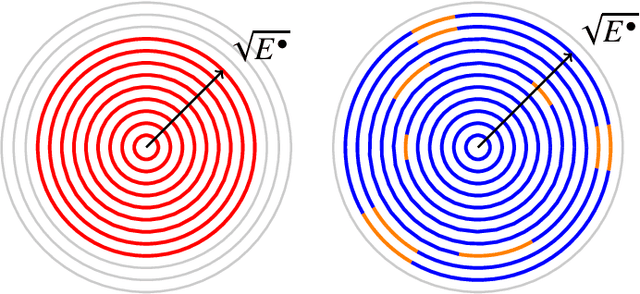
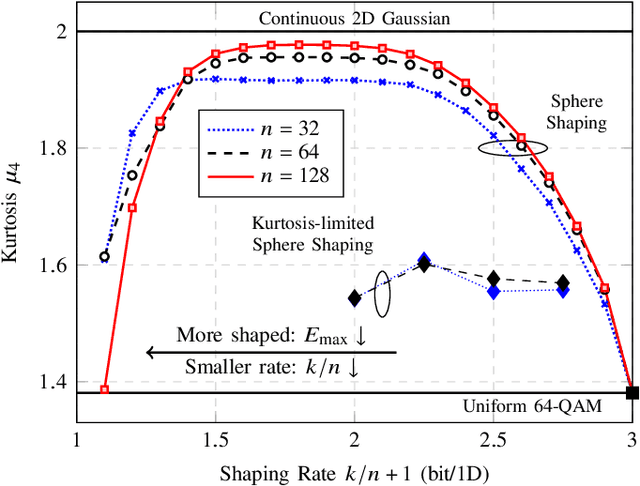
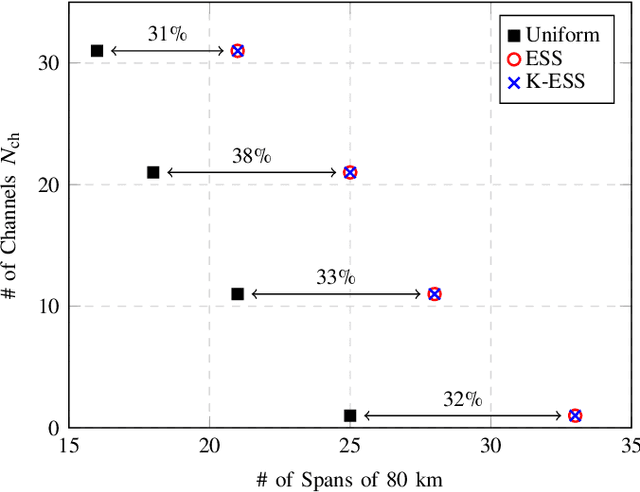
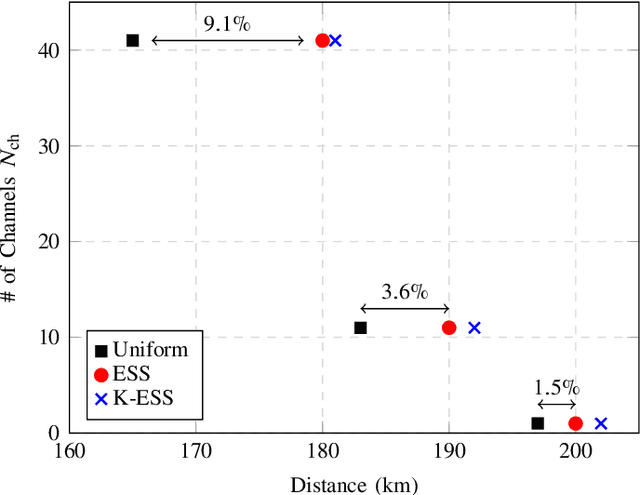
The effect of decreasing the kurtosis of channel inputs is investigated for the first time with an algorithmic shaping implementation. No significant gains in decoding performance are observed for multi-span systems, while an increase in reach is obtained for single-span transmission.
Real-time Transmission of Geometrically-shaped Signals using a Software-defined GPU-based Optical Receiver
Aug 16, 2021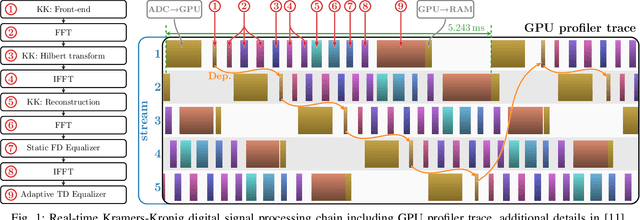
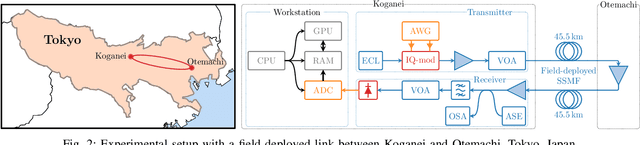
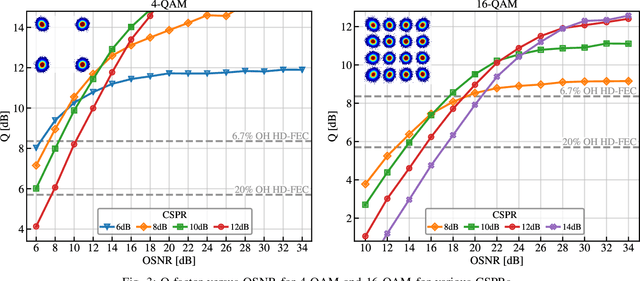
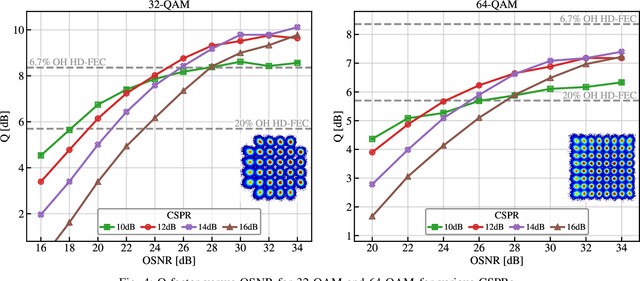
A software-defined optical receiver is implemented on an off-the-shelf commercial graphics processing unit (GPU). The receiver provides real-time signal processing functionality to process 1 GBaud minimum phase (MP) 4-, 8-, 16-, 32-, 64-, 128-ary quadrature amplitude modulation (QAM) as well as geometrically shaped (GS) 8- and 128-QAM signals using Kramers-Kronig (KK) coherent detection. Experimental validation of this receiver over a 91 km field-deployed optical fiber link between two Tokyo locations is shown with detailed optical signal-to-noise ratio (OSNR) investigations. A net data rate of 5 Gbps using 64-QAM is demonstrated.
Orthogonal Time Frequency Space Modulation: A Discrete Zak Transform Approach
Jun 24, 2021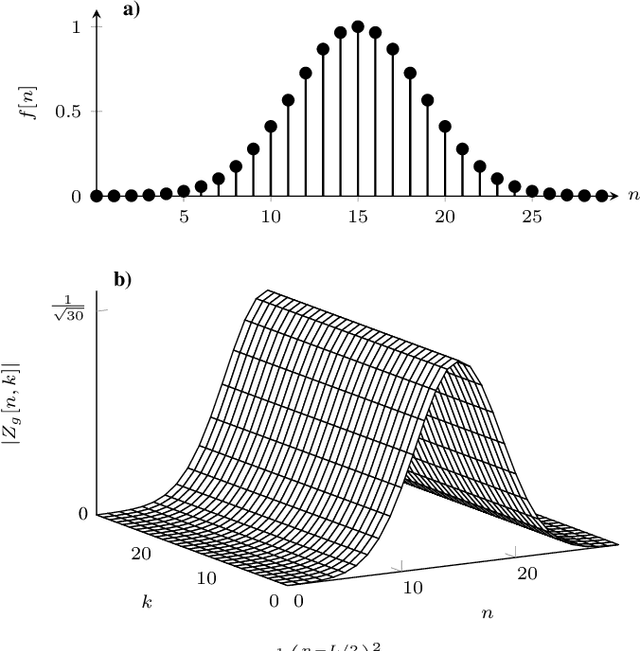
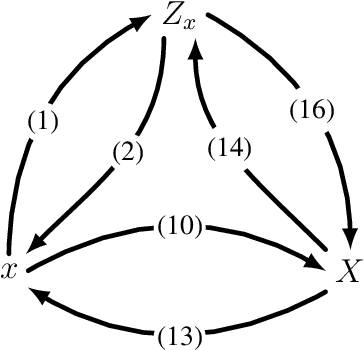
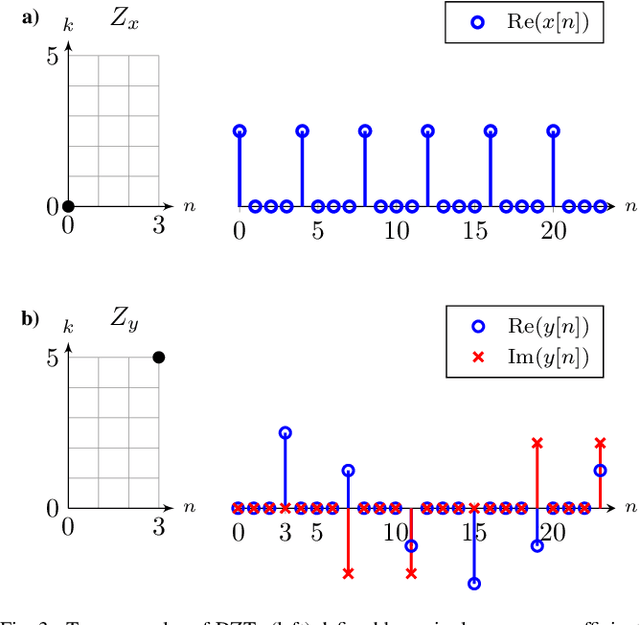
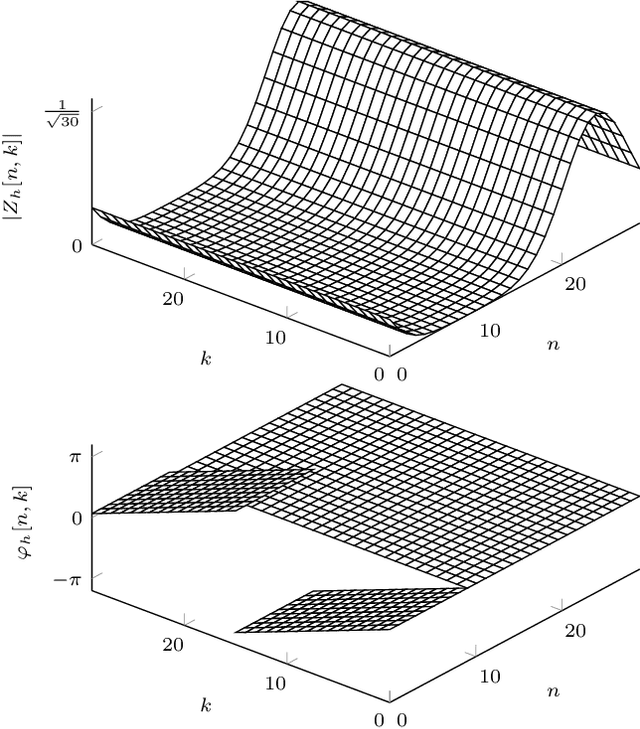
In orthogonal time frequency space (OTFS) modulation, information-carrying symbols reside in the delay-Doppler (DD) domain. By operating in the DD domain, an appealing property for communication arises: time-frequency (TF) dispersive channels encountered in high mobility environments become time-invariant. The time-invariance of the channel in the DD domain enables efficient equalizers for time-frequency dispersive channels. In this paper, we propose an OTFS system based on the discrete Zak transform. The presented formulation not only allows an efficient implementation of OTFS but also simplifies the derivation and analysis of the input-output relation of TF dispersive channel in the DD domain.
Discrete-Time Accuracy Analysis of the Time-Domain Regular Perturbation Model for Unamplified Links
Jun 09, 2021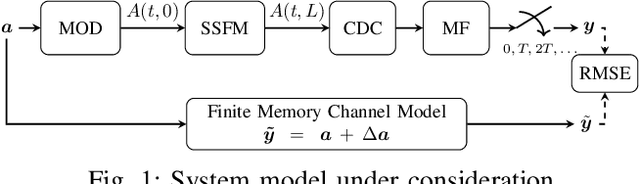
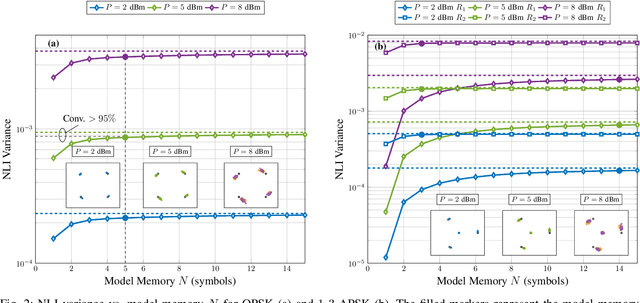
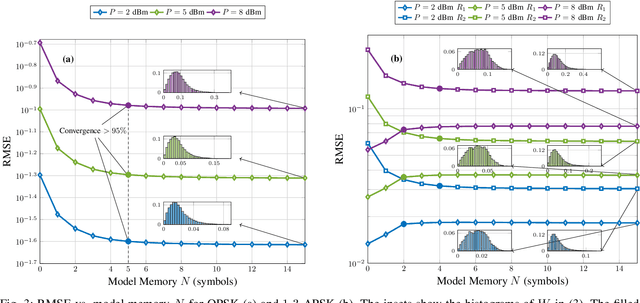
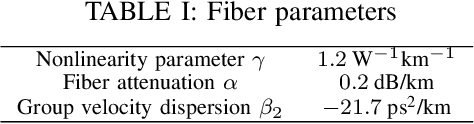
The accuracy of a discrete-time channel model based on regular perturbation is numerically studied for unamplified links. We analyse the distance between discrete nonlinear interference points and show that such distance can be used to estimate the effective channel memory.
Exponentially-Weighted Energy Dispersion Index for the Nonlinear Interference Analysis of Finite-Blocklength Shaping
Jun 08, 2021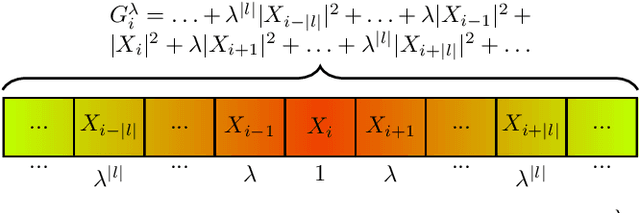
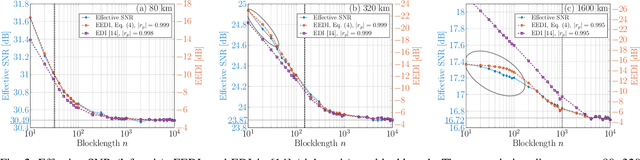
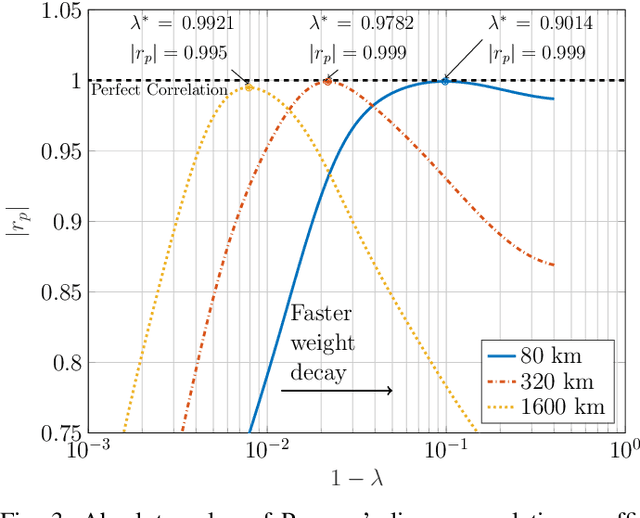
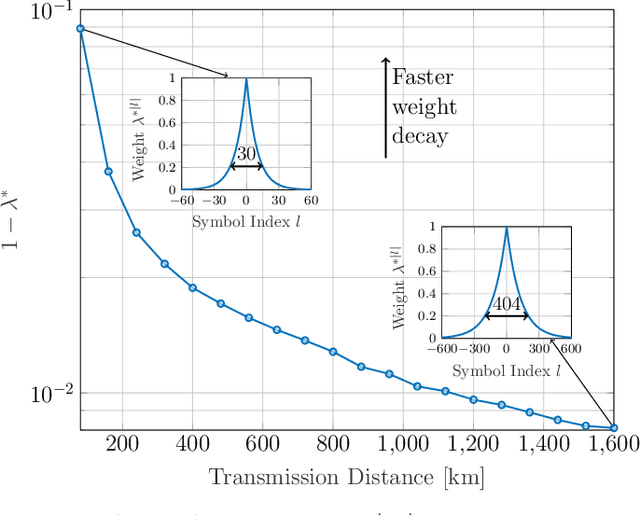
A metric called exponentially-weighted energy dispersion index (EEDI) is proposed to explain the blocklength-dependent effective signal-to-noise ratio (SNR) in probabilistically shaped fiber-optic systems. EEDI is better than energy dispersion index (EDI) at capturing the dependency of the effective SNR on the blocklength for long-distance transmission.
Kurtosis-limited Sphere Shaping for Nonlinear Interference Noise Reduction in Optical Channels
May 31, 2021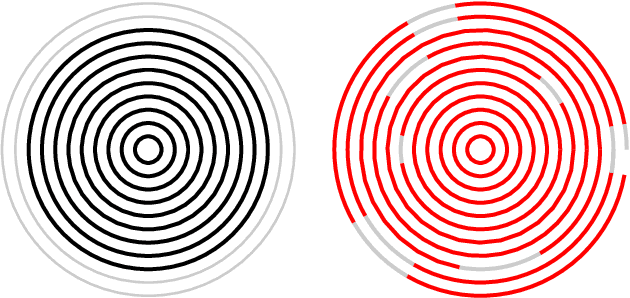
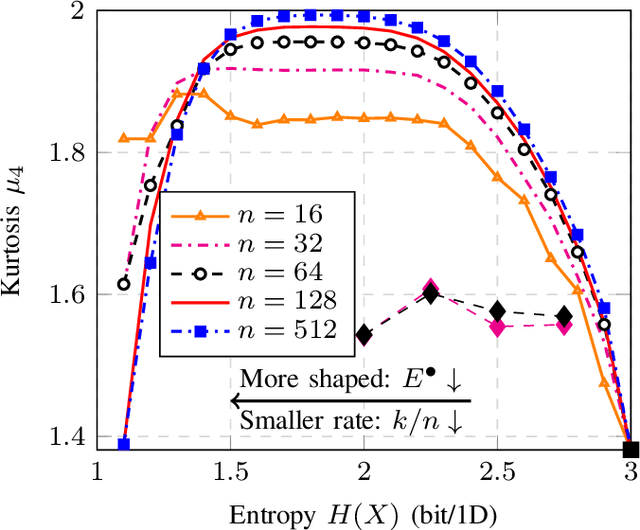
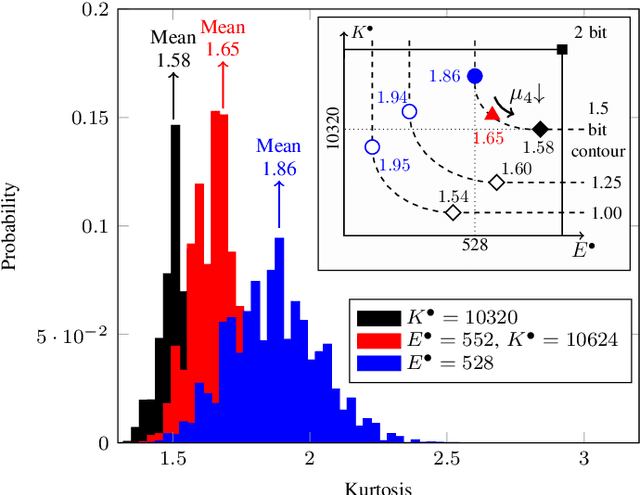
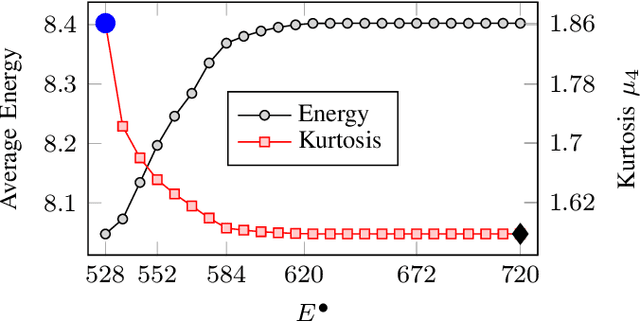
Nonlinear interference (NLI) generated during the propagation of an optical waveform through the fiber depends on the fourth order standardized moment of the channel input distribution, also known as kurtosis. Probabilistically-shaped inputs optimized for the linear Gaussian channel have a Gaussian-like distribution with high kurtosis. For optical channels, this leads to an increase in NLI power and consequently, a decrease in effective signal-to-noise ratio (SNR). In this work, we propose kurtosis-limited enumerative sphere shaping (K-ESS) as an algorithm to generate low-kurtosis shaped inputs. Numerical simulations demonstrate that with K-ESS, it is possible to increase the effective SNRs by 0.4 dB in a single-span single-channel scenario at 400 Gbit/s. K-ESS offers also a twofold decrease in frame error rate with respect to Gaussian-channel-optimal sphere shaping.