 Add to Chrome
 Add to Firefox
 Add to Edge
Verifier-Guided Model Discovery for Physical Dynamical Systems with Pretrained Symbolic Transformers
Aug 01, 2026
Reliable forecasting of nonlinear physical systems underpins scientific discovery and engineering decision-making. Yet high-fidelity simulations are prohibitively costly, and machine-learning surrogates can be opaque and encode assumptions about system dynamics, limiting generalizability. Pretrained transformers mapping synthetic ODE trajectories to equations offer interpretable alternatives, promising transfer without system-specific equation knowledge. Transferring them reliably to high-dimensional physical data, however, remains an open challenge. We develop a verifier-guided (VG) workflow around ODEFormer as a symbolic backbone, using dynamical and physical-admissibility criteria to select from a multi-trajectory candidate equation pool, enabling transfer. On canonical Van der Pol oscillators, VG outperforms the original ODEFormer workflow across held-out initial conditions. We then address vortex shedding, a phenomenon occurring in atmospheric and plasma systems of societal relevance, through coordinate reduction and symbolic discovery at fixed and varying Reynolds numbers. VG discovers fixed-parameter reduced-order equations that recover the fundamental shedding oscillator and higher harmonics without a wake-specific candidate library or prescribed Navier-Stokes structure, while the cross-parameter model generalizes to withheld regimes. Reconstruction fidelity alone did not determine symbolic discoverability, highlighting the importance of compatibility between latent dynamics and the backbone's pretraining distribution. This work establishes a verifier-guided neural-to-symbolic methodology for interpretable and physically auditable forecasting in the natural sciences.

Contract-Based Compositional Shielding for Safe Multi-Agent Reinforcement Learning
Jun 12, 2026Safe coordination problems surface in multi-agent reinforcement learning when global safety cannot be enforced by any agent unilaterally: the admissibility of one agent's action may depend on the dynamics of other agents. Decentralised shields can enforce safety at runtime, but purely factorised permissions often exclude optimal team behaviour that is safe only through coordination. We study deterministic safety guarantees for agents trained and deployed under decentralised execution, recovering team-optimal safe behaviour without centralised runtime control. Agents have a shared global specification $φ$ in the safety fragment of Linear Temporal Logic ($\mathsf{LTL}_{\mathsf{safe}}$ ), and select among tuples of local $\mathsf{LTL}_{\mathsf{safe}}$ obligations whose conjunction implies the global specification $φ$. Each agent may rely on the other agents' local obligations as assumptions because the whole contract tuple is certified simultaneously and allows projection into local action masks. At learning time, a non-stationary multi-armed bandit chooses among a library of local $\mathsf{LTL}_{\mathsf{safe}}$ obligations to select the tuple that optimises team reward, all without forgoing end-to-end safety. We evaluate the approach across 6 environments and 15 algorithmic variants.
Robust Shielding for Safe Reinforcement Learning
May 29, 2026Shielding is an effective approach to formally guarantee the safety of reinforcement learning agents in Markov decision processes (MDPs). However, existing shielding techniques typically assume knowledge of the safety-relevant transition dynamics - a requirement that is seldom met in practice. To address this limitation, we introduce a novel shielding framework for robust MDPs (RMDPs), i.e., MDPs with sets of transition probabilities. We define safety as the satisfaction of a linear temporal logic (LTL) formula with a certain threshold probability under the worst-case transition probabilities of the RMDP. We prove that our shielding framework is both sound and optimal for the RMDP: every policy admissible by the shield is safe, and conversely, every safe RMDP policy is admissible by the shield. We combine our approach with existing sampling methods for learning transition probabilities of MDPs with probably approximately correct (PAC) guarantees. This combination enables the construction of shields for MDPs that, with high confidence, guarantee safety while remaining minimally restrictive. Our experiments show that our shields for learned RMDPs guarantee safety in unknown MDPs while recovering strong expected return as the number of samples increases.
SafeAdapt: Provably Safe Policy Updates in Deep Reinforcement Learning
Apr 10, 2026Safety guarantees are a prerequisite to the deployment of reinforcement learning (RL) agents in safety-critical tasks. Often, deployment environments exhibit non-stationary dynamics or are subject to changing performance goals, requiring updates to the learned policy. This leads to a fundamental challenge: how to update an RL policy while preserving its safety properties on previously encountered tasks? The majority of current approaches either do not provide formal guarantees or verify policy safety only a posteriori. We propose a novel a priori approach to safe policy updates in continual RL by introducing the Rashomon set: a region in policy parameter space certified to meet safety constraints within the demonstration data distribution. We then show that one can provide formal, provable guarantees for arbitrary RL algorithms used to update a policy by projecting their updates onto the Rashomon set. Empirically, we validate this approach across grid-world navigation environments (Frozen Lake and Poisoned Apple) where we guarantee an a priori provably deterministic safety on the source task during downstream adaptation. In contrast, we observe that regularisation-based baselines experience catastrophic forgetting of safety constraints while our approach enables strong adaptation with provable guarantees that safety is preserved.
Safe Reinforcement Learning via Recovery-based Shielding with Gaussian Process Dynamics Models
Feb 17, 2026Reinforcement learning (RL) is a powerful framework for optimal decision-making and control but often lacks provable guarantees for safety-critical applications. In this paper, we introduce a novel recovery-based shielding framework that enables safe RL with a provable safety lower bound for unknown and non-linear continuous dynamical systems. The proposed approach integrates a backup policy (shield) with the RL agent, leveraging Gaussian process (GP) based uncertainty quantification to predict potential violations of safety constraints, dynamically recovering to safe trajectories only when necessary. Experience gathered by the 'shielded' agent is used to construct the GP models, with policy optimization via internal model-based sampling - enabling unrestricted exploration and sample efficient learning, without compromising safety. Empirically our approach demonstrates strong performance and strict safety-compliance on a suite of continuous control environments.
Expressive Temporal Specifications for Reward Monitoring
Nov 16, 2025Specifying informative and dense reward functions remains a pivotal challenge in Reinforcement Learning, as it directly affects the efficiency of agent training. In this work, we harness the expressive power of quantitative Linear Temporal Logic on finite traces (($\text{LTL}_f[\mathcal{F}]$)) to synthesize reward monitors that generate a dense stream of rewards for runtime-observable state trajectories. By providing nuanced feedback during training, these monitors guide agents toward optimal behaviour and help mitigate the well-known issue of sparse rewards under long-horizon decision making, which arises under the Boolean semantics dominating the current literature. Our framework is algorithm-agnostic and only relies on a state labelling function, and naturally accommodates specifying non-Markovian properties. Empirical results show that our quantitative monitors consistently subsume and, depending on the environment, outperform Boolean monitors in maximizing a quantitative measure of task completion and in reducing convergence time.
Behaviour Policy Optimization: Provably Lower Variance Return Estimates for Off-Policy Reinforcement Learning
Nov 13, 2025Many reinforcement learning algorithms, particularly those that rely on return estimates for policy improvement, can suffer from poor sample efficiency and training instability due to high-variance return estimates. In this paper we leverage new results from off-policy evaluation; it has recently been shown that well-designed behaviour policies can be used to collect off-policy data for provably lower variance return estimates. This result is surprising as it means collecting data on-policy is not variance optimal. We extend this key insight to the online reinforcement learning setting, where both policy evaluation and improvement are interleaved to learn optimal policies. Off-policy RL has been well studied (e.g., IMPALA), with correct and truncated importance weighted samples for de-biasing and managing variance appropriately. Generally these approaches are concerned with reconciling data collected from multiple workers in parallel, while the policy is updated asynchronously, mismatch between the workers and policy is corrected in a mathematically sound way. Here we consider only one worker - the behaviour policy, which is used to collect data for policy improvement, with provably lower variance return estimates. In our experiments we extend two policy-gradient methods with this regime, demonstrating better sample efficiency and performance over a diverse set of environments.
Multi-Agent Q-Learning Dynamics in Random Networks: Convergence due to Exploration and Sparsity
Mar 13, 2025Beyond specific settings, many multi-agent learning algorithms fail to converge to an equilibrium solution, and instead display complex, non-stationary behaviours such as recurrent or chaotic orbits. In fact, recent literature suggests that such complex behaviours are likely to occur when the number of agents increases. In this paper, we study Q-learning dynamics in network polymatrix games where the network structure is drawn from classical random graph models. In particular, we focus on the Erdos-Renyi model, a well-studied model for social networks, and the Stochastic Block model, which generalizes the above by accounting for community structures within the network. In each setting, we establish sufficient conditions under which the agents' joint strategies converge to a unique equilibrium. We investigate how this condition depends on the exploration rates, payoff matrices and, crucially, the sparsity of the network. Finally, we validate our theoretical findings through numerical simulations and demonstrate that convergence can be reliably achieved in many-agent systems, provided network sparsity is controlled.
Probabilistic Shielding for Safe Reinforcement Learning
Mar 09, 2025

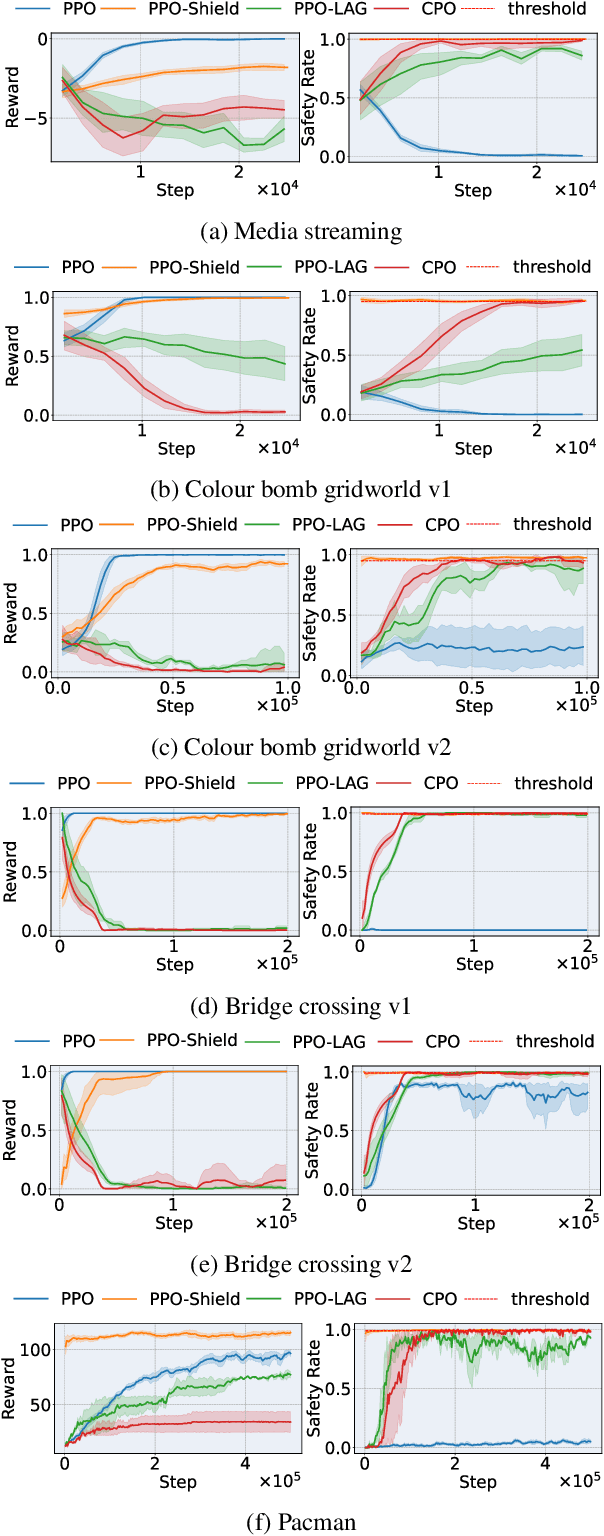

In real-life scenarios, a Reinforcement Learning (RL) agent aiming to maximise their reward, must often also behave in a safe manner, including at training time. Thus, much attention in recent years has been given to Safe RL, where an agent aims to learn an optimal policy among all policies that satisfy a given safety constraint. However, strict safety guarantees are often provided through approaches based on linear programming, and thus have limited scaling. In this paper we present a new, scalable method, which enjoys strict formal guarantees for Safe RL, in the case where the safety dynamics of the Markov Decision Process (MDP) are known, and safety is defined as an undiscounted probabilistic avoidance property. Our approach is based on state-augmentation of the MDP, and on the design of a shield that restricts the actions available to the agent. We show that our approach provides a strict formal safety guarantee that the agent stays safe at training and test time. Furthermore, we demonstrate that our approach is viable in practice through experimental evaluation.
Explainable Reinforcement Learning for Formula One Race Strategy
Jan 07, 2025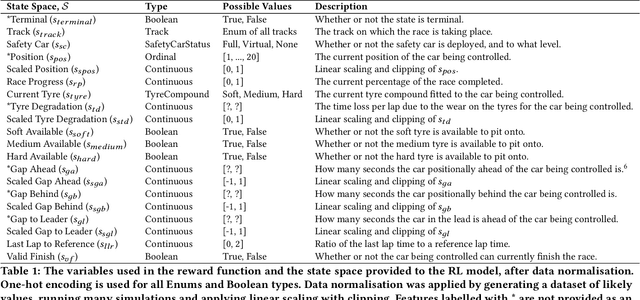

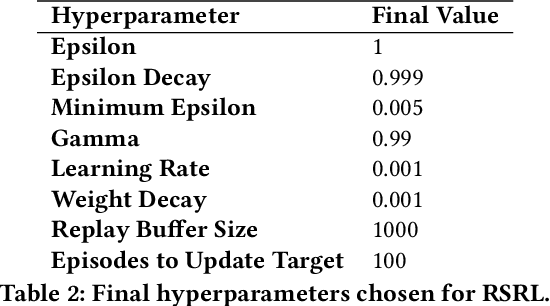
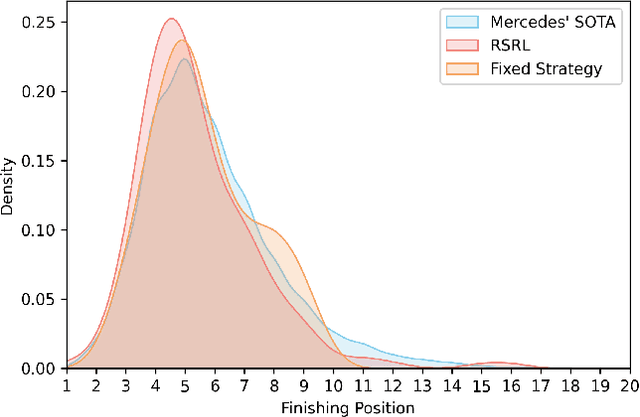
In Formula One, teams compete to develop their cars and achieve the highest possible finishing position in each race. During a race, however, teams are unable to alter the car, so they must improve their cars' finishing positions via race strategy, i.e. optimising their selection of which tyre compounds to put on the car and when to do so. In this work, we introduce a reinforcement learning model, RSRL (Race Strategy Reinforcement Learning), to control race strategies in simulations, offering a faster alternative to the industry standard of hard-coded and Monte Carlo-based race strategies. Controlling cars with a pace equating to an expected finishing position of P5.5 (where P1 represents first place and P20 is last place), RSRL achieves an average finishing position of P5.33 on our test race, the 2023 Bahrain Grand Prix, outperforming the best baseline of P5.63. We then demonstrate, in a generalisability study, how performance for one track or multiple tracks can be prioritised via training. Further, we supplement model predictions with feature importance, decision tree-based surrogate models, and decision tree counterfactuals towards improving user trust in the model. Finally, we provide illustrations which exemplify our approach in real-world situations, drawing parallels between simulations and reality.