 Add to Chrome
 Add to Firefox
 Add to Edge
A Networked Multi-Agent System for Mobile Wireless Infrastructure on Demand
Jun 14, 2023
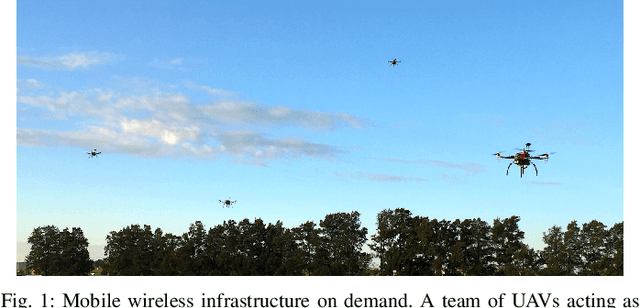
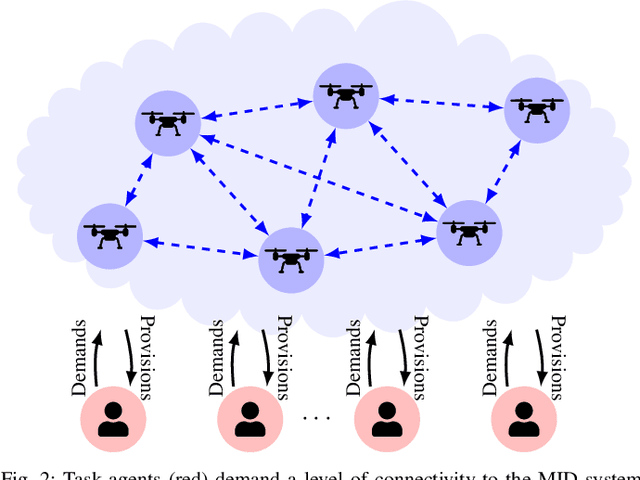
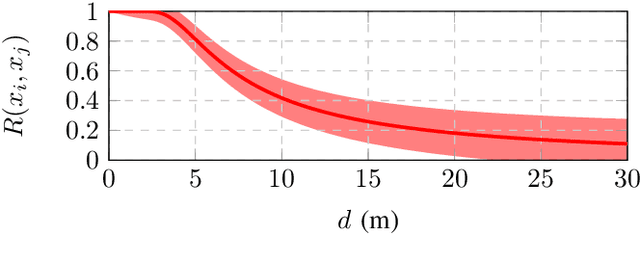
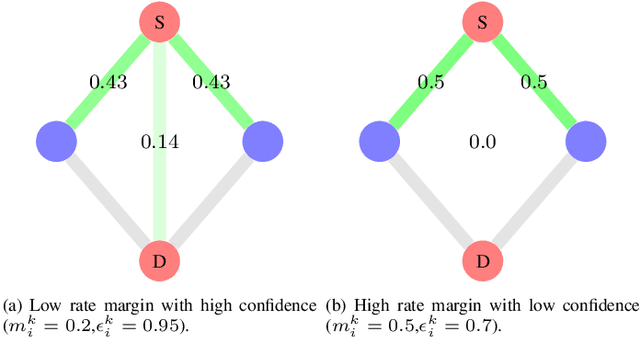
Despite the prevalence of wireless connectivity in urban areas around the globe, there remain numerous and diverse situations where connectivity is insufficient or unavailable. To address this, we introduce mobile wireless infrastructure on demand, a system of UAVs that can be rapidly deployed to establish an ad-hoc wireless network. This network has the capability of reconfiguring itself dynamically to satisfy and maintain the required quality of communication. The system optimizes the positions of the UAVs and the routing of data flows throughout the network to achieve this quality of service (QoS). By these means, task agents using the network simply request a desired QoS, and the system adapts accordingly while allowing them to move freely. We have validated this system both in simulation and in real-world experiments. The results demonstrate that our system effectively offers mobile wireless infrastructure on demand, extending the operational range of task agents and supporting complex mobility patterns, all while ensuring connectivity and being resilient to agent failures.

Resilient Constrained Learning
Jun 04, 2023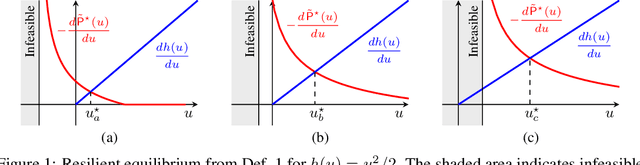
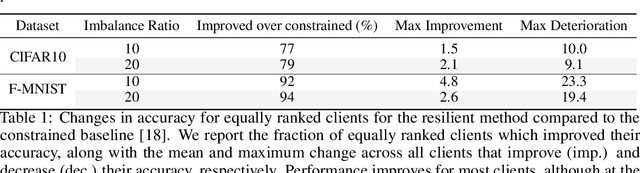
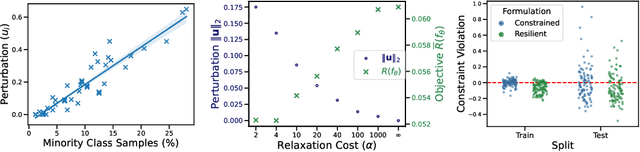

When deploying machine learning solutions, they must satisfy multiple requirements beyond accuracy, such as fairness, robustness, or safety. These requirements are imposed during training either implicitly, using penalties, or explicitly, using constrained optimization methods based on Lagrangian duality. Either way, specifying requirements is hindered by the presence of compromises and limited prior knowledge about the data. Furthermore, their impact on performance can often only be evaluated by actually solving the learning problem. This paper presents a constrained learning approach that adapts the requirements while simultaneously solving the learning task. To do so, it relaxes the learning constraints in a way that contemplates how much they affect the task at hand by balancing the performance gains obtained from the relaxation against a user-defined cost of that relaxation. We call this approach resilient constrained learning after the term used to describe ecological systems that adapt to disruptions by modifying their operation. We show conditions under which this balance can be achieved and introduce a practical algorithm to compute it, for which we derive approximation and generalization guarantees. We showcase the advantages of this resilient learning method in image classification tasks involving multiple potential invariances and in heterogeneous federated learning.
Geometric Graph Filters and Neural Networks: Limit Properties and Discriminability Trade-offs
May 29, 2023This paper studies the relationship between a graph neural network (GNN) and a manifold neural network (MNN) when the graph is constructed from a set of points sampled from the manifold, thus encoding geometric information. We consider convolutional MNNs and GNNs where the manifold and the graph convolutions are respectively defined in terms of the Laplace-Beltrami operator and the graph Laplacian. Using the appropriate kernels, we analyze both dense and moderately sparse graphs. We prove non-asymptotic error bounds showing that convolutional filters and neural networks on these graphs converge to convolutional filters and neural networks on the continuous manifold. As a byproduct of this analysis, we observe an important trade-off between the discriminability of graph filters and their ability to approximate the desired behavior of manifold filters. We then discuss how this trade-off is ameliorated in neural networks due to the frequency mixing property of nonlinearities. We further derive a transferability corollary for geometric graphs sampled from the same manifold. We validate our results numerically on a navigation control problem and a point cloud classification task.
Active Collaborative Localization in Heterogeneous Robot Teams
May 29, 2023Accurate and robust state estimation is critical for autonomous navigation of robot teams. This task is especially challenging for large groups of size, weight, and power (SWAP) constrained aerial robots operating in perceptually-degraded GPS-denied environments. We can, however, actively increase the amount of perceptual information available to such robots by augmenting them with a small number of more expensive, but less resource-constrained, agents. Specifically, the latter can serve as sources of perceptual information themselves. In this paper, we study the problem of optimally positioning (and potentially navigating) a small number of more capable agents to enhance the perceptual environment for their lightweight,inexpensive, teammates that only need to rely on cameras and IMUs. We propose a numerically robust, computationally efficient approach to solve this problem via nonlinear optimization. Our method outperforms the standard approach based on the greedy algorithm, while matching the accuracy of a heuristic evolutionary scheme for global optimization at a fraction of its running time. Ultimately, we validate our solution in both photorealistic simulations and real-world experiments. In these experiments, we use lidar-based autonomous ground vehicles as the more capable agents, and vision-based aerial robots as their SWAP-constrained teammates. Our method is able to reduce drift in visual-inertial odometry by as much as 90%, and it outperforms random positioning of lidar-equipped agents by a significant margin. Furthermore, our method can be generalized to different types of robot teams with heterogeneous perception capabilities. It has a wide range of applications, such as surveying and mapping challenging dynamic environments, and enabling resilience to large-scale perturbations that can be caused by earthquakes or storms.
Explainable Brain Age Prediction using coVariance Neural Networks
May 27, 2023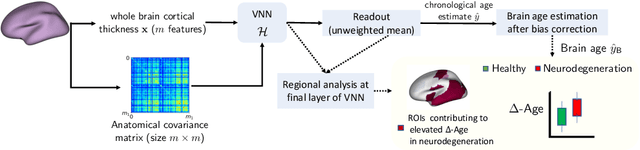
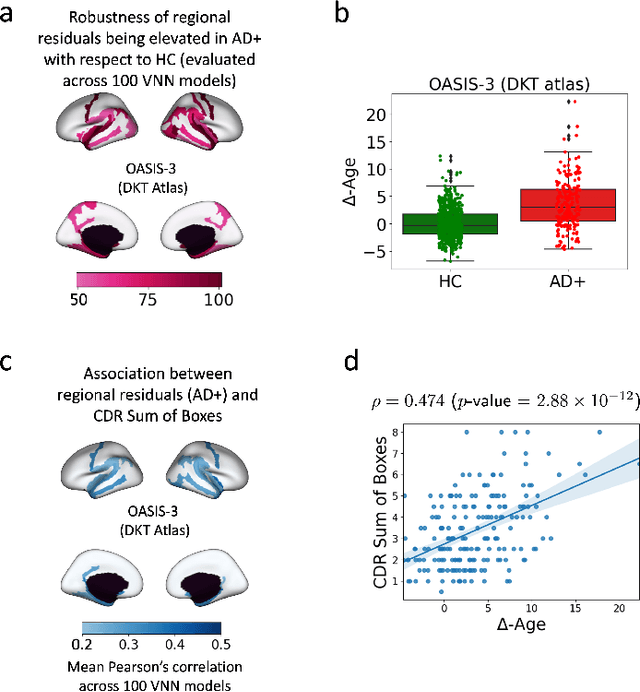
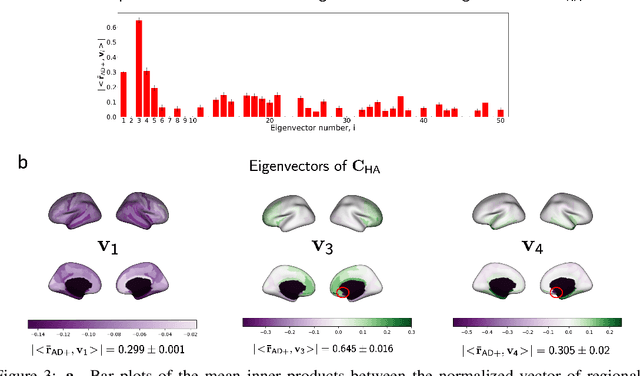
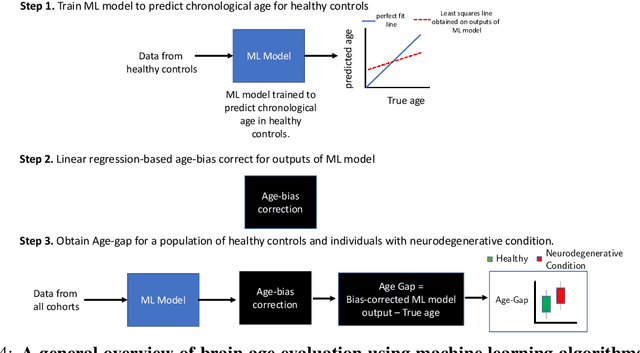
In computational neuroscience, there has been an increased interest in developing machine learning algorithms that leverage brain imaging data to provide estimates of "brain age" for an individual. Importantly, the discordance between brain age and chronological age (referred to as "brain age gap") can capture accelerated aging due to adverse health conditions and therefore, can reflect increased vulnerability towards neurological disease or cognitive impairments. However, widespread adoption of brain age for clinical decision support has been hindered due to lack of transparency and methodological justifications in most existing brain age prediction algorithms. In this paper, we leverage coVariance neural networks (VNN) to propose an anatomically interpretable framework for brain age prediction using cortical thickness features. Specifically, our brain age prediction framework extends beyond the coarse metric of brain age gap in Alzheimer's disease (AD) and we make two important observations: (i) VNNs can assign anatomical interpretability to elevated brain age gap in AD by identifying contributing brain regions, (ii) the interpretability offered by VNNs is contingent on their ability to exploit specific eigenvectors of the anatomical covariance matrix. Together, these observations facilitate an explainable perspective to the task of brain age prediction.
Stochastic Unrolled Federated Learning
May 24, 2023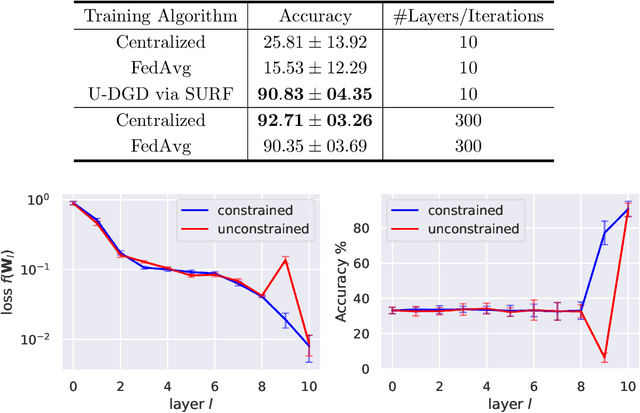
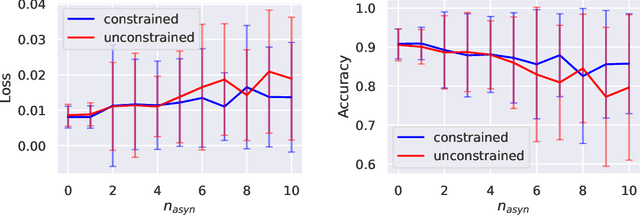
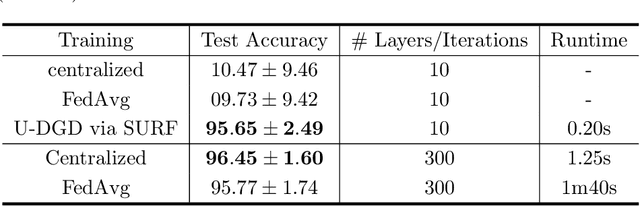

Algorithm unrolling has emerged as a learning-based optimization paradigm that unfolds truncated iterative algorithms in trainable neural-network optimizers. We introduce Stochastic UnRolled Federated learning (SURF), a method that expands algorithm unrolling to a federated learning scenario. Our proposed method tackles two challenges of this expansion, namely the need to feed whole datasets to the unrolled optimizers to find a descent direction and the decentralized nature of federated learning. We circumvent the former challenge by feeding stochastic mini-batches to each unrolled layer and imposing descent constraints to mitigate the randomness induced by using mini-batches. We address the latter challenge by unfolding the distributed gradient descent (DGD) algorithm in a graph neural network (GNN)-based unrolled architecture, which preserves the decentralized nature of training in federated learning. We theoretically prove that our proposed unrolled optimizer converges to a near-optimal region infinitely often. Through extensive numerical experiments, we also demonstrate the effectiveness of the proposed framework in collaborative training of image classifiers.
Lie Group Algebra Convolutional Filters
May 08, 2023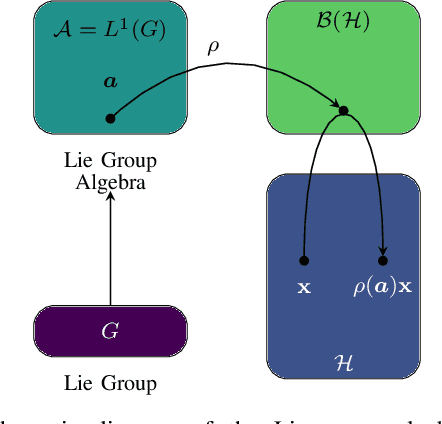
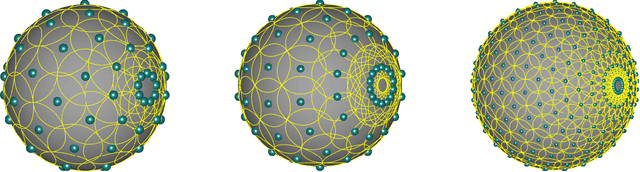
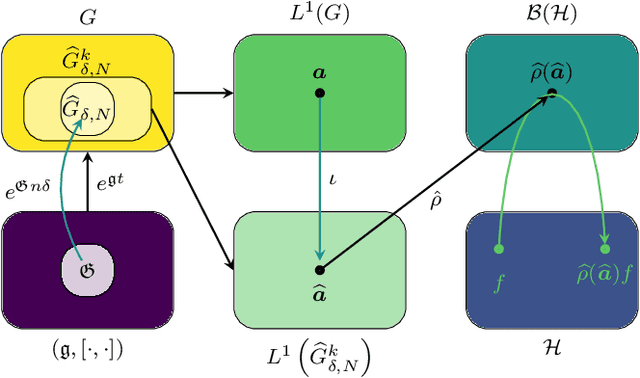

In this paper we propose a framework to leverage Lie group symmetries on arbitrary spaces exploiting algebraic signal processing (ASP). We show that traditional group convolutions are one particular instantiation of a more general Lie group algebra homomorphism associated to an algebraic signal model rooted in the Lie group algebra $L^{1}(G)$ for given Lie group $G$. Exploiting this fact, we decouple the discretization of the Lie group convolution elucidating two separate sampling instances: the filter and the signal. To discretize the filters, we exploit the exponential map that links a Lie group with its associated Lie algebra. We show that the discrete Lie group filter learned from the data determines a unique filter in $L^{1}(G)$, and we show how this uniqueness of representation is defined by the bandwidth of the filter given a spectral representation. We also derive error bounds for the approximations of the filters in $L^{1}(G)$ with respect to its learned discrete representations. The proposed framework allows the processing of signals on spaces of arbitrary dimension and where the actions of some elements of the group are not necessarily well defined. Finally, we show that multigraph convolutional signal models come as the natural discrete realization of Lie group signal processing models, and we use this connection to establish stability results for Lie group algebra filters. To evaluate numerically our results, we build neural networks with these filters and we apply them in multiple datasets, including a knot classification problem.
Transferability of coVariance Neural Networks and Application to Interpretable Brain Age Prediction using Anatomical Features
May 04, 2023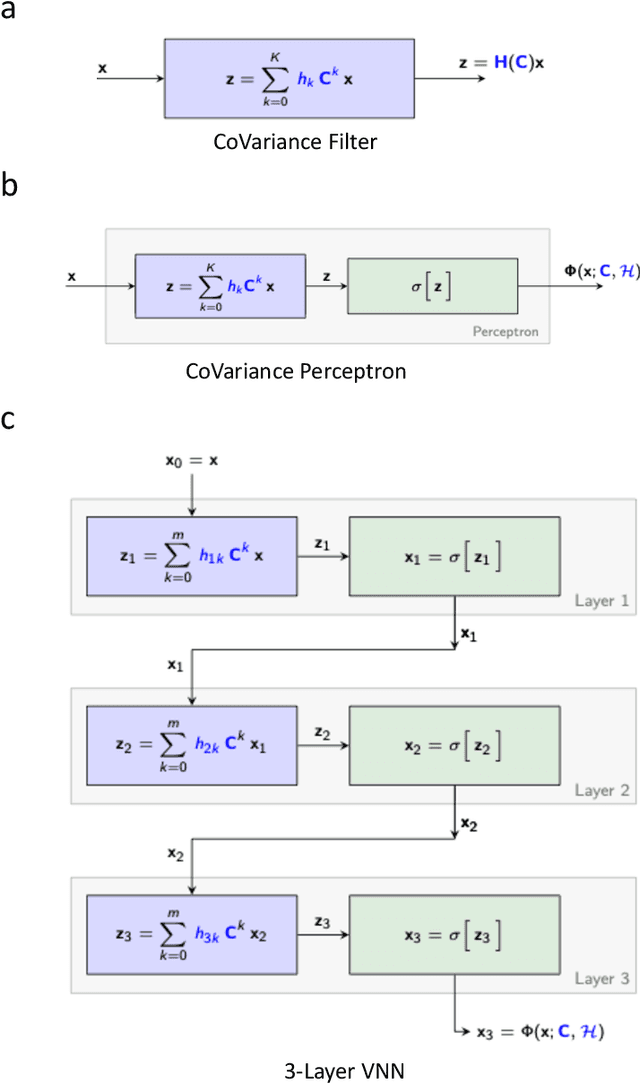
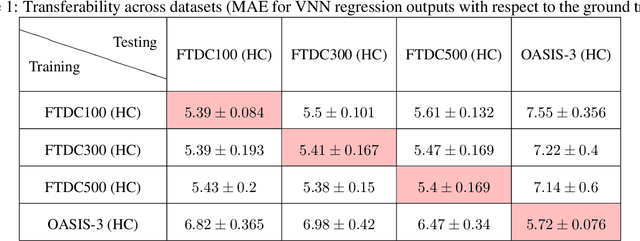
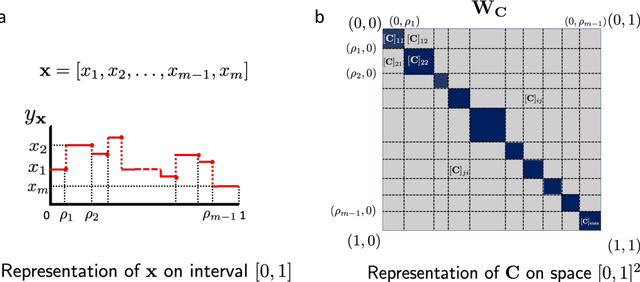
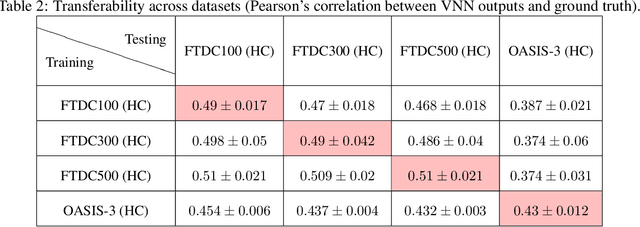
Graph convolutional networks (GCN) leverage topology-driven graph convolutional operations to combine information across the graph for inference tasks. In our recent work, we have studied GCNs with covariance matrices as graphs in the form of coVariance neural networks (VNNs) that draw similarities with traditional PCA-driven data analysis approaches while offering significant advantages over them. In this paper, we first focus on theoretically characterizing the transferability of VNNs. The notion of transferability is motivated from the intuitive expectation that learning models could generalize to "compatible" datasets (possibly of different dimensionalities) with minimal effort. VNNs inherit the scale-free data processing architecture from GCNs and here, we show that VNNs exhibit transferability of performance over datasets whose covariance matrices converge to a limit object. Multi-scale neuroimaging datasets enable the study of the brain at multiple scales and hence, can validate the theoretical results on the transferability of VNNs. To gauge the advantages offered by VNNs in neuroimaging data analysis, we focus on the task of "brain age" prediction using cortical thickness features. In clinical neuroscience, there has been an increased interest in machine learning algorithms which provide estimates of "brain age" that deviate from chronological age. We leverage the architecture of VNNs to extend beyond the coarse metric of brain age gap in Alzheimer's disease (AD) and make two important observations: (i) VNNs can assign anatomical interpretability to elevated brain age gap in AD, and (ii) the interpretability offered by VNNs is contingent on their ability to exploit specific principal components of the anatomical covariance matrix. We further leverage the transferability of VNNs to cross validate the above observations across different datasets.
Tangent Bundle Convolutional Learning: from Manifolds to Cellular Sheaves and Back
Mar 20, 2023


In this work we introduce a convolution operation over the tangent bundle of Riemann manifolds in terms of exponentials of the Connection Laplacian operator. We define tangent bundle filters and tangent bundle neural networks (TNNs) based on this convolution operation, which are novel continuous architectures operating on tangent bundle signals, i.e. vector fields over the manifolds. Tangent bundle filters admit a spectral representation that generalizes the ones of scalar manifold filters, graph filters and standard convolutional filters in continuous time. We then introduce a discretization procedure, both in the space and time domains, to make TNNs implementable, showing that their discrete counterpart is a novel principled variant of the very recently introduced sheaf neural networks. We formally prove that this discretized architecture converges to the underlying continuous TNN. Finally, we numerically evaluate the effectiveness of the proposed architecture on various learning tasks, both on synthetic and real data.
Graph Neural Networks for Decentralized Multi-Agent Perimeter Defense
Jan 23, 2023In this work, we study the problem of decentralized multi-agent perimeter defense that asks for computing actions for defenders with local perceptions and communications to maximize the capture of intruders. One major challenge for practical implementations is to make perimeter defense strategies scalable for large-scale problem instances. To this end, we leverage graph neural networks (GNNs) to develop an imitation learning framework that learns a mapping from defenders' local perceptions and their communication graph to their actions. The proposed GNN-based learning network is trained by imitating a centralized expert algorithm such that the learned actions are close to that generated by the expert algorithm. We demonstrate that our proposed network performs closer to the expert algorithm and is superior to other baseline algorithms by capturing more intruders. Our GNN-based network is trained at a small scale and can be generalized to large-scale cases. We run perimeter defense games in scenarios with different team sizes and configurations to demonstrate the performance of the learned network.