 Add to Chrome
 Add to Firefox
 Add to Edge
Adjacency-Based Spectral Proxy Control of Mobile Communication Agents
Aug 12, 2026
We consider a heterogeneous mobile-agent network composed of uncontrolled task agents and controllable communication agents. The objective is to reposition communication agents online as task agents move. Since throughput-based objectives are generally unsuitable for real-time control, spectral graph metrics such as algebraic connectivity are commonly adopted as surrogate objectives. However, controlling algebraic connectivity relies on the eigenvector corresponding to the second-smallest eigenvalue of a graph's Laplacian matrix (i.e., the Fiedler vector), whose distributed estimation requires an unbounded number of communication rounds to converge. In this work, we identify a structural decomposition of this Fiedler-gradient controller into a local interaction rule and a graph embedding component, suggesting the use of alternative embeddings that are easier to estimate distributively than the Fiedler vector. As a particular instance, we propose A-Fiedler, which replaces the Fiedler embedding with the dominant eigenvector of the adjacency matrix, commonly used as a graph embedding of nodes into a latent geometry. This representation is more naturally suited for distributed implementation under local communication constraints. We evaluate A-Fiedler against the classical Fiedler-gradient controller. Results show comparable network performance in the absence of communication constraints and improved robustness under distributed estimation. For instance, under the same number of communication rounds, the Fielder-gradient may even converge to disconnected configurations whereas our proposition maintains performance. We believe our contribution provides a simpler path toward distributed network control.

Navigation with shadow prices to optimize multi-commodity flow rates
Sep 25, 2023
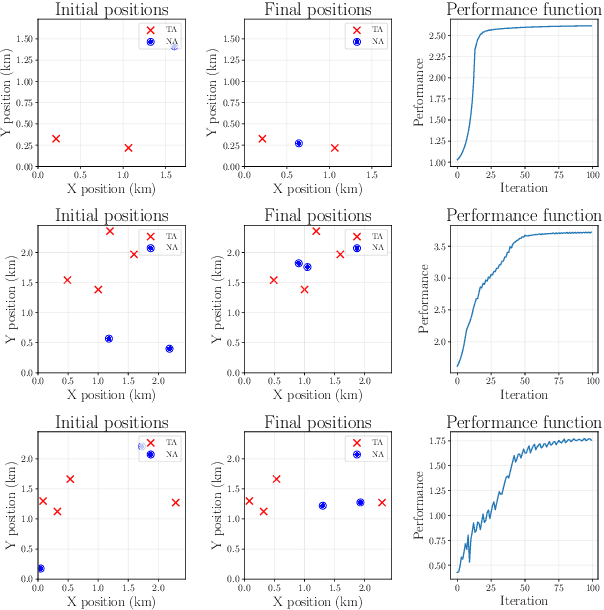
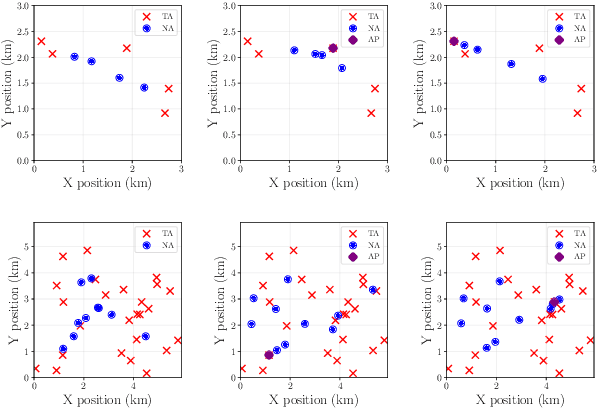
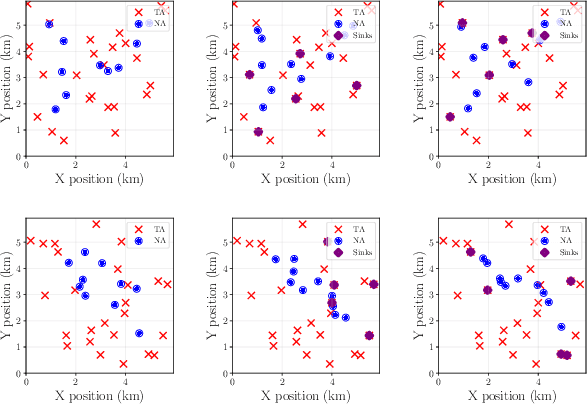
We propose a method for providing communication network infrastructure in autonomous multi-agent teams. In particular, we consider a set of communication agents that are placed alongside regular agents from the system in order to improve the rate of information transfer between the latter. In order to find the optimal positions to place such agents, we define a flexible performance function that adapts to network requirements for different systems. We provide an algorithm based on shadow prices of a related convex optimization problem in order to drive the configuration of the complete system towards a local maximum. We apply our method to three different performance functions associated with three practical scenarios in which we show both the performance of the algorithm and the flexibility it allows for optimizing different network requirements.
A Networked Multi-Agent System for Mobile Wireless Infrastructure on Demand
Jun 14, 2023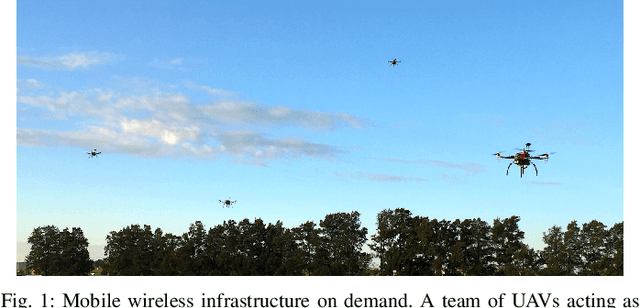
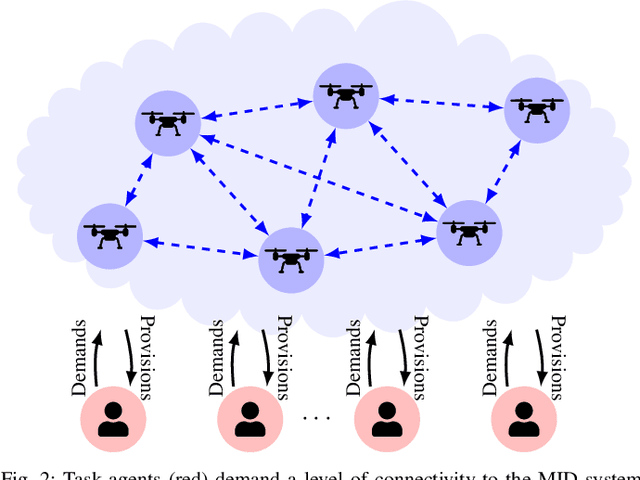
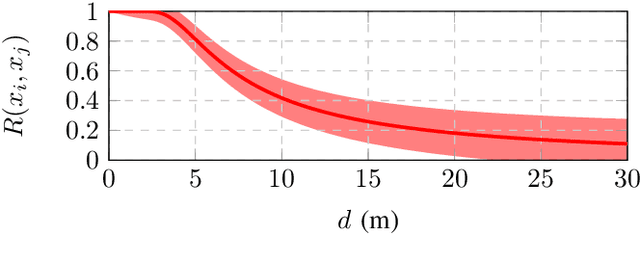
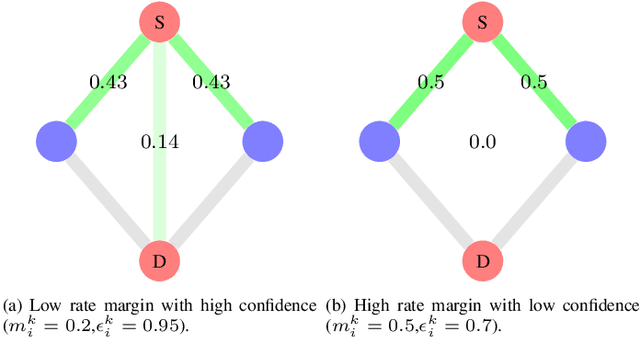
Despite the prevalence of wireless connectivity in urban areas around the globe, there remain numerous and diverse situations where connectivity is insufficient or unavailable. To address this, we introduce mobile wireless infrastructure on demand, a system of UAVs that can be rapidly deployed to establish an ad-hoc wireless network. This network has the capability of reconfiguring itself dynamically to satisfy and maintain the required quality of communication. The system optimizes the positions of the UAVs and the routing of data flows throughout the network to achieve this quality of service (QoS). By these means, task agents using the network simply request a desired QoS, and the system adapts accordingly while allowing them to move freely. We have validated this system both in simulation and in real-world experiments. The results demonstrate that our system effectively offers mobile wireless infrastructure on demand, extending the operational range of task agents and supporting complex mobility patterns, all while ensuring connectivity and being resilient to agent failures.