 Add to Chrome
 Add to Firefox
 Add to Edge
A Calibrated Memorization Index (MI) for Detecting Training Data Leakage in Generative MRI Models
Feb 13, 2026
Image generative models are known to duplicate images from the training data as part of their outputs, which can lead to privacy concerns when used for medical image generation. We propose a calibrated per-sample metric for detecting memorization and duplication of training data. Our metric uses image features extracted using an MRI foundation model, aggregates multi-layer whitened nearest-neighbor similarities, and maps them to a bounded \emph{Overfit/Novelty Index} (ONI) and \emph{Memorization Index} (MI) scores. Across three MRI datasets with controlled duplication percentages and typical image augmentations, our metric robustly detects duplication and provides more consistent metric values across datasets. At the sample level, our metric achieves near-perfect detection of duplicates.

CS2-Net: Deep Learning Segmentation of Curvilinear Structures in Medical Imaging
Oct 19, 2020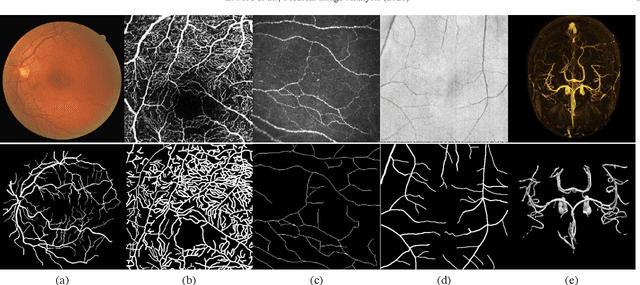
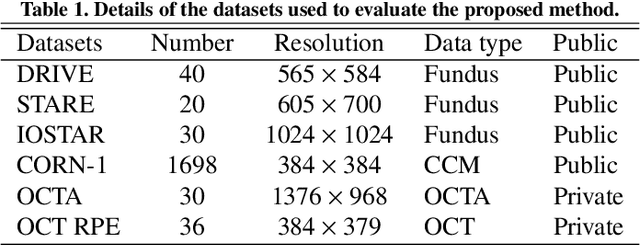
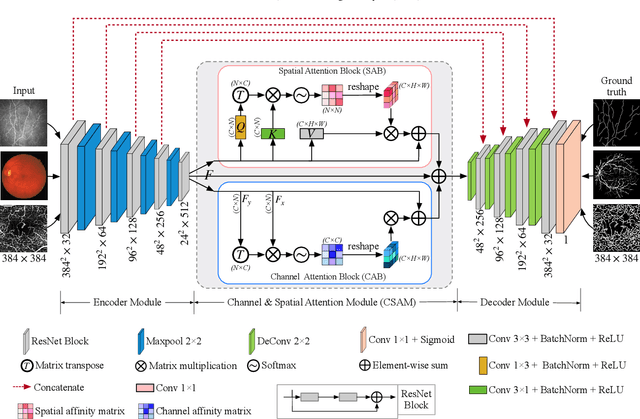
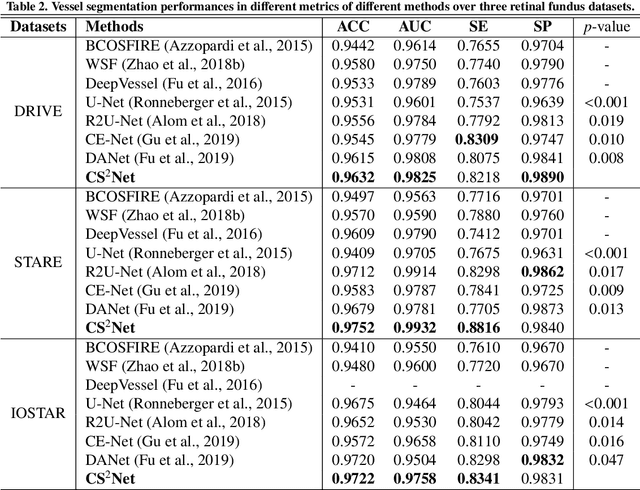
Automated detection of curvilinear structures, e.g., blood vessels or nerve fibres, from medical and biomedical images is a crucial early step in automatic image interpretation associated to the management of many diseases. Precise measurement of the morphological changes of these curvilinear organ structures informs clinicians for understanding the mechanism, diagnosis, and treatment of e.g. cardiovascular, kidney, eye, lung, and neurological conditions. In this work, we propose a generic and unified convolution neural network for the segmentation of curvilinear structures and illustrate in several 2D/3D medical imaging modalities. We introduce a new curvilinear structure segmentation network (CS2-Net), which includes a self-attention mechanism in the encoder and decoder to learn rich hierarchical representations of curvilinear structures. Two types of attention modules - spatial attention and channel attention - are utilized to enhance the inter-class discrimination and intra-class responsiveness, to further integrate local features with their global dependencies and normalization, adaptively. Furthermore, to facilitate the segmentation of curvilinear structures in medical images, we employ a 1x3 and a 3x1 convolutional kernel to capture boundary features. ...