 Add to Chrome
 Add to Firefox
 Add to Edge
Formally Guaranteed Control Adaptation for ODD-Resilient Autonomous Systems
Apr 08, 2026
Ensuring reliable performance in situations outside the Operational Design Domain (ODD) remains a primary challenge in devising resilient autonomous systems. We explore this challenge by introducing an approach for adapting probabilistic system models to handle out-of-ODD scenarios while, in parallel, providing quantitative guarantees. Our approach dynamically extends the coverage of existing system situation capabilities, supporting the verification and adaptation of the system's behaviour under unanticipated situations. Preliminary results demonstrate that our approach effectively increases system reliability by adapting its behaviour and providing formal guarantees even under unforeseen out-of-ODD situations.

A Calibrated Memorization Index (MI) for Detecting Training Data Leakage in Generative MRI Models
Feb 13, 2026Image generative models are known to duplicate images from the training data as part of their outputs, which can lead to privacy concerns when used for medical image generation. We propose a calibrated per-sample metric for detecting memorization and duplication of training data. Our metric uses image features extracted using an MRI foundation model, aggregates multi-layer whitened nearest-neighbor similarities, and maps them to a bounded \emph{Overfit/Novelty Index} (ONI) and \emph{Memorization Index} (MI) scores. Across three MRI datasets with controlled duplication percentages and typical image augmentations, our metric robustly detects duplication and provides more consistent metric values across datasets. At the sample level, our metric achieves near-perfect detection of duplicates.
SCALOFT: An Initial Approach for Situation Coverage-Based Safety Analysis of an Autonomous Aerial Drone in a Mine Environment
May 27, 2025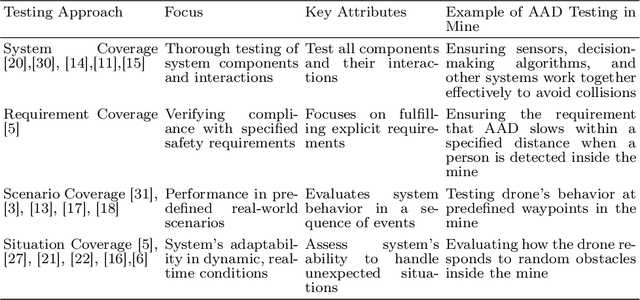
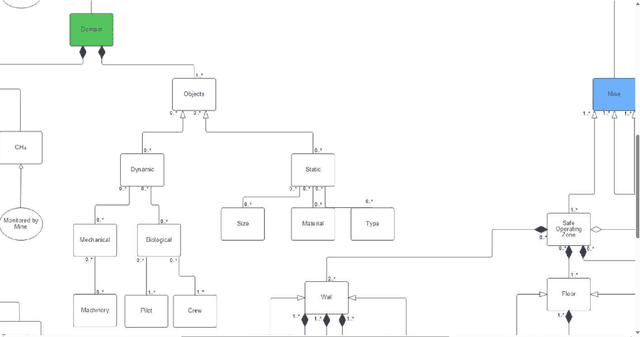

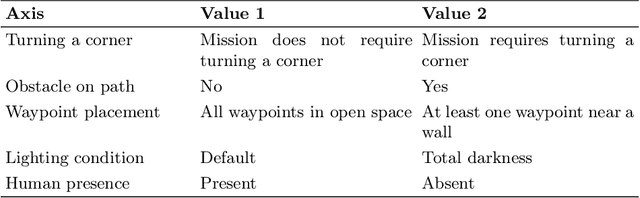
The safety of autonomous systems in dynamic and hazardous environments poses significant challenges. This paper presents a testing approach named SCALOFT for systematically assessing the safety of an autonomous aerial drone in a mine. SCALOFT provides a framework for developing diverse test cases, real-time monitoring of system behaviour, and detection of safety violations. Detected violations are then logged with unique identifiers for detailed analysis and future improvement. SCALOFT helps build a safety argument by monitoring situation coverage and calculating a final coverage measure. We have evaluated the performance of this approach by deliberately introducing seeded faults into the system and assessing whether SCALOFT is able to detect those faults. For a small set of plausible faults, we show that SCALOFT is successful in this.