 Add to Chrome
 Add to Firefox
 Add to Edge
From Words to Amino Acids: Does the Curse of Depth Persist?
Feb 25, 2026
Protein language models (PLMs) have become widely adopted as general-purpose models, demonstrating strong performance in protein engineering and de novo design. Like large language models (LLMs), they are typically trained as deep transformers with next-token or masked-token prediction objectives on massive sequence corpora and are scaled by increasing model depth. Recent work on autoregressive LLMs has identified the Curse of Depth: later layers contribute little to the final output predictions. These findings naturally raise the question of whether a similar depth inefficiency also appears in PLMs, where many widely used models are not autoregressive, and some are multimodal, accepting both protein sequence and structure as input. In this work, we present a depth analysis of six popular PLMs across model families and scales, spanning three training objectives, namely autoregressive, masked, and diffusion, and quantify how layer contributions evolve with depth using a unified set of probing- and perturbation-based measurements. Across all models, we observe consistent depth-dependent patterns that extend prior findings on LLMs: later layers depend less on earlier computations and mainly refine the final output distribution, and these effects are increasingly pronounced in deeper models. Taken together, our results suggest that PLMs exhibit a form of depth inefficiency, motivating future work on more depth-efficient architectures and training methods.

Seqret: Mining Rule Sets from Event Sequences
May 09, 2025

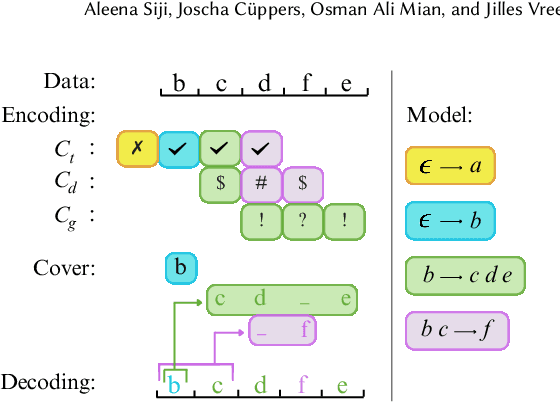
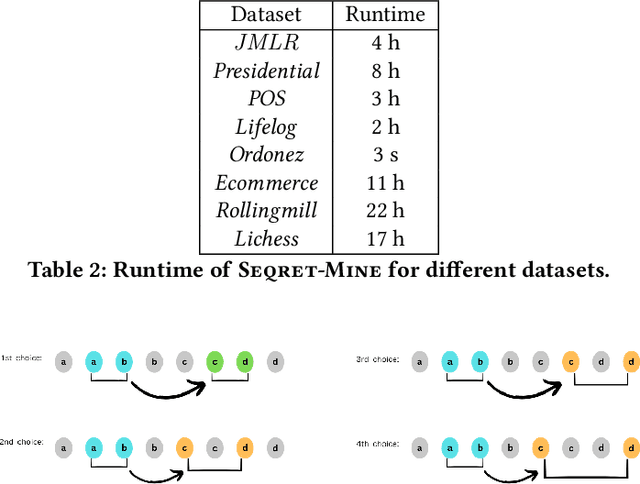
Summarizing event sequences is a key aspect of data mining. Most existing methods neglect conditional dependencies and focus on discovering sequential patterns only. In this paper, we study the problem of discovering both conditional and unconditional dependencies from event sequence data. We do so by discovering rules of the form $X \rightarrow Y$ where $X$ and $Y$ are sequential patterns. Rules like these are simple to understand and provide a clear description of the relation between the antecedent and the consequent. To discover succinct and non-redundant sets of rules we formalize the problem in terms of the Minimum Description Length principle. As the search space is enormous and does not exhibit helpful structure, we propose the Seqret method to discover high-quality rule sets in practice. Through extensive empirical evaluation we show that unlike the state of the art, Seqret ably recovers the ground truth on synthetic datasets and finds useful rules from real datasets.