 Add to Chrome
 Add to Firefox
 Add to Edge
From Words to Amino Acids: Does the Curse of Depth Persist?
Feb 25, 2026
Protein language models (PLMs) have become widely adopted as general-purpose models, demonstrating strong performance in protein engineering and de novo design. Like large language models (LLMs), they are typically trained as deep transformers with next-token or masked-token prediction objectives on massive sequence corpora and are scaled by increasing model depth. Recent work on autoregressive LLMs has identified the Curse of Depth: later layers contribute little to the final output predictions. These findings naturally raise the question of whether a similar depth inefficiency also appears in PLMs, where many widely used models are not autoregressive, and some are multimodal, accepting both protein sequence and structure as input. In this work, we present a depth analysis of six popular PLMs across model families and scales, spanning three training objectives, namely autoregressive, masked, and diffusion, and quantify how layer contributions evolve with depth using a unified set of probing- and perturbation-based measurements. Across all models, we observe consistent depth-dependent patterns that extend prior findings on LLMs: later layers depend less on earlier computations and mainly refine the final output distribution, and these effects are increasingly pronounced in deeper models. Taken together, our results suggest that PLMs exhibit a form of depth inefficiency, motivating future work on more depth-efficient architectures and training methods.

From Growing to Looping: A Unified View of Iterative Computation in LLMs
Feb 18, 2026Looping, reusing a block of layers across depth, and depth growing, training shallow-to-deep models by duplicating middle layers, have both been linked to stronger reasoning, but their relationship remains unclear. We provide a mechanistic unification: looped and depth-grown models exhibit convergent depth-wise signatures, including increased reliance on late layers and recurring patterns aligned with the looped or grown block. These shared signatures support the view that their gains stem from a common form of iterative computation. Building on this connection, we show that the two techniques are adaptable and composable: applying inference-time looping to the middle blocks of a depth-grown model improves accuracy on some reasoning primitives by up to $2\times$, despite the model never being trained to loop. Both approaches also adapt better than the baseline when given more in-context examples or additional supervised fine-tuning data. Additionally, depth-grown models achieve the largest reasoning gains when using higher-quality, math-heavy cooldown mixtures, which can be further boosted by adapting a middle block to loop. Overall, our results position depth growth and looping as complementary, practical methods for inducing and scaling iterative computation to improve reasoning.
Are Object-Centric Representations Better At Compositional Generalization?
Feb 18, 2026Compositional generalization, the ability to reason about novel combinations of familiar concepts, is fundamental to human cognition and a critical challenge for machine learning. Object-centric (OC) representations, which encode a scene as a set of objects, are often argued to support such generalization, but systematic evidence in visually rich settings is limited. We introduce a Visual Question Answering benchmark across three controlled visual worlds (CLEVRTex, Super-CLEVR, and MOVi-C) to measure how well vision encoders, with and without object-centric biases, generalize to unseen combinations of object properties. To ensure a fair and comprehensive comparison, we carefully account for training data diversity, sample size, representation size, downstream model capacity, and compute. We use DINOv2 and SigLIP2, two widely used vision encoders, as the foundation models and their OC counterparts. Our key findings reveal that (1) OC approaches are superior in harder compositional generalization settings; (2) original dense representations surpass OC only on easier settings and typically require substantially more downstream compute; and (3) OC models are more sample efficient, achieving stronger generalization with fewer images, whereas dense encoders catch up or surpass them only with sufficient data and diversity. Overall, object-centric representations offer stronger compositional generalization when any one of dataset size, training data diversity, or downstream compute is constrained.
Do Depth-Grown Models Overcome the Curse of Depth? An In-Depth Analysis
Dec 09, 2025Gradually growing the depth of Transformers during training can not only reduce training cost but also lead to improved reasoning performance, as shown by MIDAS (Saunshi et al., 2024). Thus far, however, a mechanistic understanding of these gains has been missing. In this work, we establish a connection to recent work showing that layers in the second half of non-grown, pre-layernorm Transformers contribute much less to the final output distribution than those in the first half - also known as the Curse of Depth (Sun et al., 2025, Csordás et al., 2025). Using depth-wise analyses, we demonstrate that growth via gradual middle stacking yields more effective utilization of model depth, alters the residual stream structure, and facilitates the formation of permutable computational blocks. In addition, we propose a lightweight modification of MIDAS that yields further improvements in downstream reasoning benchmarks. Overall, this work highlights how the gradual growth of model depth can lead to the formation of distinct computational circuits and overcome the limited depth utilization seen in standard non-grown models.
Conditionally Invariant Representation Learning for Disentangling Cellular Heterogeneity
Jul 02, 2023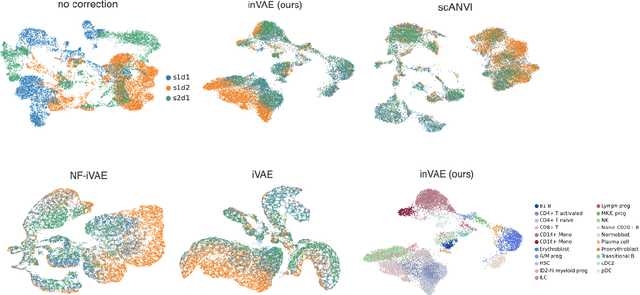
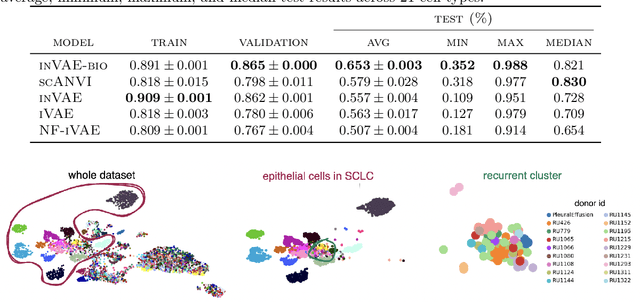
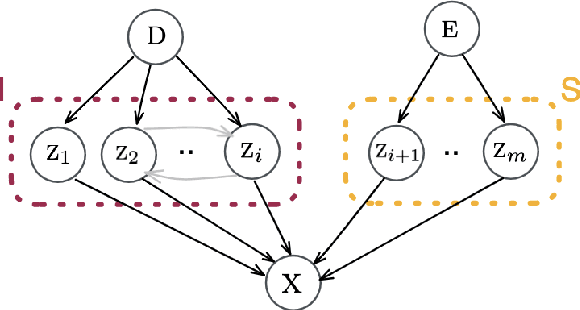
This paper presents a novel approach that leverages domain variability to learn representations that are conditionally invariant to unwanted variability or distractors. Our approach identifies both spurious and invariant latent features necessary for achieving accurate reconstruction by placing distinct conditional priors on latent features. The invariant signals are disentangled from noise by enforcing independence which facilitates the construction of an interpretable model with a causal semantic. By exploiting the interplay between data domains and labels, our method simultaneously identifies invariant features and builds invariant predictors. We apply our method to grand biological challenges, such as data integration in single-cell genomics with the aim of capturing biological variations across datasets with many samples, obtained from different conditions or multiple laboratories. Our approach allows for the incorporation of specific biological mechanisms, including gene programs, disease states, or treatment conditions into the data integration process, bridging the gap between the theoretical assumptions and real biological applications. Specifically, the proposed approach helps to disentangle biological signals from data biases that are unrelated to the target task or the causal explanation of interest. Through extensive benchmarking using large-scale human hematopoiesis and human lung cancer data, we validate the superiority of our approach over existing methods and demonstrate that it can empower deeper insights into cellular heterogeneity and the identification of disease cell states.