 Add to Chrome
 Add to Firefox
 Add to Edge
Joint Deep Image Restoration and Unsupervised Quality Assessment
Nov 27, 2023
Deep learning techniques have revolutionized the fields of image restoration and image quality assessment in recent years. While image restoration methods typically utilize synthetically distorted training data for training, deep quality assessment models often require expensive labeled subjective data. However, recent studies have shown that activations of deep neural networks trained for visual modeling tasks can also be used for perceptual quality assessment of images. Following this intuition, we propose a novel attention-based convolutional neural network capable of simultaneously performing both image restoration and quality assessment. We achieve this by training a JPEG deblocking network augmented with "quality attention" maps and demonstrating state-of-the-art deblocking accuracy, achieving a high correlation of predicted quality with human opinion scores.

Quality Modeling Under A Relaxed Natural Scene Statistics Model
Nov 26, 2023Information-theoretic image quality assessment (IQA) models such as Visual Information Fidelity (VIF) and Spatio-temporal Reduced Reference Entropic Differences (ST-RRED) have enjoyed great success by seamlessly integrating natural scene statistics (NSS) with information theory. The Gaussian Scale Mixture (GSM) model that governs the wavelet subband coefficients of natural images forms the foundation for these algorithms. However, the explosion of user-generated content on social media, which is typically distorted by one or more of many possible unknown impairments, has revealed the limitations of NSS-based IQA models that rely on the simple GSM model. Here, we seek to elaborate the VIF index by deriving useful properties of the Multivariate Generalized Gaussian Distribution (MGGD), and using them to study the behavior of VIF under a Generalized GSM (GGSM) model.
HIDRO-VQA: High Dynamic Range Oracle for Video Quality Assessment
Nov 18, 2023We introduce HIDRO-VQA, a no-reference (NR) video quality assessment model designed to provide precise quality evaluations of High Dynamic Range (HDR) videos. HDR videos exhibit a broader spectrum of luminance, detail, and color than Standard Dynamic Range (SDR) videos. As HDR content becomes increasingly popular, there is a growing demand for video quality assessment (VQA) algorithms that effectively address distortions unique to HDR content. To address this challenge, we propose a self-supervised contrastive fine-tuning approach to transfer quality-aware features from the SDR to the HDR domain, utilizing unlabeled HDR videos. Our findings demonstrate that self-supervised pre-trained neural networks on SDR content can be further fine-tuned in a self-supervised setting using limited unlabeled HDR videos to achieve state-of-the-art performance on the only publicly available VQA database for HDR content, the LIVE-HDR VQA database. Moreover, our algorithm can be extended to the Full Reference VQA setting, also achieving state-of-the-art performance. Our code is available publicly at https://github.com/avinabsaha/HIDRO-VQA.
Study of Subjective and Objective Quality Assessment of Mobile Cloud Gaming Videos
May 26, 2023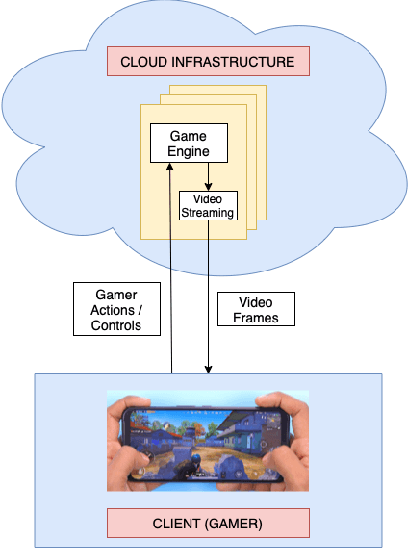
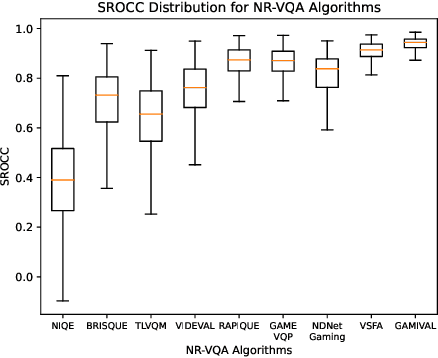
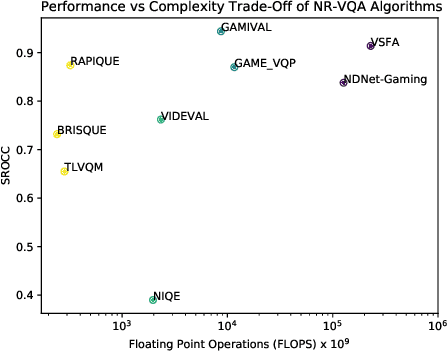
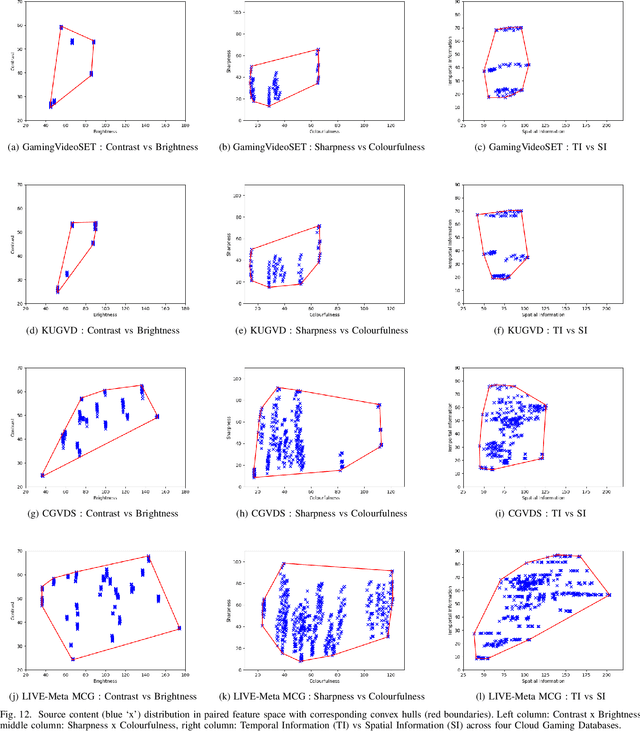
We present the outcomes of a recent large-scale subjective study of Mobile Cloud Gaming Video Quality Assessment (MCG-VQA) on a diverse set of gaming videos. Rapid advancements in cloud services, faster video encoding technologies, and increased access to high-speed, low-latency wireless internet have all contributed to the exponential growth of the Mobile Cloud Gaming industry. Consequently, the development of methods to assess the quality of real-time video feeds to end-users of cloud gaming platforms has become increasingly important. However, due to the lack of a large-scale public Mobile Cloud Gaming Video dataset containing a diverse set of distorted videos with corresponding subjective scores, there has been limited work on the development of MCG-VQA models. Towards accelerating progress towards these goals, we created a new dataset, named the LIVE-Meta Mobile Cloud Gaming (LIVE-Meta-MCG) video quality database, composed of 600 landscape and portrait gaming videos, on which we collected 14,400 subjective quality ratings from an in-lab subjective study. Additionally, to demonstrate the usefulness of the new resource, we benchmarked multiple state-of-the-art VQA algorithms on the database. The new database will be made publicly available on our website: \url{https://live.ece.utexas.edu/research/LIVE-Meta-Mobile-Cloud-Gaming/index.html}
SAMScore: A Semantic Structural Similarity Metric for Image Translation Evaluation
May 24, 2023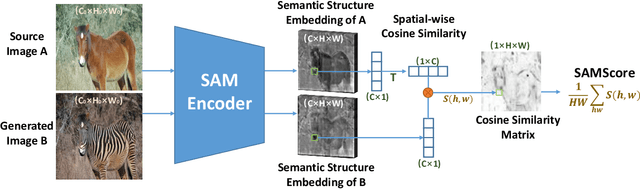

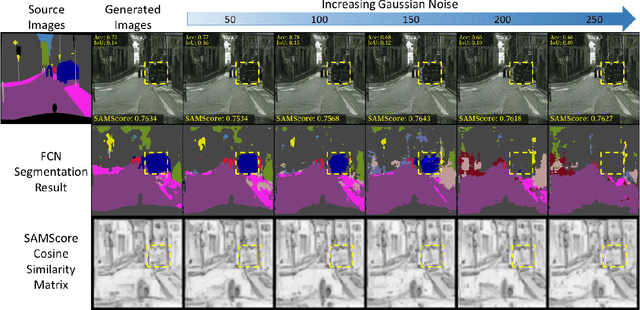
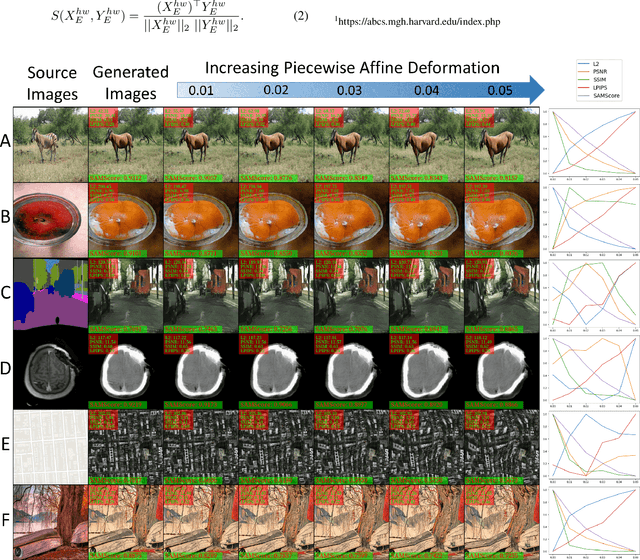
Image translation has wide applications, such as style transfer and modality conversion, usually aiming to generate images having both high degrees of realism and faithfulness. These problems remain difficult, especially when it is important to preserve semantic structures. Traditional image-level similarity metrics are of limited use, since the semantics of an image are high-level, and not strongly governed by pixel-wise faithfulness to an original image. Towards filling this gap, we introduce SAMScore, a generic semantic structural similarity metric for evaluating the faithfulness of image translation models. SAMScore is based on the recent high-performance Segment Anything Model (SAM), which can perform semantic similarity comparisons with standout accuracy. We applied SAMScore on 19 image translation tasks, and found that it is able to outperform all other competitive metrics on all of the tasks. We envision that SAMScore will prove to be a valuable tool that will help to drive the vibrant field of image translation, by allowing for more precise evaluations of new and evolving translation models. The code is available at https://github.com/Kent0n-Li/SAMScore.
Helping Visually Impaired People Take Better Quality Pictures
May 14, 2023Perception-based image analysis technologies can be used to help visually impaired people take better quality pictures by providing automated guidance, thereby empowering them to interact more confidently on social media. The photographs taken by visually impaired users often suffer from one or both of two kinds of quality issues: technical quality (distortions), and semantic quality, such as framing and aesthetic composition. Here we develop tools to help them minimize occurrences of common technical distortions, such as blur, poor exposure, and noise. We do not address the complementary problems of semantic quality, leaving that aspect for future work. The problem of assessing and providing actionable feedback on the technical quality of pictures captured by visually impaired users is hard enough, owing to the severe, commingled distortions that often occur. To advance progress on the problem of analyzing and measuring the technical quality of visually impaired user-generated content (VI-UGC), we built a very large and unique subjective image quality and distortion dataset. This new perceptual resource, which we call the LIVE-Meta VI-UGC Database, contains $40$K real-world distorted VI-UGC images and $40$K patches, on which we recorded $2.7$M human perceptual quality judgments and $2.7$M distortion labels. Using this psychometric resource we also created an automatic blind picture quality and distortion predictor that learns local-to-global spatial quality relationships, achieving state-of-the-art prediction performance on VI-UGC pictures, significantly outperforming existing picture quality models on this unique class of distorted picture data. We also created a prototype feedback system that helps to guide users to mitigate quality issues and take better quality pictures, by creating a multi-task learning framework.
GAMIVAL: Video Quality Prediction on Mobile Cloud Gaming Content
May 12, 2023The mobile cloud gaming industry has been rapidly growing over the last decade. When streaming gaming videos are transmitted to customers' client devices from cloud servers, algorithms that can monitor distorted video quality without having any reference video available are desirable tools. However, creating No-Reference Video Quality Assessment (NR VQA) models that can accurately predict the quality of streaming gaming videos rendered by computer graphics engines is a challenging problem, since gaming content generally differs statistically from naturalistic videos, often lacks detail, and contains many smooth regions. Until recently, the problem has been further complicated by the lack of adequate subjective quality databases of mobile gaming content. We have created a new gaming-specific NR VQA model called the Gaming Video Quality Evaluator (GAMIVAL), which combines and leverages the advantages of spatial and temporal gaming distorted scene statistics models, a neural noise model, and deep semantic features. Using a support vector regression (SVR) as a regressor, GAMIVAL achieves superior performance on the new LIVE-Meta Mobile Cloud Gaming (LIVE-Meta MCG) video quality database.
* Accepted to IEEE SPL 2023. The implementation of GAMIVAL has been made available online: https://github.com/lskdream/GAMIVAL
Making Video Quality Assessment Models Robust to Bit Depth
Apr 25, 2023We introduce a novel feature set, which we call HDRMAX features, that when included into Video Quality Assessment (VQA) algorithms designed for Standard Dynamic Range (SDR) videos, sensitizes them to distortions of High Dynamic Range (HDR) videos that are inadequately accounted for by these algorithms. While these features are not specific to HDR, and also augment the equality prediction performances of VQA models on SDR content, they are especially effective on HDR. HDRMAX features modify powerful priors drawn from Natural Video Statistics (NVS) models by enhancing their measurability where they visually impact the brightest and darkest local portions of videos, thereby capturing distortions that are often poorly accounted for by existing VQA models. As a demonstration of the efficacy of our approach, we show that, while current state-of-the-art VQA models perform poorly on 10-bit HDR databases, their performances are greatly improved by the inclusion of HDRMAX features when tested on HDR and 10-bit distorted videos.
HDR or SDR? A Subjective and Objective Study of Scaled and Compressed Videos
Apr 25, 2023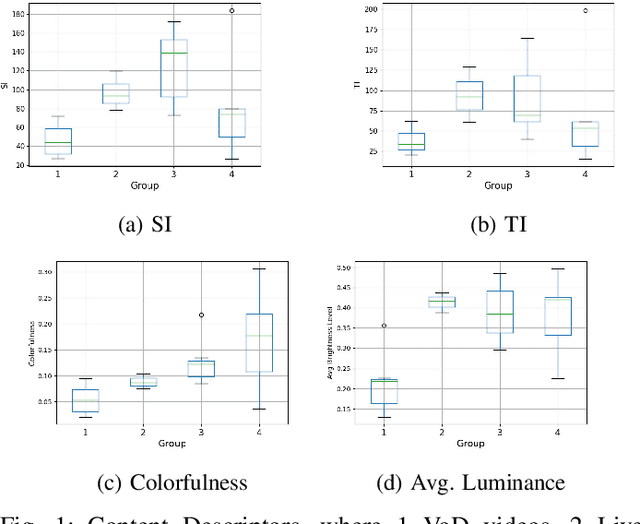

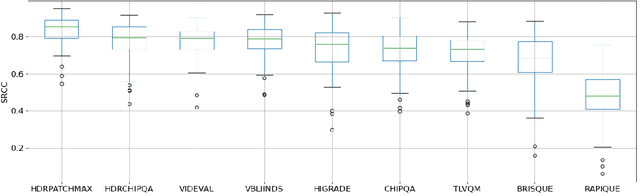

We conducted a large-scale study of human perceptual quality judgments of High Dynamic Range (HDR) and Standard Dynamic Range (SDR) videos subjected to scaling and compression levels and viewed on three different display devices. HDR videos are able to present wider color gamuts, better contrasts, and brighter whites and darker blacks than SDR videos. While conventional expectations are that HDR quality is better than SDR quality, we have found subject preference of HDR versus SDR depends heavily on the display device, as well as on resolution scaling and bitrate. To study this question, we collected more than 23,000 quality ratings from 67 volunteers who watched 356 videos on OLED, QLED, and LCD televisions. Since it is of interest to be able to measure the quality of videos under these scenarios, e.g. to inform decisions regarding scaling, compression, and SDR vs HDR, we tested several well-known full-reference and no-reference video quality models on the new database. Towards advancing progress on this problem, we also developed a novel no-reference model called HDRPatchMAX, that uses both classical and bit-depth sensitive distortion statistics more accurately than existing metrics.
HDR-ChipQA: No-Reference Quality Assessment on High Dynamic Range Videos
Apr 25, 2023We present a no-reference video quality model and algorithm that delivers standout performance for High Dynamic Range (HDR) videos, which we call HDR-ChipQA. HDR videos represent wider ranges of luminances, details, and colors than Standard Dynamic Range (SDR) videos. The growing adoption of HDR in massively scaled video networks has driven the need for video quality assessment (VQA) algorithms that better account for distortions on HDR content. In particular, standard VQA models may fail to capture conspicuous distortions at the extreme ends of the dynamic range, because the features that drive them may be dominated by distortions {that pervade the mid-ranges of the signal}. We introduce a new approach whereby a local expansive nonlinearity emphasizes distortions occurring at the higher and lower ends of the {local} luma range, allowing for the definition of additional quality-aware features that are computed along a separate path. These features are not HDR-specific, and also improve VQA on SDR video contents, albeit to a reduced degree. We show that this preprocessing step significantly boosts the power of distortion-sensitive natural video statistics (NVS) features when used to predict the quality of HDR content. In similar manner, we separately compute novel wide-gamut color features using the same nonlinear processing steps. We have found that our model significantly outperforms SDR VQA algorithms on the only publicly available, comprehensive HDR database, while also attaining state-of-the-art performance on SDR content.