 Add to Chrome
 Add to Firefox
 Add to Edge
Pixel Perfect: Relational Image Quality Assessment with Spatially-Aware Distortions
May 04, 2026
Traditional image quality assessment (IQA) methods rely on mean opinion scores (MOS), which are resource-intensive to collect and fail to provide interpretable, localized feedback on specific image distortions. We overcome these limitations by shifting from absolute quality prediction to a relational and directional assessment. Our approach utilizes a self-supervised synthetic distortion engine to generate training data, eliminating the need for manual annotation. A distortion prediction network is trained with an anti-symmetric objective to produce spatially-aware, disentangled maps that identify the type, intensity, and direction of distortions relative to a reference image. Subsequently, a scoring network is trained via contrastive learning on ordinally ranked image sets to predict a relational quality score. Our method provides a more granular and interpretable approach to IQA for the targeted optimization of image processing algorithms without requiring any human-labeled quality scores.

DRIFT: Deep Restoration, ISP Fusion, and Tone-mapping
Apr 03, 2026Smartphone cameras have gained immense popularity with the adoption of high-resolution and high-dynamic range imaging. As a result, high-performance camera Image Signal Processors (ISPs) are crucial in generating high-quality images for the end user while keeping computational costs low. In this paper, we propose DRIFT (Deep Restoration, ISP Fusion, and Tone-mapping): an efficient AI mobile camera pipeline that generates high quality RGB images from hand-held raw captures. The first stage of DRIFT is a Multi-Frame Processing (MFP) network that is trained using a adversarial perceptual loss to perform multi-frame alignment, denoising, demosaicing, and super-resolution. Then, the output of DRIFT-MFP is processed by a novel deep-learning based tone-mapping (DRIFT-TM) solution that allows for tone tunability, ensures tone-consistency with a reference pipeline, and can be run efficiently for high-resolution images on a mobile device. We show qualitative and quantitative comparisons against state-of-the-art MFP and tone-mapping methods to demonstrate the effectiveness of our approach.
GenMFSR: Generative Multi-Frame Image Restoration and Super-Resolution
Mar 19, 2026Camera pipelines receive raw Bayer-format frames that need to be denoised, demosaiced, and often super-resolved. Multiple frames are captured to utilize natural hand tremors and enhance resolution. Multi-frame super-resolution is therefore a fundamental problem in camera pipelines. Existing adversarial methods are constrained by the quality of ground truth. We propose GenMFSR, the first Generative Multi-Frame Raw-to-RGB Super Resolution pipeline, that incorporates image priors from foundation models to obtain sub-pixel information for camera ISP applications. GenMFSR can align multiple raw frames, unlike existing single-frame super-resolution methods, and we propose a loss term that restricts generation to high-frequency regions in the raw domain, thus preventing low-frequency artifacts.
Cut-FUNQUE: An Objective Quality Model for Compressed Tone-Mapped High Dynamic Range Videos
Apr 20, 2024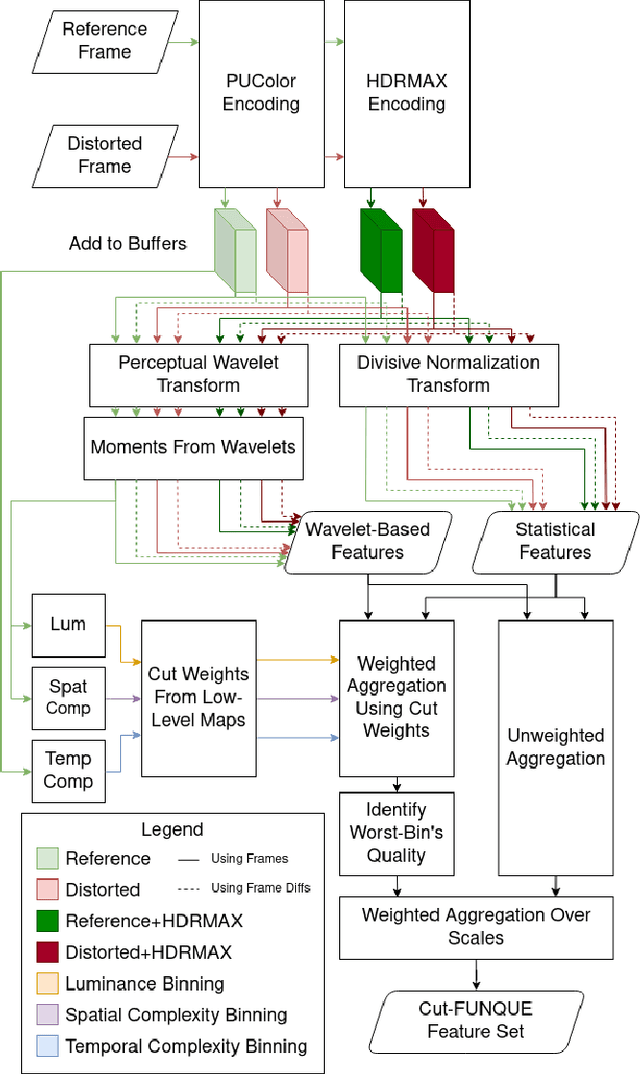
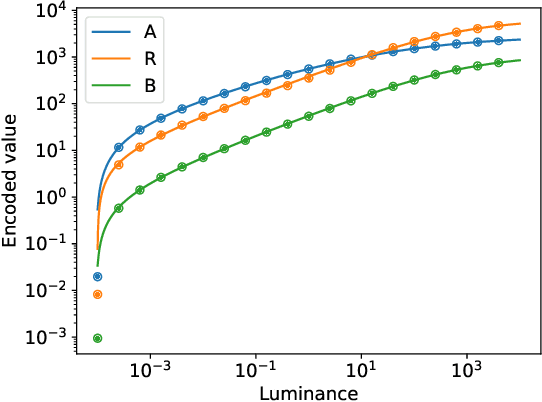
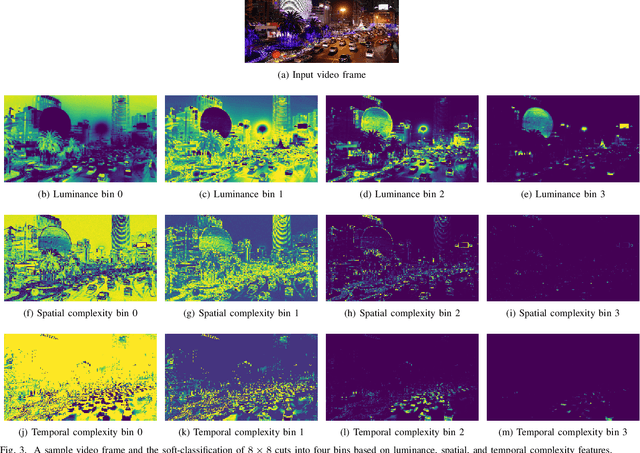
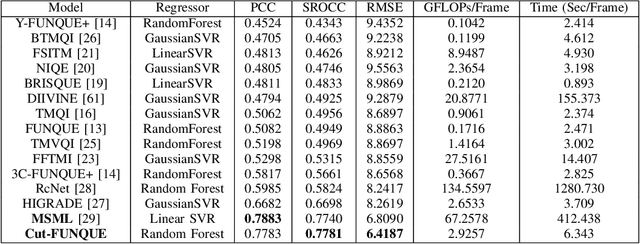
High Dynamic Range (HDR) videos have enjoyed a surge in popularity in recent years due to their ability to represent a wider range of contrast and color than Standard Dynamic Range (SDR) videos. Although HDR video capture has seen increasing popularity because of recent flagship mobile phones such as Apple iPhones, Google Pixels, and Samsung Galaxy phones, a broad swath of consumers still utilize legacy SDR displays that are unable to display HDR videos. As result, HDR videos must be processed, i.e., tone-mapped, before streaming to a large section of SDR-capable video consumers. However, server-side tone-mapping involves automating decisions regarding the choices of tone-mapping operators (TMOs) and their parameters to yield high-fidelity outputs. Moreover, these choices must be balanced against the effects of lossy compression, which is ubiquitous in streaming scenarios. In this work, we develop a novel, efficient model of objective video quality named Cut-FUNQUE that is able to accurately predict the visual quality of tone-mapped and compressed HDR videos. Finally, we evaluate Cut-FUNQUE on a large-scale crowdsourced database of such videos and show that it achieves state-of-the-art accuracy.
Joint Quality Assessment and Example-Guided Image Processing by Disentangling Picture Appearance from Content
Apr 20, 2024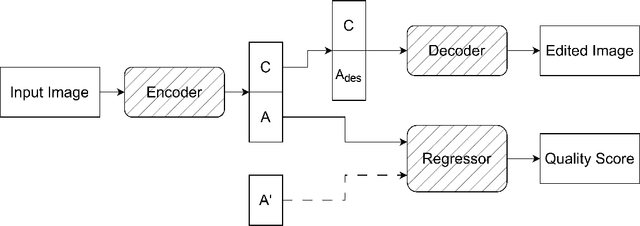
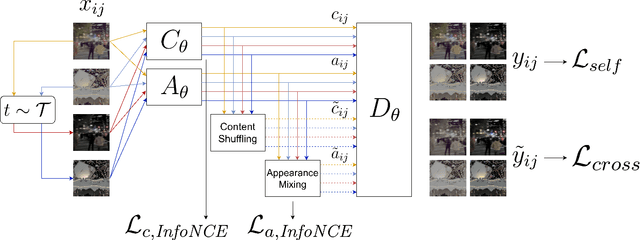

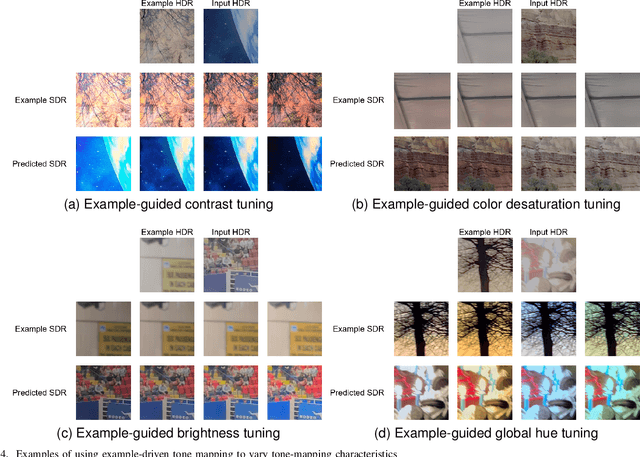
The deep learning revolution has strongly impacted low-level image processing tasks such as style/domain transfer, enhancement/restoration, and visual quality assessments. Despite often being treated separately, the aforementioned tasks share a common theme of understanding, editing, or enhancing the appearance of input images without modifying the underlying content. We leverage this observation to develop a novel disentangled representation learning method that decomposes inputs into content and appearance features. The model is trained in a self-supervised manner and we use the learned features to develop a new quality prediction model named DisQUE. We demonstrate through extensive evaluations that DisQUE achieves state-of-the-art accuracy across quality prediction tasks and distortion types. Moreover, we demonstrate that the same features may also be used for image processing tasks such as HDR tone mapping, where the desired output characteristics may be tuned using example input-output pairs.
Subjective Quality Assessment of Compressed Tone-Mapped High Dynamic Range Videos
Mar 22, 2024
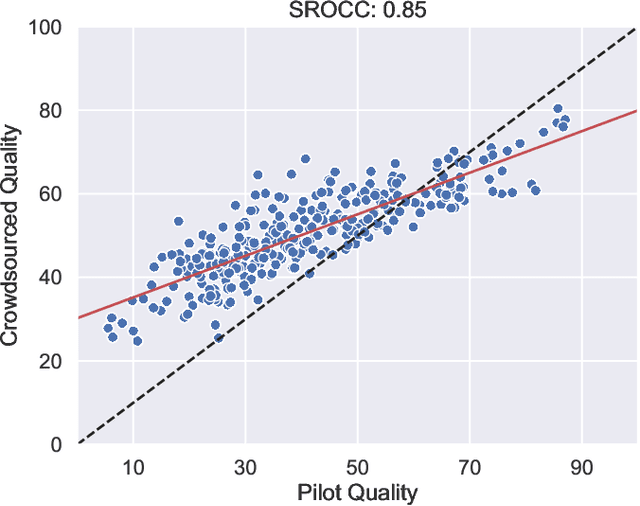
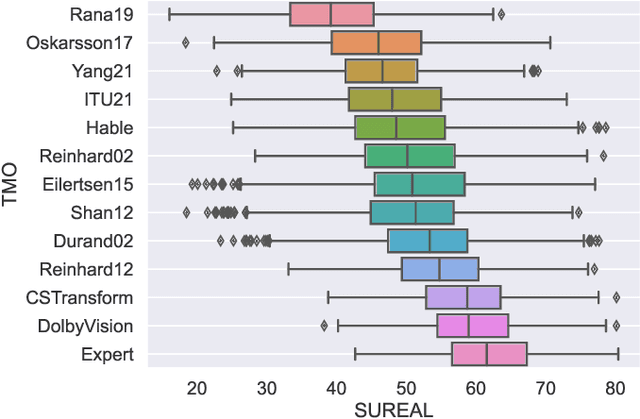
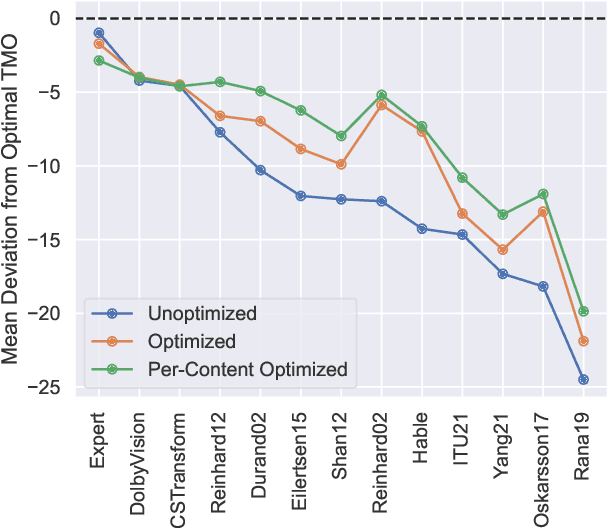
High Dynamic Range (HDR) videos are able to represent wider ranges of contrasts and colors than Standard Dynamic Range (SDR) videos, giving more vivid experiences. Due to this, HDR videos are expected to grow into the dominant video modality of the future. However, HDR videos are incompatible with existing SDR displays, which form the majority of affordable consumer displays on the market. Because of this, HDR videos must be processed by tone-mapping them to reduced bit-depths to service a broad swath of SDR-limited video consumers. Here, we analyze the impact of tone-mapping operators on the visual quality of streaming HDR videos. To this end, we built the first large-scale subjectively annotated open-source database of compressed tone-mapped HDR videos, containing 15,000 tone-mapped sequences derived from 40 unique HDR source contents. The videos in the database were labeled with more than 750,000 subjective quality annotations, collected from more than 1,600 unique human observers. We demonstrate the usefulness of the new subjective database by benchmarking objective models of visual quality on it. We envision that the new LIVE Tone-Mapped HDR (LIVE-TMHDR) database will enable significant progress on HDR video tone mapping and quality assessment in the future. To this end, we make the database freely available to the community at https://live.ece.utexas.edu/research/LIVE_TMHDR/index.html
A FUNQUE Approach to the Quality Assessment of Compressed HDR Videos
Dec 13, 2023

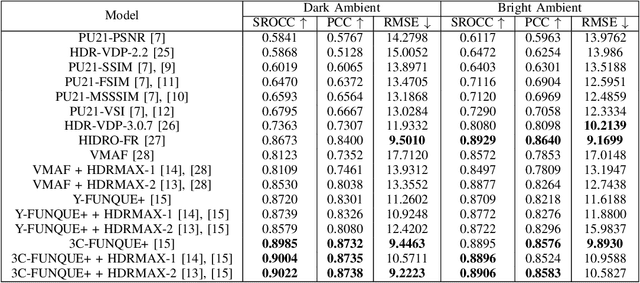
Recent years have seen steady growth in the popularity and availability of High Dynamic Range (HDR) content, particularly videos, streamed over the internet. As a result, assessing the subjective quality of HDR videos, which are generally subjected to compression, is of increasing importance. In particular, we target the task of full-reference quality assessment of compressed HDR videos. The state-of-the-art (SOTA) approach HDRMAX involves augmenting off-the-shelf video quality models, such as VMAF, with features computed on non-linearly transformed video frames. However, HDRMAX increases the computational complexity of models like VMAF. Here, we show that an efficient class of video quality prediction models named FUNQUE+ achieves SOTA accuracy. This shows that the FUNQUE+ models are flexible alternatives to VMAF that achieve higher HDR video quality prediction accuracy at lower computational cost.
Joint Deep Image Restoration and Unsupervised Quality Assessment
Nov 27, 2023Deep learning techniques have revolutionized the fields of image restoration and image quality assessment in recent years. While image restoration methods typically utilize synthetically distorted training data for training, deep quality assessment models often require expensive labeled subjective data. However, recent studies have shown that activations of deep neural networks trained for visual modeling tasks can also be used for perceptual quality assessment of images. Following this intuition, we propose a novel attention-based convolutional neural network capable of simultaneously performing both image restoration and quality assessment. We achieve this by training a JPEG deblocking network augmented with "quality attention" maps and demonstrating state-of-the-art deblocking accuracy, achieving a high correlation of predicted quality with human opinion scores.
Quality Modeling Under A Relaxed Natural Scene Statistics Model
Nov 26, 2023Information-theoretic image quality assessment (IQA) models such as Visual Information Fidelity (VIF) and Spatio-temporal Reduced Reference Entropic Differences (ST-RRED) have enjoyed great success by seamlessly integrating natural scene statistics (NSS) with information theory. The Gaussian Scale Mixture (GSM) model that governs the wavelet subband coefficients of natural images forms the foundation for these algorithms. However, the explosion of user-generated content on social media, which is typically distorted by one or more of many possible unknown impairments, has revealed the limitations of NSS-based IQA models that rely on the simple GSM model. Here, we seek to elaborate the VIF index by deriving useful properties of the Multivariate Generalized Gaussian Distribution (MGGD), and using them to study the behavior of VIF under a Generalized GSM (GGSM) model.
Edge-Aware Image Color Appearance and Difference Modeling
Apr 20, 2023The perception of color is one of the most important aspects of human vision. From an evolutionary perspective, the accurate perception of color is crucial to distinguishing friend from foe, and food from fatal poison. As a result, humans have developed a keen sense of color and are able to detect subtle differences in appearance, while also robustly identifying colors across illumination and viewing conditions. In this paper, we shall briefly review methods for adapting traditional color appearance and difference models to complex image stimuli, and propose mechanisms to improve their performance. In particular, we find that applying contrast sensitivity functions and local adaptation rules in an edge-aware manner improves image difference predictions.