 Add to Chrome
 Add to Firefox
 Add to Edge
Multi-View Face and Gesture Animation with Dynamic Gaussians
Aug 05, 2026
Creating photorealistic 3D human avatars with realistic upper-body motion remains challenging. Existing approaches either focus on the head and overlook hand gestures, or reconstruct the full body but fail to preserve fine-grained facial fidelity and hand pose accuracy. As a result, current methods struggle to capture the subtle dynamics of facial expressions and hand gestures that are crucial for natural human communication. While methods based on full-body parametric models enable avatar reconstruction from monocular or multi-view inputs, they often lack accurate facial animation and detailed hand articulation. To address these limitations, we propose MVFGA, a novel multi-view-consistent pipeline for generating realistic upper-body avatars. Our approach models the face and hands separately and fuses them with a parametric upper-body mesh model, enabling the capture of fine-grained facial expressions and hand poses for accurate upper-body avatar reconstruction. We then splat 3D Gaussians onto the obtained mesh, enabling high-quality rendering of dynamic avatars from novel viewpoints. Furthermore, we introduce MVFGA-MoCap, a multi-view upper-body motion capture dataset featuring controlled facial expression sequences, diverse hand gestures, and free-form communication. Experiments show that MVFGA generates visually realistic avatars with high-fidelity facial expressions and hand motions, outperforming baselines for upper-body avatar animation. Project page: https://dfki-av.github.io/MVFGA/
* Accepted at SCA 2026

EgoForce: Forearm-Guided Camera-Space 3D Hand Pose from a Monocular Egocentric Camera
May 12, 2026Reconstructing the absolute 3D pose and shape of the hands from the user's viewpoint using a single head-mounted camera is crucial for practical egocentric interaction in AR/VR, telepresence, and hand-centric manipulation tasks, where sensing must remain compact and unobtrusive. While monocular RGB methods have made progress, they remain constrained by depth-scale ambiguity and struggle to generalize across the diverse optical configurations of head-mounted devices. As a result, models typically require extensive training on device-specific datasets, which are costly and laborious to acquire. This paper addresses these challenges by introducing EgoForce, a monocular 3D hand reconstruction framework that recovers robust, absolute 3D hand pose and its position from the user's (camera-space) viewpoint. EgoForce operates across fisheye, perspective, and distorted wide-FOV camera models using a single unified network. Our approach combines a differentiable forearm representation that stabilizes hand pose, a unified arm-hand transformer that predicts both hand and forearm geometry from a single egocentric view, mitigating depth-scale ambiguity, and a ray space closed-form solver that enables absolute 3D pose recovery across diverse head-mounted camera models. Experiments on three egocentric benchmarks show that EgoForce achieves state-of-the-art 3D accuracy, reducing camera-space MPJPE by up to 28% on the HOT3D dataset compared to prior methods and maintaining consistent performance across camera configurations. For more details, visit the project page at https://dfki-av.github.io/EgoForce.
ReLaGS: Relational Language Gaussian Splatting
Mar 18, 2026Achieving unified 3D perception and reasoning across tasks such as segmentation, retrieval, and relation understanding remains challenging, as existing methods are either object-centric or rely on costly training for inter-object reasoning. We present a novel framework that constructs a hierarchical language-distilled Gaussian scene and its 3D semantic scene graph without scene-specific training. A Gaussian pruning mechanism refines scene geometry, while a robust multi-view language alignment strategy aggregates noisy 2D features into accurate 3D object embeddings. On top of this hierarchy, we build an open-vocabulary 3D scene graph with Vision Language derived annotations and Graph Neural Network-based relational reasoning. Our approach enables efficient and scalable open-vocabulary 3D reasoning by jointly modeling hierarchical semantics and inter/intra-object relationships, validated across tasks including open-vocabulary segmentation, scene graph generation, and relation-guided retrieval. Project page: https://dfki-av.github.io/ReLaGS/
Probing the Reliability of Driving VLMs: From Inconsistent Responses to Grounded Temporal Reasoning
Mar 10, 2026A reliable driving assistant should provide consistent responses based on temporally grounded reasoning derived from observed information. In this work, we investigate whether Vision-Language Models (VLMs), when applied as driving assistants, can response consistantly and understand how present observations shape future outcomes, or whether their outputs merely reflect patterns memorized during training without temporally grounded reasoning. While recent efforts have integrated VLMs into autonomous driving, prior studies typically emphasize scene understanding and instruction generation, implicitly assuming that strong visual interpretation naturally enables consistant future reasoning and thus ensures reliable decision-making, a claim we critically examine. We focus on two major challenges limiting VLM reliability in this setting: response inconsistency, where minor input perturbations yield different answers or, in some cases, responses degenerate toward near-random guessing, and limited temporal reasoning, in which models fail to reason and align sequential events from current observations, often resulting in incorrect or even contradictory responses. Moreover, we find that models with strong visual understanding do not necessarily perform best on tasks requiring temporal reasoning, indicating a tendency to over-rely on pretrained patterns rather than modeling temporal dynamics. To address these issues, we adopt existing evaluation methods and introduce FutureVQA, a human-annotated benchmark dataset specifically designed to assess future scene reasoning. In addition, we propose a simple yet effective self-supervised tuning approach with chain-of-thought reasoning that improves both consistency and temporal reasoning without requiring temporal labels.
TinyIceNet: Low-Power SAR Sea Ice Segmentation for On-Board FPGA Inference
Mar 03, 2026Accurate sea ice mapping is essential for safe maritime navigation in polar regions, where rapidly changing ice conditions require timely and reliable information. While Sentinel-1 Synthetic Aperture Radar (SAR) provides high-resolution, all-weather observations of sea ice, conventional ground-based processing is limited by downlink bandwidth, latency, and energy costs associated with transmitting large volumes of raw data. On-board processing, enabled by dedicated inference chips integrated directly within the satellite payload, offers a transformative alternative by generating actionable sea ice products in orbit. In this context, we present TinyIceNet, a compact semantic segmentation network co-designed for on-board Stage of Development (SOD) mapping from dual-polarized Sentinel-1 SAR imagery under strict hardware and power constraints. Trained on the AI4Arctic dataset, TinyIceNet combines SAR-aware architectural simplifications with low-precision quantization to balance accuracy and efficiency. The model is synthesized using High-Level Synthesis and deployed on a Xilinx Zynq UltraScale+ FPGA platform, demonstrating near-real-time inference with significantly reduced energy consumption. Experimental results show that TinyIceNet achieves 75.216% F1 score on SOD segmentation while reducing energy consumption by 2x compared to full-precision GPU baselines, underscoring the potential of chip-level hardware-algorithm co-design for future spaceborne and edge AI systems.
Inpaint360GS: Efficient Object-Aware 3D Inpainting via Gaussian Splatting for 360° Scenes
Nov 09, 2025Despite recent advances in single-object front-facing inpainting using NeRF and 3D Gaussian Splatting (3DGS), inpainting in complex 360° scenes remains largely underexplored. This is primarily due to three key challenges: (i) identifying target objects in the 3D field of 360° environments, (ii) dealing with severe occlusions in multi-object scenes, which makes it hard to define regions to inpaint, and (iii) maintaining consistent and high-quality appearance across views effectively. To tackle these challenges, we propose Inpaint360GS, a flexible 360° editing framework based on 3DGS that supports multi-object removal and high-fidelity inpainting in 3D space. By distilling 2D segmentation into 3D and leveraging virtual camera views for contextual guidance, our method enables accurate object-level editing and consistent scene completion. We further introduce a new dataset tailored for 360° inpainting, addressing the lack of ground truth object-free scenes. Experiments demonstrate that Inpaint360GS outperforms existing baselines and achieves state-of-the-art performance. Project page: https://dfki-av.github.io/inpaint360gs/
EventEgo3D++: 3D Human Motion Capture from a Head-Mounted Event Camera
Feb 11, 2025Monocular egocentric 3D human motion capture remains a significant challenge, particularly under conditions of low lighting and fast movements, which are common in head-mounted device applications. Existing methods that rely on RGB cameras often fail under these conditions. To address these limitations, we introduce EventEgo3D++, the first approach that leverages a monocular event camera with a fisheye lens for 3D human motion capture. Event cameras excel in high-speed scenarios and varying illumination due to their high temporal resolution, providing reliable cues for accurate 3D human motion capture. EventEgo3D++ leverages the LNES representation of event streams to enable precise 3D reconstructions. We have also developed a mobile head-mounted device (HMD) prototype equipped with an event camera, capturing a comprehensive dataset that includes real event observations from both controlled studio environments and in-the-wild settings, in addition to a synthetic dataset. Additionally, to provide a more holistic dataset, we include allocentric RGB streams that offer different perspectives of the HMD wearer, along with their corresponding SMPL body model. Our experiments demonstrate that EventEgo3D++ achieves superior 3D accuracy and robustness compared to existing solutions, even in challenging conditions. Moreover, our method supports real-time 3D pose updates at a rate of 140Hz. This work is an extension of the EventEgo3D approach (CVPR 2024) and further advances the state of the art in egocentric 3D human motion capture. For more details, visit the project page at https://eventego3d.mpi-inf.mpg.de.
3D Spatial Understanding in MLLMs: Disambiguation and Evaluation
Dec 09, 2024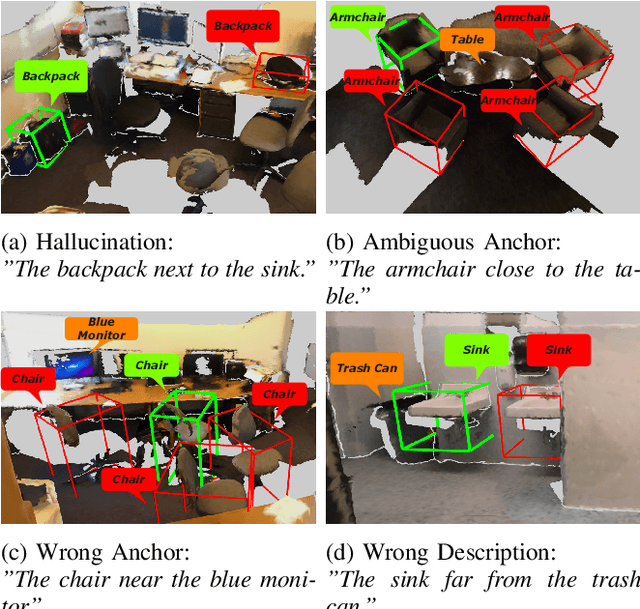
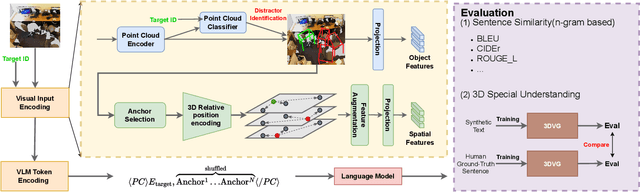
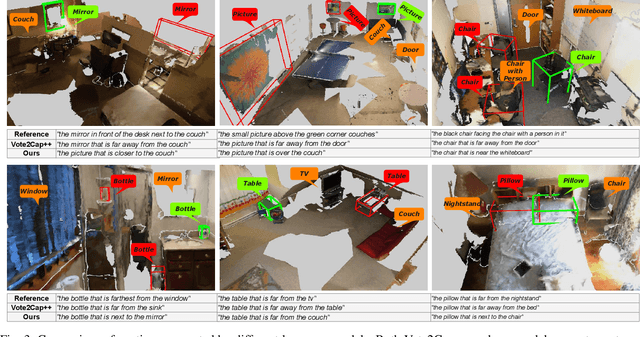

Multimodal Large Language Models (MLLMs) have made significant progress in tasks such as image captioning and question answering. However, while these models can generate realistic captions, they often struggle with providing precise instructions, particularly when it comes to localizing and disambiguating objects in complex 3D environments. This capability is critical as MLLMs become more integrated with collaborative robotic systems. In scenarios where a target object is surrounded by similar objects (distractors), robots must deliver clear, spatially-aware instructions to guide humans effectively. We refer to this challenge as contextual object localization and disambiguation, which imposes stricter constraints than conventional 3D dense captioning, especially regarding ensuring target exclusivity. In response, we propose simple yet effective techniques to enhance the model's ability to localize and disambiguate target objects. Our approach not only achieves state-of-the-art performance on conventional metrics that evaluate sentence similarity, but also demonstrates improved 3D spatial understanding through 3D visual grounding model.
Uni-SLAM: Uncertainty-Aware Neural Implicit SLAM for Real-Time Dense Indoor Scene Reconstruction
Nov 29, 2024
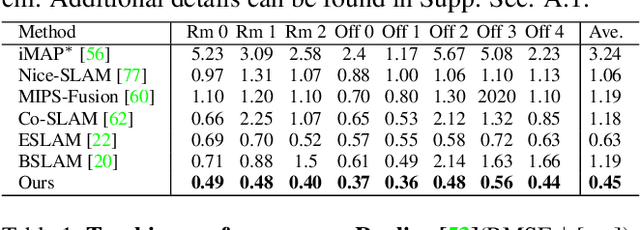

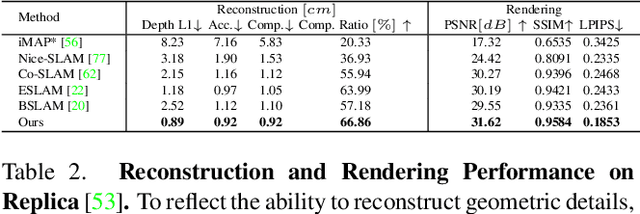
Neural implicit fields have recently emerged as a powerful representation method for multi-view surface reconstruction due to their simplicity and state-of-the-art performance. However, reconstructing thin structures of indoor scenes while ensuring real-time performance remains a challenge for dense visual SLAM systems. Previous methods do not consider varying quality of input RGB-D data and employ fixed-frequency mapping process to reconstruct the scene, which could result in the loss of valuable information in some frames. In this paper, we propose Uni-SLAM, a decoupled 3D spatial representation based on hash grids for indoor reconstruction. We introduce a novel defined predictive uncertainty to reweight the loss function, along with strategic local-to-global bundle adjustment. Experiments on synthetic and real-world datasets demonstrate that our system achieves state-of-the-art tracking and mapping accuracy while maintaining real-time performance. It significantly improves over current methods with a 25% reduction in depth L1 error and a 66.86% completion rate within 1 cm on the Replica dataset, reflecting a more accurate reconstruction of thin structures. Project page: https://shaoxiang777.github.io/project/uni-slam/
G3FA: Geometry-guided GAN for Face Animation
Aug 23, 2024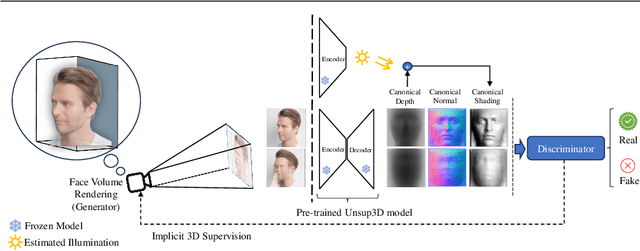
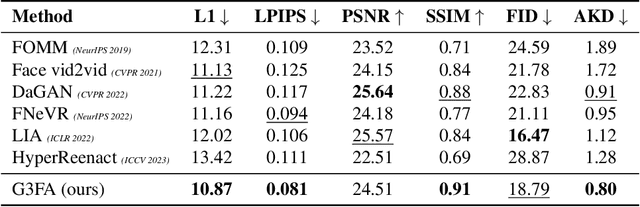
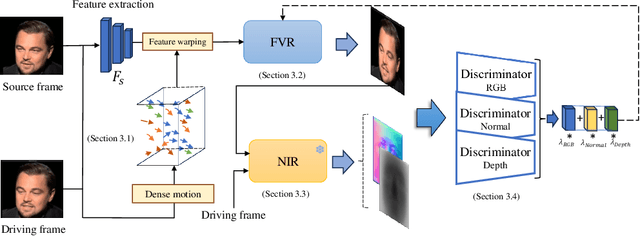
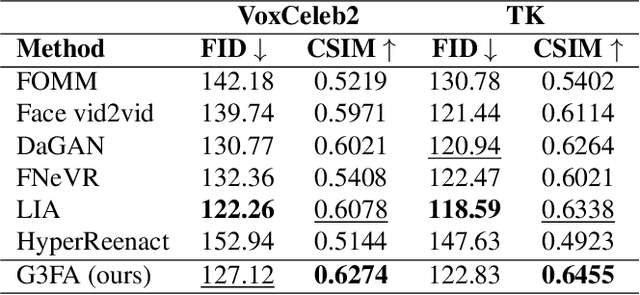
Animating human face images aims to synthesize a desired source identity in a natural-looking way mimicking a driving video's facial movements. In this context, Generative Adversarial Networks have demonstrated remarkable potential in real-time face reenactment using a single source image, yet are constrained by limited geometry consistency compared to graphic-based approaches. In this paper, we introduce Geometry-guided GAN for Face Animation (G3FA) to tackle this limitation. Our novel approach empowers the face animation model to incorporate 3D information using only 2D images, improving the image generation capabilities of the talking head synthesis model. We integrate inverse rendering techniques to extract 3D facial geometry properties, improving the feedback loop to the generator through a weighted average ensemble of discriminators. In our face reenactment model, we leverage 2D motion warping to capture motion dynamics along with orthogonal ray sampling and volume rendering techniques to produce the ultimate visual output. To evaluate the performance of our G3FA, we conducted comprehensive experiments using various evaluation protocols on VoxCeleb2 and TalkingHead benchmarks to demonstrate the effectiveness of our proposed framework compared to the state-of-the-art real-time face animation methods.