 Add to Chrome
 Add to Firefox
 Add to Edge
STEAM: Stable Self-Training with Elastic Matching and Adaptive Purification
Jul 10, 2026
Cross-view geo-localization (CVGL) aims to achieve GPS-free localization by matching drone-view images with corresponding satellite-view images. Existing supervised methods rely on large-scale manually annotated cross-view image pairs, making them costly and difficult to scale. In contrast, existing unsupervised approaches typically depend on generative models or clustering-based stage-wise optimization, which are prone to distribution bias and the accumulation of noisy pseudo-labels. To address these limitations, we propose STEAM (Stable Self-Training with Elastic Matching and Adaptive Purification), an end-to-end unsupervised cross-view geo-localization framework that performs self-training directly on real drone and satellite images. Specifically, the proposed Stable Spatial-Aware Module enhances the stability of feature representations, Elastic Matching discovers high-quality cross-view pseudo-labels, and Adaptive Purification dynamically maintains a reliable pseudo-label repository throughout the self-training process. Extensive experiments on the University-1652 and SUES-200 benchmarks demonstrate that STEAM achieves state-of-the-art performance among all existing unsupervised methods and delivers performance comparable to supervised approaches, validating the effectiveness and superiority of the proposed framework. The source code is available at https://github.com/wsx-heu/STEAM.git.

EgoForce: Forearm-Guided Camera-Space 3D Hand Pose from a Monocular Egocentric Camera
May 12, 2026Reconstructing the absolute 3D pose and shape of the hands from the user's viewpoint using a single head-mounted camera is crucial for practical egocentric interaction in AR/VR, telepresence, and hand-centric manipulation tasks, where sensing must remain compact and unobtrusive. While monocular RGB methods have made progress, they remain constrained by depth-scale ambiguity and struggle to generalize across the diverse optical configurations of head-mounted devices. As a result, models typically require extensive training on device-specific datasets, which are costly and laborious to acquire. This paper addresses these challenges by introducing EgoForce, a monocular 3D hand reconstruction framework that recovers robust, absolute 3D hand pose and its position from the user's (camera-space) viewpoint. EgoForce operates across fisheye, perspective, and distorted wide-FOV camera models using a single unified network. Our approach combines a differentiable forearm representation that stabilizes hand pose, a unified arm-hand transformer that predicts both hand and forearm geometry from a single egocentric view, mitigating depth-scale ambiguity, and a ray space closed-form solver that enables absolute 3D pose recovery across diverse head-mounted camera models. Experiments on three egocentric benchmarks show that EgoForce achieves state-of-the-art 3D accuracy, reducing camera-space MPJPE by up to 28% on the HOT3D dataset compared to prior methods and maintaining consistent performance across camera configurations. For more details, visit the project page at https://dfki-av.github.io/EgoForce.
ReLaGS: Relational Language Gaussian Splatting
Mar 18, 2026Achieving unified 3D perception and reasoning across tasks such as segmentation, retrieval, and relation understanding remains challenging, as existing methods are either object-centric or rely on costly training for inter-object reasoning. We present a novel framework that constructs a hierarchical language-distilled Gaussian scene and its 3D semantic scene graph without scene-specific training. A Gaussian pruning mechanism refines scene geometry, while a robust multi-view language alignment strategy aggregates noisy 2D features into accurate 3D object embeddings. On top of this hierarchy, we build an open-vocabulary 3D scene graph with Vision Language derived annotations and Graph Neural Network-based relational reasoning. Our approach enables efficient and scalable open-vocabulary 3D reasoning by jointly modeling hierarchical semantics and inter/intra-object relationships, validated across tasks including open-vocabulary segmentation, scene graph generation, and relation-guided retrieval. Project page: https://dfki-av.github.io/ReLaGS/
Inpaint360GS: Efficient Object-Aware 3D Inpainting via Gaussian Splatting for 360° Scenes
Nov 09, 2025Despite recent advances in single-object front-facing inpainting using NeRF and 3D Gaussian Splatting (3DGS), inpainting in complex 360° scenes remains largely underexplored. This is primarily due to three key challenges: (i) identifying target objects in the 3D field of 360° environments, (ii) dealing with severe occlusions in multi-object scenes, which makes it hard to define regions to inpaint, and (iii) maintaining consistent and high-quality appearance across views effectively. To tackle these challenges, we propose Inpaint360GS, a flexible 360° editing framework based on 3DGS that supports multi-object removal and high-fidelity inpainting in 3D space. By distilling 2D segmentation into 3D and leveraging virtual camera views for contextual guidance, our method enables accurate object-level editing and consistent scene completion. We further introduce a new dataset tailored for 360° inpainting, addressing the lack of ground truth object-free scenes. Experiments demonstrate that Inpaint360GS outperforms existing baselines and achieves state-of-the-art performance. Project page: https://dfki-av.github.io/inpaint360gs/
Uni-SLAM: Uncertainty-Aware Neural Implicit SLAM for Real-Time Dense Indoor Scene Reconstruction
Nov 29, 2024
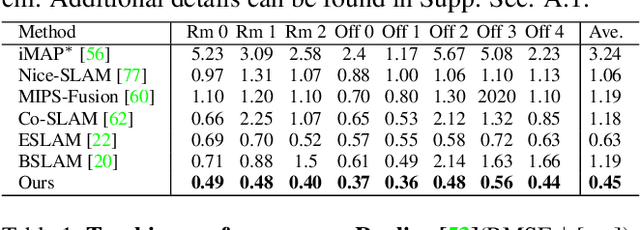

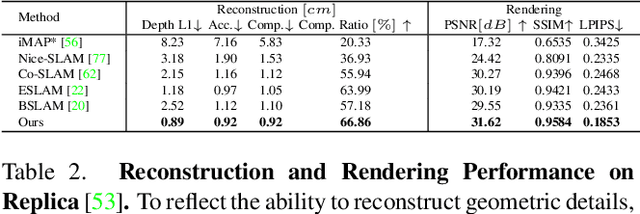
Neural implicit fields have recently emerged as a powerful representation method for multi-view surface reconstruction due to their simplicity and state-of-the-art performance. However, reconstructing thin structures of indoor scenes while ensuring real-time performance remains a challenge for dense visual SLAM systems. Previous methods do not consider varying quality of input RGB-D data and employ fixed-frequency mapping process to reconstruct the scene, which could result in the loss of valuable information in some frames. In this paper, we propose Uni-SLAM, a decoupled 3D spatial representation based on hash grids for indoor reconstruction. We introduce a novel defined predictive uncertainty to reweight the loss function, along with strategic local-to-global bundle adjustment. Experiments on synthetic and real-world datasets demonstrate that our system achieves state-of-the-art tracking and mapping accuracy while maintaining real-time performance. It significantly improves over current methods with a 25% reduction in depth L1 error and a 66.86% completion rate within 1 cm on the Replica dataset, reflecting a more accurate reconstruction of thin structures. Project page: https://shaoxiang777.github.io/project/uni-slam/
MiKASA: Multi-Key-Anchor & Scene-Aware Transformer for 3D Visual Grounding
Mar 11, 20243D visual grounding involves matching natural language descriptions with their corresponding objects in 3D spaces. Existing methods often face challenges with accuracy in object recognition and struggle in interpreting complex linguistic queries, particularly with descriptions that involve multiple anchors or are view-dependent. In response, we present the MiKASA (Multi-Key-Anchor Scene-Aware) Transformer. Our novel end-to-end trained model integrates a self-attention-based scene-aware object encoder and an original multi-key-anchor technique, enhancing object recognition accuracy and the understanding of spatial relationships. Furthermore, MiKASA improves the explainability of decision-making, facilitating error diagnosis. Our model achieves the highest overall accuracy in the Referit3D challenge for both the Sr3D and Nr3D datasets, particularly excelling by a large margin in categories that require viewpoint-dependent descriptions. The source code and additional resources for this project are available on GitHub: https://github.com/birdy666/MiKASA-3DVG