 Add to Chrome
 Add to Firefox
 Add to Edge
T3D: Few-Step Diffusion Language Models via Trajectory Self-Distillation with Direct Discriminative Optimization
Feb 13, 2026
Diffusion large language models (DLLMs) have the potential to enable fast text generation by decoding multiple tokens in parallel. However, in practice, their inference efficiency is constrained by the need for many refinement steps, while aggressively reducing the number of steps leads to a substantial degradation in generation quality. To alleviate this, we propose a trajectory self-distillation framework that improves few-step decoding by distilling the model's own generative trajectories. We incorporate Direct Discriminative Optimization (DDO), a reverse-KL objective that promotes mode-seeking distillation and encourages the student to concentrate on high-probability teacher modes. Across benchmarks, our approach consistently outperforms strong few-step baselines and standard training under tight step budgets. Although full-step decoding remains superior, we substantially narrow the gap, establishing a strong foundation towards practical few-step DLLMs. The source code is available at https://github.com/Tyrion58/T3D.

DeepMIDE: A Multivariate Spatio-Temporal Method for Ultra-Scale Offshore Wind Energy Forecasting
Oct 26, 2024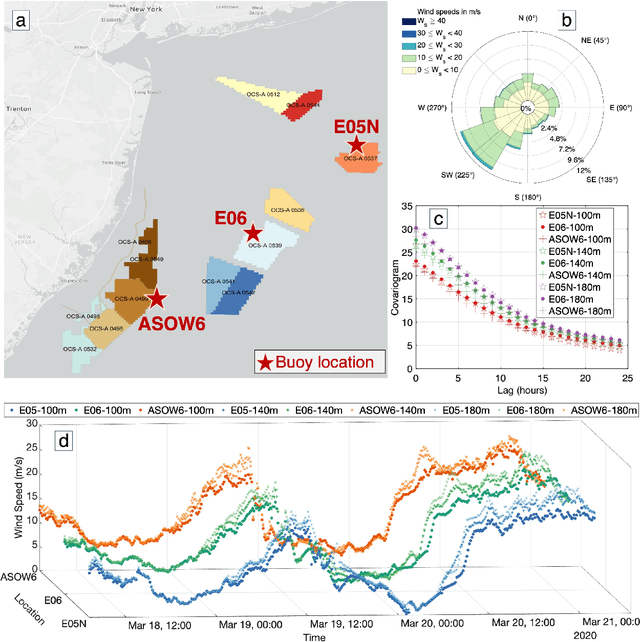
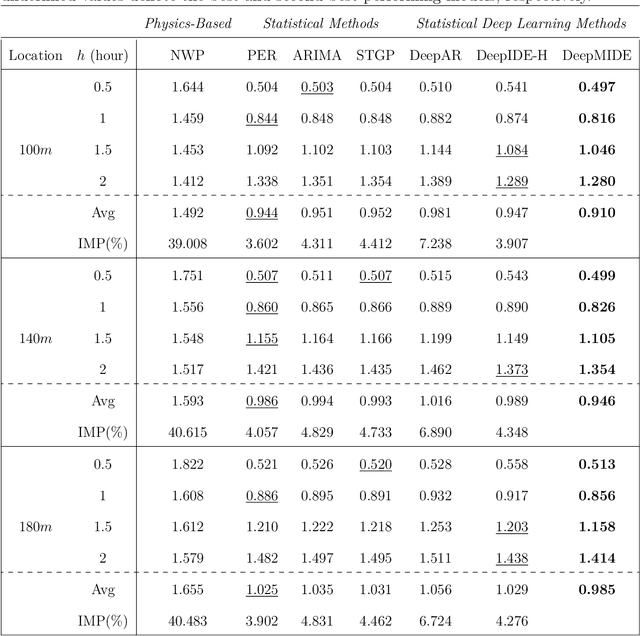
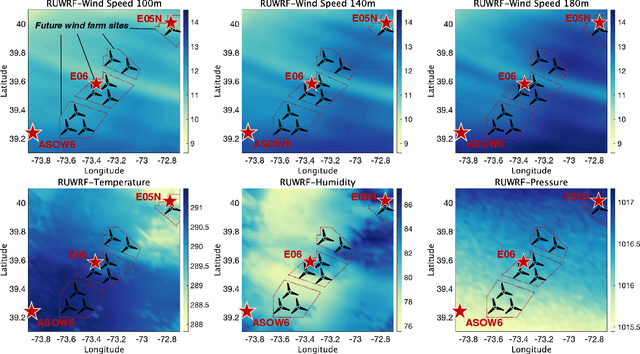

To unlock access to stronger winds, the offshore wind industry is advancing with significantly larger and taller wind turbines. This massive upscaling motivates a departure from univariate wind forecasting methods that traditionally focused on a single representative height. To fill this gap, we propose DeepMIDE--a statistical deep learning method which jointly models the offshore wind speeds across space, time, and height. DeepMIDE is formulated as a multi-output integro-difference equation model with a multivariate, nonstationary, and state-dependent kernel characterized by a set of advection vectors that encode the physics of wind field formation and propagation. Embedded within DeepMIDE, an advanced deep learning architecture learns these advection vectors from high dimensional streams of exogenous weather information, which, along with other parameters, are plugged back into the statistical model for probabilistic multi-height space-time forecasting. Tested on real-world data from future offshore wind energy sites in the Northeastern United States, the wind speed and power forecasts from DeepMIDE are shown to outperform those from prevalent time series, spatio-temporal, and deep learning methods.
Spectrum-Aware Parameter Efficient Fine-Tuning for Diffusion Models
May 31, 2024Adapting large-scale pre-trained generative models in a parameter-efficient manner is gaining traction. Traditional methods like low rank adaptation achieve parameter efficiency by imposing constraints but may not be optimal for tasks requiring high representation capacity. We propose a novel spectrum-aware adaptation framework for generative models. Our method adjusts both singular values and their basis vectors of pretrained weights. Using the Kronecker product and efficient Stiefel optimizers, we achieve parameter-efficient adaptation of orthogonal matrices. We introduce Spectral Orthogonal Decomposition Adaptation (SODA), which balances computational efficiency and representation capacity. Extensive evaluations on text-to-image diffusion models demonstrate SODA's effectiveness, offering a spectrum-aware alternative to existing fine-tuning methods.