 Add to Chrome
 Add to Firefox
 Add to Edge
Subarray based Wideband Beamforming and Variational Sparse CSI Estimation for Low-Resolution MU THz MIMO Systems
Jun 04, 2026
This work conceives a unified channel estimation and beamforming framework, formulated within the principles of variational Bayesian inference. Recognizing the limitations imposed by hardware constraints, frequency-dependent propagation effects, and the structural restrictions of partially connected architectures in the Terahertz (THz) band, we formulate a dual-wideband channel model incorporating root raised cosine (RRC) pulse shape to account its band-limited nature. To further address the nonlinear distortions introduced by low-resolution ADCs, Bussgang decomposition is employed, enabling a tractable linearized inference process. Unlike conventional techniques, the proposed method accommodates both on-grid and off-grid angular domains, capturing spatial sparsity with improved resolution and robustness. The multi-user (MU) Bayesian Cramér-Rao lower bound is also derived to benchmark the performance of the proposed estimator. Moreover, the framework incorporates a true time delay (TTD)-based hybrid transceiver design that inherently compensates for the beam-squint effect; a frequency-dependent angular deviation that arises due to the fixedphase nature of the conventional beamformer in wideband systems, thereby ensuring accurate directional alignment across all subcarriers. Extensive simulation results validate the effectiveness of the proposed variational Bayesian inference-based estimator and the TTD-enabled beamforming architecture, highlighting their robustness and performance gains under practical wideband THz system.

Terahertz Beamforming and Group Sparse Channel Estimation Relying on Low-Resolution ADCs in MU Hybrid MIMO systems
Mar 21, 2026A unified beamforming and channel estimation framework relying on Bayesian learning is conceived. Recognizing the limitations imposed by low-resolution analog-to-digital converter (ADCs) and frequency-dependent propagation effects occurring in the Terahertz (THz) band, we formulate a dual-wideband channel model incorporating root raised cosine (RRC) pulse shaping. To address the non-linear distortions introduced by low-resolution ADCs, Bussgang decomposition is employed, leading to a tractable linearized inference process. By leveraging the shared sparsity inherent in a multi-user (MU) scenario of THz systems, we propose a Hierarchical Bayesian Group-sparse Regression (HBG-SR) based channel learning technique that exploits the group-sparse structure of THz band channels. The estimated dominant angle-of-arrival/ angle-of-departure (AoA/AoD) indices are then exploited for appropriately configuring the true-time-delay (TTD) elements in the hybrid transceiver, enabling precise beam alignment across subcarriers and the effective compensation of the beam-squint effect occurring in wideband THz systems. Extensive simulation results validate the efficiency of the proposed channel estimator and the TTD-aided beamforming architecture, highlighting their robustness and performance gains under practical wideband THz system constraints.
Two-Stage Hybrid Transceiver Design Relying on Low-Resolution ADCs in Partially Connected MU Terahertz (THz) MIMO Systems
Mar 10, 2026A two-stage hybrid transceiver is designed by considering a partially connected architecture at the base station (BS) for a low-resolution multi-user (MU) THz massive multiple input multiple output (MIMO) system. Due to its high bandwidth coupled with a high number of antennas, the THz band suffers from the deleterious spatial-wideband and frequency-wideband effects jointly termed as the dual-wideband effect. To address this undesired phenomenon, we rigorously model the THz MIMO channel at each subarray corresponding to each user by incorporating the absorption, reflection, and free-space losses. Subsequently, a novel beamforming technique is proposed that employs only a few true time delay (TTD) lines for eliminating the beam-split effect, which is the manifestation of the spatial-wideband effect in the frequency domain. Our simulation results demonstrate a performance improvement of around 13% in terms of spectral efficiency over the existing state-of-the-art techniques.
MCEL: Margin-Based Cross-Entropy Loss for Error-Tolerant Quantized Neural Networks
Mar 05, 2026Robustness to bit errors is a key requirement for the reliable use of neural networks (NNs) on emerging approximate computing platforms and error-prone memory technologies. A common approach to achieve bit error tolerance in NNs is injecting bit flips during training according to a predefined error model. While effective in certain scenarios, training-time bit flip injection introduces substantial computational overhead, often degrades inference accuracy at high error rates, and scales poorly for larger NN architectures. These limitations make error injection an increasingly impractical solution for ensuring robustness on future approximate computing platforms and error-prone memory technologies. In this work, we investigate the mechanisms that enable NNs to tolerate bit errors without relying on error-aware training. We establish a direct connection between bit error tolerance and classification margins at the output layer. Building on this insight, we propose a novel loss function, the Margin Cross-Entropy Loss (MCEL), which explicitly promotes logit-level margin separation while preserving the favorable optimization properties of the standard cross-entropy loss. Furthermore, MCEL introduces an interpretable margin parameter that allows robustness to be tuned in a principled manner. Extensive experimental evaluations across multiple datasets of varying complexity, diverse NN architectures, and a range of quantization schemes demonstrate that MCEL substantially improves bit error tolerance, up to 15 % in accuracy for an error rate of 1 %. Our proposed MCEL method is simple to implement, efficient, and can be integrated as a drop-in replacement for standard CEL. It provides a scalable and principled alternative to training-time bit flip injection, offering new insights into the origins of NN robustness and enabling more efficient deployment on approximate computing and memory systems.
Bitwise Systolic Array Architecture for Runtime-Reconfigurable Multi-precision Quantized Multiplication on Hardware Accelerators
Feb 26, 2026Neural network accelerators have been widely applied to edge devices for complex tasks like object tracking, image recognition, etc. Previous works have explored the quantization technologies in related lightweight accelerator designs to reduce hardware resource consumption. However, low precision leads to high accuracy loss in inference. Therefore, mixed-precision quantization becomes an alternative solution by applying different precision in different layers to trade off resource consumption and accuracy. Because regular designs for multiplication on hardware cannot support the precision reconfiguration for a multi-precision Quantized Neural Network (QNN) model in runtime, we propose a runtime reconfigurable multi-precision multi-channel bitwise systolic array design for QNN accelerators. We have implemented and evaluated our work on the Ultra96 FPGA platform. Results show that our work can achieve 1.3185 to 3.5671 times speedup in inferring mixed-precision models and has less critical path delay, supporting a higher clock frequency (250MHz).
GRAU: Generic Reconfigurable Activation Unit Design for Neural Network Hardware Accelerators
Feb 25, 2026With the continuous growth of neural network scales, low-precision quantization is widely used in edge accelerators. Classic multi-threshold activation hardware requires 2^n thresholds for n-bit outputs, causing a rapid increase in hardware cost as precision increases. We propose a reconfigurable activation hardware, GRAU, based on piecewise linear fitting, where the segment slopes are approximated by powers of two. Our design requires only basic comparators and 1-bit right shifters, supporting mixed-precision quantization and nonlinear functions such as SiLU. Compared with multi-threshold activators, GRAU reduces LUT consumption by over 90%, achieving higher hardware efficiency, flexibility, and scalability.
A Gap Between Decision Trees and Neural Networks
Jan 08, 2026We study when geometric simplicity of decision boundaries, used here as a notion of interpretability, can conflict with accurate approximation of axis-aligned decision trees by shallow neural networks. Decision trees induce rule-based, axis-aligned decision regions (finite unions of boxes), whereas shallow ReLU networks are typically trained as score models whose predictions are obtained by thresholding. We analyze the infinite-width, bounded-norm, single-hidden-layer ReLU class through the Radon total variation ($\mathrm{R}\mathrm{TV}$) seminorm, which controls the geometric complexity of level sets. We first show that the hard tree indicator $1_A$ has infinite $\mathrm{R}\mathrm{TV}$. Moreover, two natural split-wise continuous surrogates--piecewise-linear ramp smoothing and sigmoidal (logistic) smoothing--also have infinite $\mathrm{R}\mathrm{TV}$ in dimensions $d>1$, while Gaussian convolution yields finite $\mathrm{R}\mathrm{TV}$ but with an explicit exponential dependence on $d$. We then separate two goals that are often conflated: classification after thresholding (recovering the decision set) versus score learning (learning a calibrated score close to $1_A$). For classification, we construct a smooth barrier score $S_A$ with finite $\mathrm{R}\mathrm{TV}$ whose fixed threshold $τ=1$ exactly recovers the box. Under a mild tube-mass condition near $\partial A$, we prove an $L_1(P)$ calibration bound that decays polynomially in a sharpness parameter, along with an explicit $\mathrm{R}\mathrm{TV}$ upper bound in terms of face measures. Experiments on synthetic unions of rectangles illustrate the resulting accuracy--complexity tradeoff and how threshold selection shifts where training lands along it.
CoSPlan: Corrective Sequential Planning via Scene Graph Incremental Updates
Dec 11, 2025Large-scale Vision-Language Models (VLMs) exhibit impressive complex reasoning capabilities but remain largely unexplored in visual sequential planning, i.e., executing multi-step actions towards a goal. Additionally, practical sequential planning often involves non-optimal (erroneous) steps, challenging VLMs to detect and correct such steps. We propose Corrective Sequential Planning Benchmark (CoSPlan) to evaluate VLMs in error-prone, vision-based sequential planning tasks across 4 domains: maze navigation, block rearrangement, image reconstruction,and object reorganization. CoSPlan assesses two key abilities: Error Detection (identifying non-optimal action) and Step Completion (correcting and completing action sequences to reach the goal). Despite using state-of-the-art reasoning techniques such as Chain-of-Thought and Scene Graphs, VLMs (e.g. Intern-VLM and Qwen2) struggle on CoSPlan, failing to leverage contextual cues to reach goals. Addressing this, we propose a novel training-free method, Scene Graph Incremental updates (SGI), which introduces intermediate reasoning steps between the initial and goal states. SGI helps VLMs reason about sequences, yielding an average performance gain of 5.2%. In addition to enhancing reliability in corrective sequential planning, SGI generalizes to traditional planning tasks such as Plan-Bench and VQA.
RobustGait: Robustness Analysis for Appearance Based Gait Recognition
Nov 17, 2025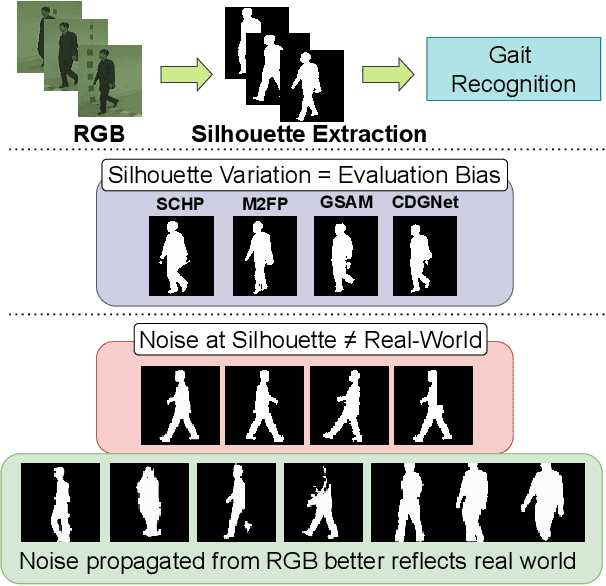
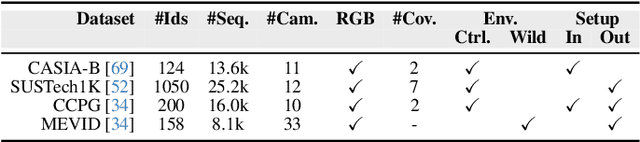
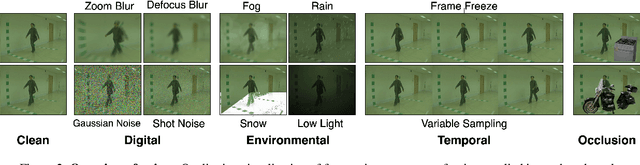
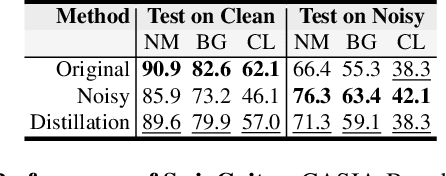
Appearance-based gait recognition have achieved strong performance on controlled datasets, yet systematic evaluation of its robustness to real-world corruptions and silhouette variability remains lacking. We present RobustGait, a framework for fine-grained robustness evaluation of appearance-based gait recognition systems. RobustGait evaluation spans four dimensions: the type of perturbation (digital, environmental, temporal, occlusion), the silhouette extraction method (segmentation and parsing networks), the architectural capacities of gait recognition models, and various deployment scenarios. The benchmark introduces 15 corruption types at 5 severity levels across CASIA-B, CCPG, and SUSTech1K, with in-the-wild validation on MEVID, and evaluates six state-of-the-art gait systems. We came across several exciting insights. First, applying noise at the RGB level better reflects real-world degradation, and reveal how distortions propagate through silhouette extraction to the downstream gait recognition systems. Second, gait accuracy is highly sensitive to silhouette extractor biases, revealing an overlooked source of benchmark bias. Third, robustness is dependent on both the type of perturbation and the architectural design. Finally, we explore robustness-enhancing strategies, showing that noise-aware training and knowledge distillation improve performance and move toward deployment-ready systems.
Bayesian Learning Aided Simultaneous Sparse Estimation of Dual-Wideband THz Channels in Multi-User Hybrid MIMO Systems
Nov 15, 2025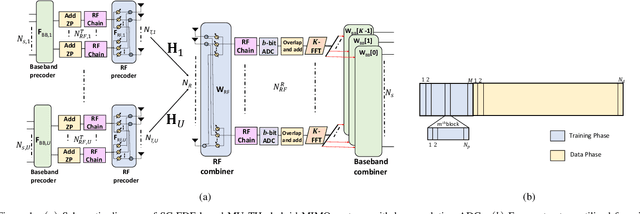
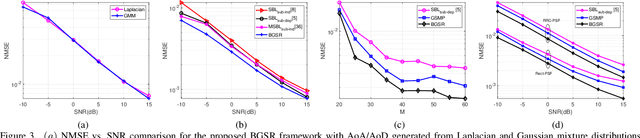
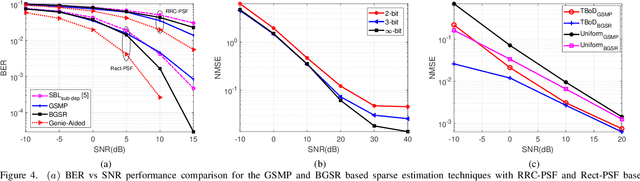
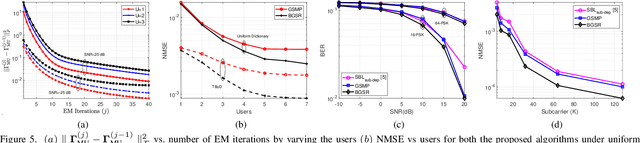
This work conceives the Bayesian Group-Sparse Regression (BGSR) for the estimation of a spatial and frequency wideband, i.e., a dual wideband channel in Multi-User (MU) THz hybrid MIMO scenarios. We develop a practical dual wideband THz channel model that incorporates absorption losses, reflection losses, diffused ray modeling and angles of arrival/departure (AoAs/AoDs) using a Gaussian Mixture Model (GMM). Furthermore, a low-resolution analog-to-digital converter (ADC) is employed at each RF chain, which is crucial for wideband THz massive MIMO systems to reduce power consumption and hardware complexity, given the high sampling rates and large number of antennas involved. The quantized MU THz MIMO model is linearized using the popular Bussgang decomposition followed by BGSR based channel learning framework that results in sparsity across different subcarriers, where each subcarrier has its unique dictionary matrix. Next, the Bayesian Cramér Rao Bound (BCRB) is devised for bounding the normalized mean square error (NMSE) performance. Extensive simulations were performed to assess the performance improvements achieved by the proposed BGSR method compared to other sparse estimation techniques. The metrics considered for quantifying the performance improvements include the NMSE and bit error rate (BER).