 Add to Chrome
 Add to Firefox
 Add to Edge
SEMIKHORN: Globally balanced affinities for mmWave Localization in MU mMIMO systems
Jun 04, 2026
This work conceives SEMIKHORN, a semisupervised channel charting (CC) framework for mmWave localization, which leverages t-SNEkhorn, a doubly stochastic variant of t-distributed Stochastic Neighbor Embedding (t-SNE) that utilizes entropic optimal transport to construct pairwise similarities. Unlike standard t-SNE, which normalizes affinities independently for each data point, t-SNEkhorn generates globally balanced similarities ensuring consistent neighborhood representation. We consider wireless networks with distributed base stations (BSs) equipped with multiple antennas, where each BS constructs a local dissimilarity matrix from the channel state information (CSI). These local dissimilarity matrices are then fused to obtain a single global dissimilarity matrix, which is processed through manifold learning to embed users onto a geometric map. The performance is evaluated in a simulated outdoor environment, and Bayesian optimization is employed on the framework hyperparameters to minimize the mean localization error (MLE). Experimental results demonstrate that the proposed framework achieves an MLE of 6.86% in a circular vicinity of radius 100m, requiring less than 15% of labeled CSI samples.

Variational Bayes Estimation for Affine-Precoded Superimposed Pilots in Partially Connected Dual-Wideband Tera-Hertz MU-MIMO Systems
Jun 04, 2026This work conceives two affine precoding based system models, common precoding with joint channel estimation (CP-JCE) and user-specific precoding for decoupled channel estimation (USPDCE). Considering a dual-wideband effected partially connected architecture, we rigorously model the terahertz (THz) multiple input multiple output (MIMO) channel for each subarray corresponding to each user by incorporating the absorption, reflection, and freespace losses. Next, to address the significant bandwidth overhead associated with conventional pilot-based channel estimation, we employ superimposed pilots. Building on this, we formulate a structured sparse channel model and develop a variational Bayesian inference algorithm that jointly estimates the channel coefficients and learns the underlying sparsity structure through hyperparameter inference, thereby enabling robust and high-precision superimposed pilotbased channel estimation under severe model uncertainty. Lastly, we compare our results for both systems and provide a trade-off analysis between them.
Subarray based Wideband Beamforming and Variational Sparse CSI Estimation for Low-Resolution MU THz MIMO Systems
Jun 04, 2026This work conceives a unified channel estimation and beamforming framework, formulated within the principles of variational Bayesian inference. Recognizing the limitations imposed by hardware constraints, frequency-dependent propagation effects, and the structural restrictions of partially connected architectures in the Terahertz (THz) band, we formulate a dual-wideband channel model incorporating root raised cosine (RRC) pulse shape to account its band-limited nature. To further address the nonlinear distortions introduced by low-resolution ADCs, Bussgang decomposition is employed, enabling a tractable linearized inference process. Unlike conventional techniques, the proposed method accommodates both on-grid and off-grid angular domains, capturing spatial sparsity with improved resolution and robustness. The multi-user (MU) Bayesian Cramér-Rao lower bound is also derived to benchmark the performance of the proposed estimator. Moreover, the framework incorporates a true time delay (TTD)-based hybrid transceiver design that inherently compensates for the beam-squint effect; a frequency-dependent angular deviation that arises due to the fixedphase nature of the conventional beamformer in wideband systems, thereby ensuring accurate directional alignment across all subcarriers. Extensive simulation results validate the effectiveness of the proposed variational Bayesian inference-based estimator and the TTD-enabled beamforming architecture, highlighting their robustness and performance gains under practical wideband THz system.
Bayesian Learning-Aided Near-Field Channel Estimation for mmWave Hybrid MIMO systems employing Uniform Circular Array
May 07, 2026This work conceives a Ring-Bayes channel learning framework that unifies Bayesian learning with near-field channel estimation in millimeter-wave (mmWave) hybrid MIMO systems. As the number of antennas scales up, users increasingly fall within the near-field region, rendering the conventional planar-wave assumption invalid. Moreover, the widely studied uniform linear arrays (ULAs) at the base station are impractical for large-scale deployment, whereas uniform circular arrays (UCAs) achieve superior beamforming gain and spatial directivity with the same antenna aperture. To exploit these advantages, we design a near-field concentric-ring codebook that captures channel features jointly in angular and distance domains. Leveraging this structure, the proposed Ring-Bayes framework enables highly accurate recovery of UCA near-field channels. Extensive simulations confirm that our approach delivers substantial improvements over existing methods, establishing Ring-Bayes as a powerful and scalable solution for next-generation mmWave communications.
Semi-Blind Channel Estimation and Hybrid Receiver Beamforming in the Tera-Hertz Multi-User Massive MIMO Uplink
Mar 23, 2026We develop a pragmatic multi-user (MU) massive multiple-input multiple-output (MIMO) channel model tailored to the THz band, encompassing factors such as molecular absorption, reflection losses and multipath diffused ray components. Next, we propose a novel semi-blind based channel state information (CSI) acquisition technique i.e. MU whitening decorrelation semi-blind (MU-WD-SB) that exploits the second order statistics corresponding to the unknown data symbols along with pilot vectors. A constrained Cramer-Rao Lower Bound (C-CRLB) is derived to bound the normalized mean square error (NMSE) performance of the proposed semi-blind learning technique. Our proposed scheme efficiently reduces the training overheads while enhancing the overall accuracy of the channel learning process. Furthermore, a novel hybrid receiver combiner framework is devised for MU THz massive MIMO systems, leveraging multiple measurement vector based sparse Bayesian learning (MMV-SBL) that relies on the estimated CSI acquired through our proposed semi-blind technique relying on low resolution analog-to-digital converters (ADCs). Finally, we propose an optimal hybrid combiner based on MMV-SBL, which directly reduces the MU interference. Extensive simulations are conducted to evaluate the performance gain of the proposed MU-WD-SB scheme over conventional training-based and other semi-blind learning techniques for a practical THz channel obtained from the high-resolution transmission (HITRAN) database. The metrics considered for quantifying the improvements include the NMSE, bit error rate (BER) and spectral-efficiency (SE).
Terahertz Beamforming and Group Sparse Channel Estimation Relying on Low-Resolution ADCs in MU Hybrid MIMO systems
Mar 21, 2026A unified beamforming and channel estimation framework relying on Bayesian learning is conceived. Recognizing the limitations imposed by low-resolution analog-to-digital converter (ADCs) and frequency-dependent propagation effects occurring in the Terahertz (THz) band, we formulate a dual-wideband channel model incorporating root raised cosine (RRC) pulse shaping. To address the non-linear distortions introduced by low-resolution ADCs, Bussgang decomposition is employed, leading to a tractable linearized inference process. By leveraging the shared sparsity inherent in a multi-user (MU) scenario of THz systems, we propose a Hierarchical Bayesian Group-sparse Regression (HBG-SR) based channel learning technique that exploits the group-sparse structure of THz band channels. The estimated dominant angle-of-arrival/ angle-of-departure (AoA/AoD) indices are then exploited for appropriately configuring the true-time-delay (TTD) elements in the hybrid transceiver, enabling precise beam alignment across subcarriers and the effective compensation of the beam-squint effect occurring in wideband THz systems. Extensive simulation results validate the efficiency of the proposed channel estimator and the TTD-aided beamforming architecture, highlighting their robustness and performance gains under practical wideband THz system constraints.
Two-Stage Hybrid Transceiver Design Relying on Low-Resolution ADCs in Partially Connected MU Terahertz (THz) MIMO Systems
Mar 10, 2026A two-stage hybrid transceiver is designed by considering a partially connected architecture at the base station (BS) for a low-resolution multi-user (MU) THz massive multiple input multiple output (MIMO) system. Due to its high bandwidth coupled with a high number of antennas, the THz band suffers from the deleterious spatial-wideband and frequency-wideband effects jointly termed as the dual-wideband effect. To address this undesired phenomenon, we rigorously model the THz MIMO channel at each subarray corresponding to each user by incorporating the absorption, reflection, and free-space losses. Subsequently, a novel beamforming technique is proposed that employs only a few true time delay (TTD) lines for eliminating the beam-split effect, which is the manifestation of the spatial-wideband effect in the frequency domain. Our simulation results demonstrate a performance improvement of around 13% in terms of spectral efficiency over the existing state-of-the-art techniques.
Bayesian Learning Aided Simultaneous Sparse Estimation of Dual-Wideband THz Channels in Multi-User Hybrid MIMO Systems
Nov 15, 2025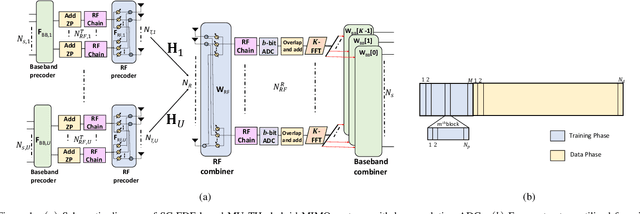
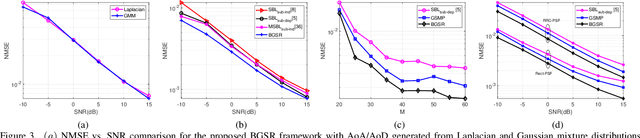
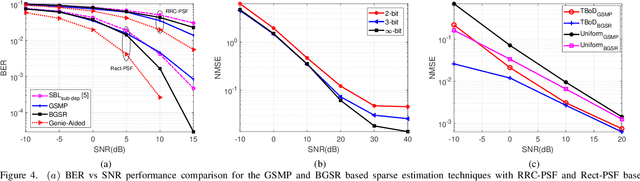
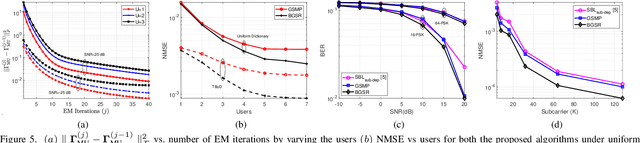
This work conceives the Bayesian Group-Sparse Regression (BGSR) for the estimation of a spatial and frequency wideband, i.e., a dual wideband channel in Multi-User (MU) THz hybrid MIMO scenarios. We develop a practical dual wideband THz channel model that incorporates absorption losses, reflection losses, diffused ray modeling and angles of arrival/departure (AoAs/AoDs) using a Gaussian Mixture Model (GMM). Furthermore, a low-resolution analog-to-digital converter (ADC) is employed at each RF chain, which is crucial for wideband THz massive MIMO systems to reduce power consumption and hardware complexity, given the high sampling rates and large number of antennas involved. The quantized MU THz MIMO model is linearized using the popular Bussgang decomposition followed by BGSR based channel learning framework that results in sparsity across different subcarriers, where each subcarrier has its unique dictionary matrix. Next, the Bayesian Cramér Rao Bound (BCRB) is devised for bounding the normalized mean square error (NMSE) performance. Extensive simulations were performed to assess the performance improvements achieved by the proposed BGSR method compared to other sparse estimation techniques. The metrics considered for quantifying the performance improvements include the NMSE and bit error rate (BER).
Angularly Sparse Channel Estimation in Dual-Wideband Tera-Hertz (THz) Hybrid MIMO Systems Relying on Bayesian Learning
Feb 19, 2024


Bayesian learning aided massive antenna array based THz MIMO systems are designed for spatial-wideband and frequency-wideband scenarios, collectively termed as the dual-wideband channels. Essentially, numerous antenna modules of the THz system result in a significant delay in the transmission/ reception of signals in the time-domain across the antennas, which leads to spatial-selectivity. As a further phenomenon, the wide bandwidth of THz communication results in substantial variation of the effective angle of arrival/ departure (AoA/ AoD) with respect to the subcarrier frequency. This is termed as the beam squint effect, which renders the channel state information (CSI) estimation challenging in such systems. To address this problem, initially, a pilot-aided (PA) Bayesian learning (PA-BL) framework is derived for the estimation of the Terahertz (THz) MIMO channel that relies exclusively on the pilot beams transmitted. Since the framework designed can successfully operate in an ill-posed model, it can verifiably lead to reduced pilot transmissions in comparison to conventional methodologies. The above paradigm is subsequently extended to additionally incorporate data symbols to derive a Data-Aided (DA) BL approach that performs joint data detection and CSI estimation. We will demonstrate that it is capable of improving the dual-wideband channels estimate, despite further reducing the training overhead. The Bayesian Cramer-Rao bounds (BCRLBs) are also obtained for explicitly characterizing the lower bounds on the mean squared error (MSE) of the PA-BL and DA-BL frameworks. Our simulation results show the improved normalized MSE (NMSE) and bit-error rate (BER) performance of the proposed estimation schemes and confirm that they approach their respective BCRLB benchmarks.