 Add to Chrome
 Add to Firefox
 Add to Edge
ProDiG: Progressive Diffusion-Guided Gaussian Splatting for Aerial to Ground Reconstruction
Apr 02, 2026
Generating ground-level views and coherent 3D site models from aerial-only imagery is challenging due to extreme viewpoint changes, missing intermediate observations, and large scale variations. Existing methods either refine renderings post-hoc, often producing geometrically inconsistent results, or rely on multi-altitude ground-truth, which is rarely available. Gaussian Splatting and diffusion-based refinements improve fidelity under small variations but fail under wide aerial-to-ground gaps. To address these limitations, we introduce ProDiG (Progressive Altitude Gaussian Splatting), a diffusion-guided framework that progressively transforms aerial 3D representations toward ground-level fidelity. ProDiG synthesizes intermediate-altitude views and refines the Gaussian representation at each stage using a geometry-aware causal attention module that injects epipolar structure into reference-view diffusion. A distance-adaptive Gaussian module dynamically adjusts Gaussian scale and opacity based on camera distance, ensuring stable reconstruction across large viewpoint gaps. Together, these components enable progressive, geometrically grounded refinement without requiring additional ground-truth viewpoints. Extensive experiments on synthetic and real-world datasets demonstrate that ProDiG produces visually realistic ground-level renderings and coherent 3D geometry, significantly outperforming existing approaches in terms of visual quality, geometric consistency, and robustness to extreme viewpoint changes.

Sky2Ground: A Benchmark for Site Modeling under Varying Altitude
Mar 14, 2026We introduce Sky2Ground, a three-view dataset designed for varying altitude camera localization, correspondence learning, and reconstruction. The dataset combines structured synthetic imagery with real, in-the-wild images, providing both controlled multi-view geometry and realistic scene noise. Each of the 51 sites contains thousands of satellite, aerial, and ground images spanning wide altitude ranges and nearly orthogonal viewing angles, enabling rigorous evaluation across global-to-local contexts. We benchmark state of the art pose estimation models, including MASt3R, DUSt3R, Map Anything, and VGGT, and observe that the use of satellite imagery often degrades performance, highlighting the challenges under large altitude variations. We also examine reconstruction methods, highlighting the challenges introduced by sparse geometric overlap, varying perspectives, and the use of real imagery, which often introduces noise and reduces rendering quality. To address some of these challenges, we propose SkyNet, a model which enhances cross-view consistency when incorporating satellite imagery with a curriculum-based training strategy to progressively incorporate more satellite views. SkyNet significantly strengthens multi-view alignment and outperforms existing methods by 9.6% on RRA@5 and 18.1% on RTA@5 in terms of absolute performance. Sky2Ground and SkyNet together establish a comprehensive testbed and baseline for advancing large-scale, multi-altitude 3D perception and generalizable camera localization. Code and models will be released publicly for future research.
RobustGait: Robustness Analysis for Appearance Based Gait Recognition
Nov 17, 2025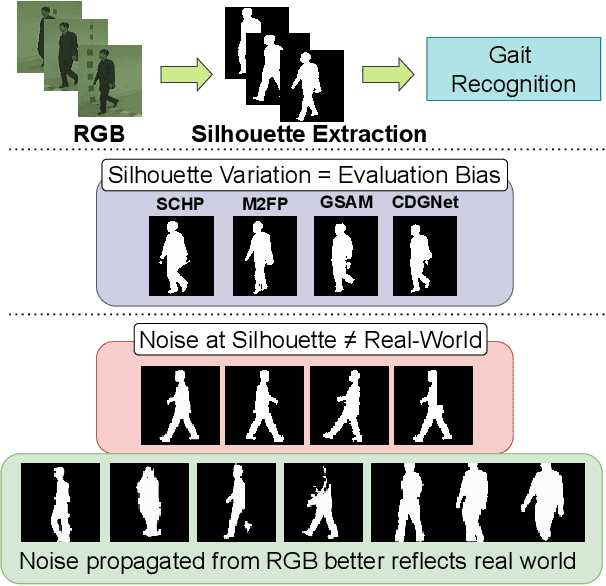
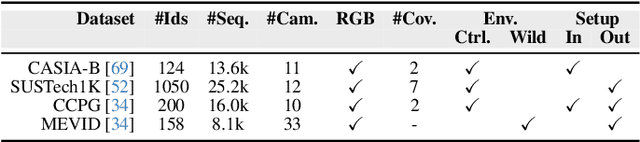
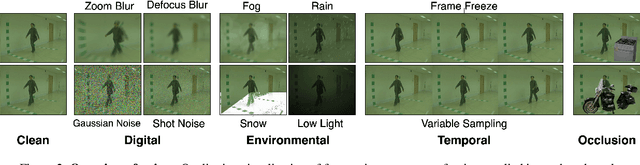
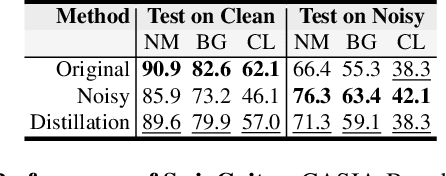
Appearance-based gait recognition have achieved strong performance on controlled datasets, yet systematic evaluation of its robustness to real-world corruptions and silhouette variability remains lacking. We present RobustGait, a framework for fine-grained robustness evaluation of appearance-based gait recognition systems. RobustGait evaluation spans four dimensions: the type of perturbation (digital, environmental, temporal, occlusion), the silhouette extraction method (segmentation and parsing networks), the architectural capacities of gait recognition models, and various deployment scenarios. The benchmark introduces 15 corruption types at 5 severity levels across CASIA-B, CCPG, and SUSTech1K, with in-the-wild validation on MEVID, and evaluates six state-of-the-art gait systems. We came across several exciting insights. First, applying noise at the RGB level better reflects real-world degradation, and reveal how distortions propagate through silhouette extraction to the downstream gait recognition systems. Second, gait accuracy is highly sensitive to silhouette extractor biases, revealing an overlooked source of benchmark bias. Third, robustness is dependent on both the type of perturbation and the architectural design. Finally, we explore robustness-enhancing strategies, showing that noise-aware training and knowledge distillation improve performance and move toward deployment-ready systems.
Stable Mean Teacher for Semi-supervised Video Action Detection
Dec 10, 2024In this work, we focus on semi-supervised learning for video action detection. Video action detection requires spatiotemporal localization in addition to classification, and a limited amount of labels makes the model prone to unreliable predictions. We present Stable Mean Teacher, a simple end-to-end teacher-based framework that benefits from improved and temporally consistent pseudo labels. It relies on a novel Error Recovery (EoR) module, which learns from students' mistakes on labeled samples and transfers this knowledge to the teacher to improve pseudo labels for unlabeled samples. Moreover, existing spatiotemporal losses do not take temporal coherency into account and are prone to temporal inconsistencies. To address this, we present Difference of Pixels (DoP), a simple and novel constraint focused on temporal consistency, leading to coherent temporal detections. We evaluate our approach on four different spatiotemporal detection benchmarks: UCF101-24, JHMDB21, AVA, and YouTube-VOS. Our approach outperforms the supervised baselines for action detection by an average margin of 23.5% on UCF101-24, 16% on JHMDB21, and 3.3% on AVA. Using merely 10% and 20% of data, it provides competitive performance compared to the supervised baseline trained on 100% annotations on UCF101-24 and JHMDB21, respectively. We further evaluate its effectiveness on AVA for scaling to large-scale datasets and YouTube-VOS for video object segmentation, demonstrating its generalization capability to other tasks in the video domain. Code and models are publicly available.