 Add to Chrome
 Add to Firefox
 Add to Edge
RecurrentGPT: Expressive Depth through Recurrent Modulation in Transformers
Aug 18, 2026
Scaling transformer language models creates an inherent tension between expressivity and memory efficiency. While unique weights across layers preserve functional specialization---from input-grounding to abstract refinement---they incur a substantial memory footprint. Conversely, standard depth-sharing enforces uniform transformations that collapse representational diversity and degrade modeling quality. We introduce RecurrentGPT, a recurrent depth transformer where fixed-depth prelude and coda blocks bracket a single shared core iterated R times. Inspired by gated recurrent neural networks, we employ a lightweight projection and an elementwise update gate---conditioned on the hidden state, the fixed prelude output, and noise resampled at every step---to modulate the recurrent update. This allows the model to specialize the input to the same few layers across recurrences, rather than requiring many unique layers to achieve functional diversity. Under an isoFLOPS constraint, a 3-layer RecurrentGPT matches the accuracy of a 12-layer GPT-2 Small baseline with similar training and inference FLOPs, and leads MoR and heavy-tail depth sampling in all nine scale-by-budget cells; at medium and large scale it approaches dense quality at the standard token budget and overtakes it at medium scale once that budget is doubled. Under an isoPARAMS constraint, deeper recurrence achieves a 2.76 validation loss versus 2.84 for a non-recurrent counterpart at matched parameter and data budget. Our results demonstrate that adaptive depth reuse is a principled strategy for trading parameters for quality: at large scale, 63% fewer parameters and 59% less peak decoding memory for a 10% increase in compiled generation latency.

Safe LLM-Controlled Robots with Formal Guarantees via Reachability Analysis
Mar 05, 2025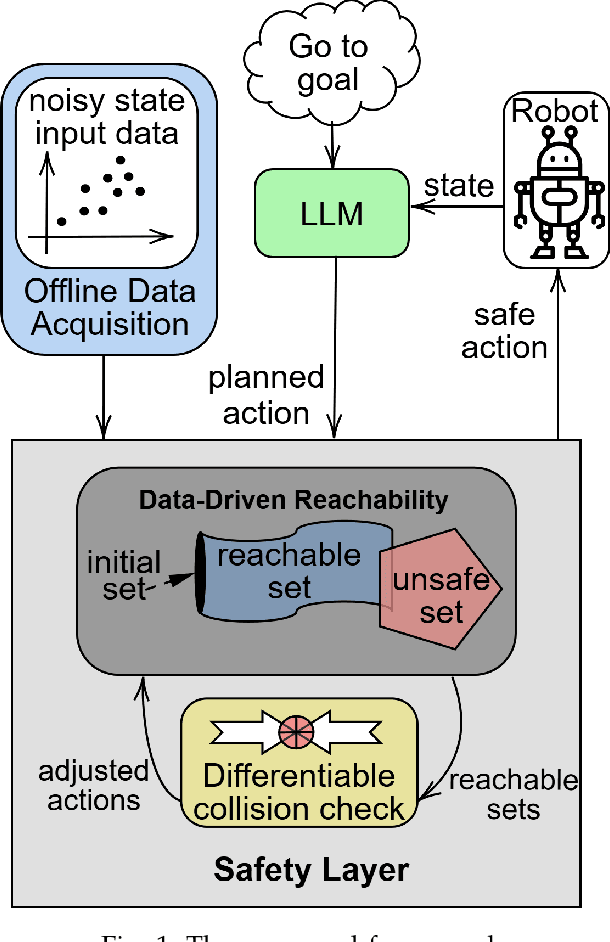
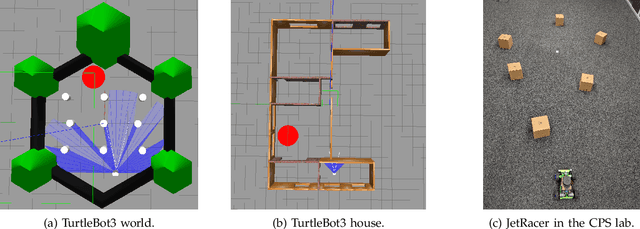
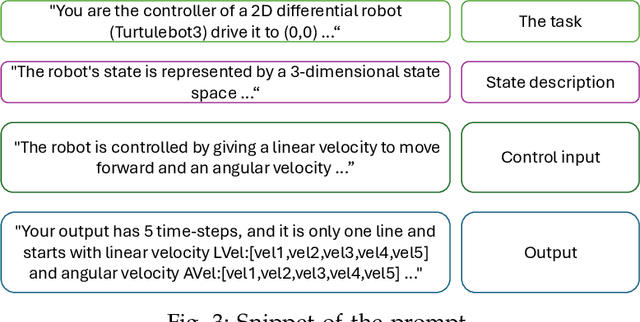
The deployment of Large Language Models (LLMs) in robotic systems presents unique safety challenges, particularly in unpredictable environments. Although LLMs, leveraging zero-shot learning, enhance human-robot interaction and decision-making capabilities, their inherent probabilistic nature and lack of formal guarantees raise significant concerns for safety-critical applications. Traditional model-based verification approaches often rely on precise system models, which are difficult to obtain for real-world robotic systems and may not be fully trusted due to modeling inaccuracies, unmodeled dynamics, or environmental uncertainties. To address these challenges, this paper introduces a safety assurance framework for LLM-controlled robots based on data-driven reachability analysis, a formal verification technique that ensures all possible system trajectories remain within safe operational limits. Our framework specifically investigates the problem of instructing an LLM to navigate the robot to a specified goal and assesses its ability to generate low-level control actions that successfully guide the robot safely toward that goal. By leveraging historical data to construct reachable sets of states for the robot-LLM system, our approach provides rigorous safety guarantees against unsafe behaviors without relying on explicit analytical models. We validate the framework through experimental case studies in autonomous navigation and task planning, demonstrating its effectiveness in mitigating risks associated with LLM-generated commands. This work advances the integration of formal methods into LLM-based robotics, offering a principled and practical approach to ensuring safety in next-generation autonomous systems.