 Add to Chrome
 Add to Firefox
 Add to Edge
LGNNIC: Acceleration of Large-Scale GNN Training using SmartNICs
Aug 07, 2026
Graph Neural Networks (GNNs) are widely used across domains such as natural sciences, social network analysis, chip design, and recommendation systems. However, as graph sizes grow, storing and processing them entirely on a single-node CPU-GPU system becomes increasingly impractical. A promising approach is to distribute the graph across multiple remote memory nodes, though this introduces a major bottleneck: inter-node network congestion during training. To address this, we propose LGNNIC, a novel inter-node system architecture that leverages SmartNICs co-located with remote memory nodes-a configuration already available in modern systems-to reduce communication overhead in distributed GNN training. LGNNIC offloads key preprocessing tasks to SmartNICs, reducing the volume of data transferred to computational (training) nodes and alleviating network congestion. We introduce two complementary techniques executed on the SmartNICs during the preprocessing phase: Neighbor Sampling, which performs mini-batch sampling, and Quantization of the sampled batches. To evaluate LGNNIC under different communication infrastructures, we designed both an optimized low-overhead DMA-based synchronization mechanism and a high-overhead socket-based alternative used as a benchmark. We evaluate the core SmartNIC offloading mechanisms across standard GNN workloads and sampling hyperparameters using a proof-of-concept (PoC) system comprising one remote-memory node with an NVIDIA BlueField-2 SmartNIC and one compute node with an A100 GPU. Both Neighbor Sampling and Quantization on the remote node demonstrated substantial training speedups in most configurations. Neighbor Sampling achieved up to 62.4x and 17.5x speedups with Sockets and DOCA-DMA, respectively, primarily due to reduced data transaction time. Quantization provided additional speedups of up to 3.6x and 1.3x, respectively, by reducing data transfer.

Predict, Reuse, and Repair: Accelerating Dynamic Sparse Attention for Long-Context LLM Decoding
Jun 29, 2026Dynamic sparse attention (DSA) accelerates long-context LLM decoding by attending to only the top-K KV blocks relevant to each query, but it introduces a serialized selection-to-attention dependency that emerges as a new latency bottleneck. We present PRR, a speculate-reuse-repair runtime that exploits temporal locality in DSA selections to predict likely blocks, speculate the attention over them while selection is in flight, and incrementally repair missed blocks once the true selected set is known. PRR uses a lightweight EMA-based predictor, a profiling-guided speculation budget that keeps speculative work off the critical path, and a FlashAttention-based repair kernel that folds missed blocks into the partial attention state using online-softmax statistics. Across long-context benchmarks and representative DSA methods, PRR reduces per-token decoding latency by up to 40% while preserving downstream task accuracy. Github: https://github.com/Tianyu9748/Incremental_FlashAttention
Spatial Sharing of GPU for Autotuning DNN models
Aug 08, 2020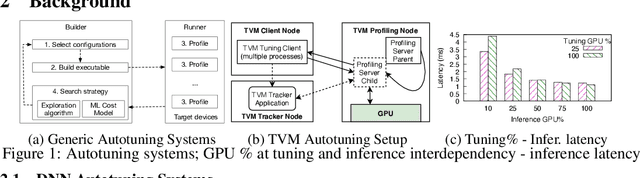
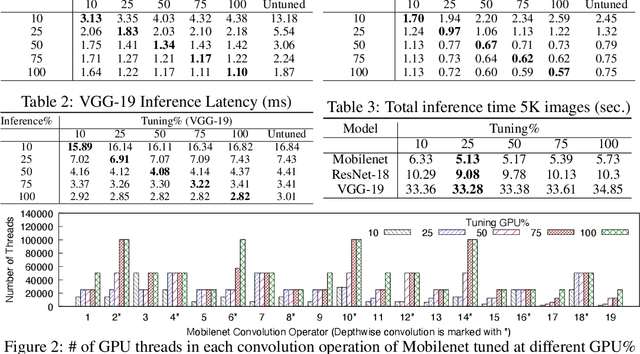
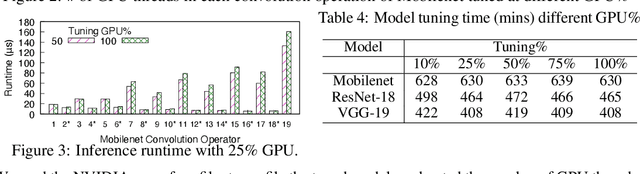
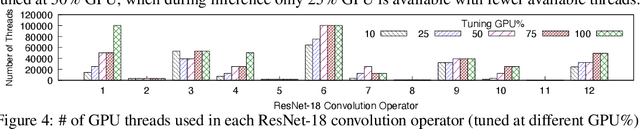
GPUs are used for training, inference, and tuning the machine learning models. However, Deep Neural Network (DNN) vary widely in their ability to exploit the full power of high-performance GPUs. Spatial sharing of GPU enables multiplexing several DNNs on the GPU and can improve GPU utilization, thus improving throughput and lowering latency. DNN models given just the right amount of GPU resources can still provide low inference latency, just as much as dedicating all of the GPU for their inference task. An approach to improve DNN inference is tuning of the DNN model. Autotuning frameworks find the optimal low-level implementation for a certain target device based on the trained machine learning model, thus reducing the DNN's inference latency and increasing inference throughput. We observe an interdependency between the tuned model and its inference latency. A DNN model tuned with specific GPU resources provides the best inference latency when inferred with close to the same amount of GPU resources. While a model tuned with the maximum amount of the GPU's resources has poorer inference latency once the GPU resources are limited for inference. On the other hand, a model tuned with an appropriate amount of GPU resources still achieves good inference latency across a wide range of GPU resource availability. We explore the causes that impact the tuning of a model at different amounts of GPU resources. We present many techniques to maximize resource utilization and improve tuning performance. We enable controlled spatial sharing of GPU to multiplex several tuning applications on the GPU. We scale the tuning server instances and shard the tuning model across multiple client instances for concurrent tuning of different operators of a model, achieving better GPU multiplexing. With our improvements, we decrease DNN autotuning time by up to 75 percent and increase throughput by a factor of 5.