 Add to Chrome
 Add to Firefox
 Add to Edge
LGNNIC: Acceleration of Large-Scale GNN Training using SmartNICs
Aug 07, 2026
Graph Neural Networks (GNNs) are widely used across domains such as natural sciences, social network analysis, chip design, and recommendation systems. However, as graph sizes grow, storing and processing them entirely on a single-node CPU-GPU system becomes increasingly impractical. A promising approach is to distribute the graph across multiple remote memory nodes, though this introduces a major bottleneck: inter-node network congestion during training. To address this, we propose LGNNIC, a novel inter-node system architecture that leverages SmartNICs co-located with remote memory nodes-a configuration already available in modern systems-to reduce communication overhead in distributed GNN training. LGNNIC offloads key preprocessing tasks to SmartNICs, reducing the volume of data transferred to computational (training) nodes and alleviating network congestion. We introduce two complementary techniques executed on the SmartNICs during the preprocessing phase: Neighbor Sampling, which performs mini-batch sampling, and Quantization of the sampled batches. To evaluate LGNNIC under different communication infrastructures, we designed both an optimized low-overhead DMA-based synchronization mechanism and a high-overhead socket-based alternative used as a benchmark. We evaluate the core SmartNIC offloading mechanisms across standard GNN workloads and sampling hyperparameters using a proof-of-concept (PoC) system comprising one remote-memory node with an NVIDIA BlueField-2 SmartNIC and one compute node with an A100 GPU. Both Neighbor Sampling and Quantization on the remote node demonstrated substantial training speedups in most configurations. Neighbor Sampling achieved up to 62.4x and 17.5x speedups with Sockets and DOCA-DMA, respectively, primarily due to reduced data transaction time. Quantization provided additional speedups of up to 3.6x and 1.3x, respectively, by reducing data transfer.

Linguistic Firewall: Geometry as Defense in Multi-Agent Systems Routing
Jun 29, 2026The rapid integration of Large Language Models (LLMs) has driven the evolution of Multi-Agent Systems (MAS), where specialized agents collaborate to execute complex workflows. Effective orchestration in these environments requires robust routing mechanisms to efficiently allocate tasks to the most suitable agent. However, existing routers fundamentally rely on unverified proxies, ranging from textual self-descriptions to static surrogate representations, to gauge an agent's competence. This reliance on non-empirical data creates a critical gap between an agent's projected profile and its actual operational capabilities, introducing severe security vulnerabilities. Malicious agents can easily misrepresent their proficiencies or harbor covert backdoors that evade both standard external analysis and static representation-learning techniques. In this work, we introduce ANTAP (Automatic Non-Textual Agent Picker), an evaluation-driven routing architecture that discards indirect proxies in favor of active capability testing. By dynamically querying agents to ascertain their true competencies empirically, ANTAP distills performance into fixed behavioral operators within a shared semantic space. At inference time, routing is performed via a purely non-textual algebraic projection, establishing a "linguistic firewall" that renders metadata-based attacks inexpressible. In our experiments, ANTAP achieves near-zero ASR against description-based injection attacks, compared to 67.3\% and above for the description-based router baseline. Against adaptive embedding attacks, ANTAP achieves substantially lower ASR than the embedding-based baseline, with a 20\% reduction, while remaining resilient to description manipulation by design.
Breaking the Bubble: Asynchronous Pipeline Parallel Training with Bounded Weight Inconsistency
Jun 05, 2026Pipeline parallelism is essential for training large neural networks, but existing schedules trade off throughput, memory, and optimization consistency. Synchronous pipelines preserve forward/backward weight consistency but suffer from bubbles; asynchronous pipelines remove bubbles but introduce weight-version mismatch, typically requiring weight stashing, prediction, or correction mechanisms. We introduce PACI (Pipeline Asynchronous training with Controlled Inconsistency), a bubble-free asynchronous pipeline method that bounds forward/backward version drift without weight stashing, prediction, additional parameter copies, or global synchronization. The key idea is to use local gradient accumulation as a version-control mechanism: by slowing parameter-version evolution relative to pipeline delay, PACI limits the number of optimizer updates crossed by any micro-batch while preserving steady-state utilization. In GPT-style language-model pretraining, PACI matches the stability and final perplexity of synchronous 1F1B-flush, retains the same peak memory footprint, achieves fully utilized pipeline throughput, and improves training time-to-accuracy by up to $1.69\times$ over the fastest flush baseline. These results show that forward/backward inconsistency need not be eliminated: when explicitly bounded, it can be safely traded for substantial efficiency gains.
Domain Restriction via Multi SAE Layer Transitions
May 12, 2026The general-purpose nature of Large Language Models (LLMs) presents a significant challenge for domain-specific applications, often leading to out-of-domain (OOD) interactions that undermine the provider's intent. Existing methods for detecting such scenarios treat the LLM as an uninterpretable black box and overlook the internal processing of inputs. In this work we show that layer transitions provide a promising avenue for extracting domain-specific signature. Specifically, we present several lightweight ways of learning on internal dynamics encoded using a sparse autoencoder (SAE) that exhibit great capability in distinguishing OOD texts. Building on top of SAEs representation transitions enables us to better interpret the LLM internal evolution of input processing and shed light on its decisions. We provide a comprehensive analysis of the method and benchmark it with the gemma-2 2B and 9B models. Our results emphasize the efficacy of the internal process in capturing fine-grained input-related details.
Extracting Recurring Vulnerabilities from Black-Box LLM-Generated Software
Feb 02, 2026LLMs are increasingly used for code generation, but their outputs often follow recurring templates that can induce predictable vulnerabilities. We study \emph{vulnerability persistence} in LLM-generated software and introduce \emph{Feature--Security Table (FSTab)} with two components. First, FSTab enables a black-box attack that predicts likely backend vulnerabilities from observable frontend features and knowledge of the source LLM, without access to backend code or source code. Second, FSTab provides a model-centric evaluation that quantifies how consistently a given model reproduces the same vulnerabilities across programs, semantics-preserving rephrasings, and application domains. We evaluate FSTab on state-of-the-art code LLMs, including GPT-5.2, Claude-4.5 Opus, and Gemini-3 Pro, across diverse application domains. Our results show strong cross-domain transfer: even when the target domain is excluded from training, FSTab achieves up to 94\% attack success and 93\% vulnerability coverage on Internal Tools (Claude-4.5 Opus). These findings expose an underexplored attack surface in LLM-generated software and highlight the security risks of code generation. Our code is available at: https://anonymous.4open.science/r/FSTab-024E.
Step-Wise Refusal Dynamics in Autoregressive and Diffusion Language Models
Feb 01, 2026Diffusion language models (DLMs) have recently emerged as a promising alternative to autoregressive (AR) models, offering parallel decoding and controllable sampling dynamics while achieving competitive generation quality at scale. Despite this progress, the role of sampling mechanisms in shaping refusal behavior and jailbreak robustness remains poorly understood. In this work, we present a fundamental analytical framework for step-wise refusal dynamics, enabling comparison between AR and diffusion sampling. Our analysis reveals that the sampling strategy itself plays a central role in safety behavior, as a factor distinct from the underlying learned representations. Motivated by this analysis, we introduce the Step-Wise Refusal Internal Dynamics (SRI) signal, which supports interpretability and improved safety for both AR and DLMs. We demonstrate that the geometric structure of SRI captures internal recovery dynamics, and identifies anomalous behavior in harmful generations as cases of \emph{incomplete internal recovery} that are not observable at the text level. This structure enables lightweight inference-time detectors that generalize to unseen attacks while matching or outperforming existing defenses with over $100\times$ lower inference overhead.
You Had One Job: Per-Task Quantization Using LLMs' Hidden Representations
Nov 09, 2025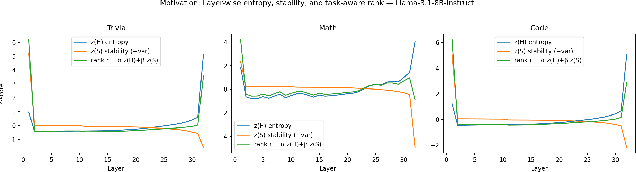
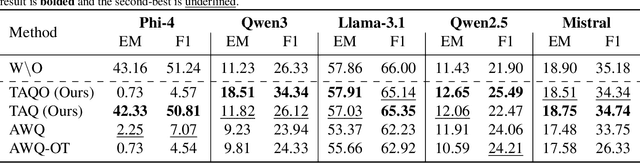
Large Language Models (LLMs) excel across diverse tasks, yet many applications require only limited capabilities, making large variants inefficient in memory and latency. Existing approaches often combine distillation and quantization, but most post-training quantization (PTQ) methods are task-agnostic, ignoring how task-specific signals are distributed across layers. In this work, we propose to use hidden representations that encode task-salient signals as a guideline for quantization. In order to fully utilize our innovative idea, this paper compares two new task-aware PTQ methods: Task-Aware Quantization (TAQ), which allocates bitwidths using task-conditioned statistics from hidden activations, and TAQO, which allocates precision based on direct layer sensitivity tests. From a small calibration set, these approaches identify task-relevant layers, preserving their precision while aggressively quantizing the rest. This yields stable task sensitivity profiles and efficient task-specialized models. Across models, TAQ and TAQO outperform the baselines; TAQ leads on Phi-4, while TAQO leads on Llama-3.1, Qwen3, and Qwen2.5. For instances, on Phi-4 it achieves 42.33 EM / 50.81 F1, far surpassing Activation-aware Weight Quantization (AWQ) (2.25 / 7.07), while remaining within < 1.0% of the original accuracy at lower average precision.
REMIND: Input Loss Landscapes Reveal Residual Memorization in Post-Unlearning LLMs
Nov 06, 2025Machine unlearning aims to remove the influence of specific training data from a model without requiring full retraining. This capability is crucial for ensuring privacy, safety, and regulatory compliance. Therefore, verifying whether a model has truly forgotten target data is essential for maintaining reliability and trustworthiness. However, existing evaluation methods often assess forgetting at the level of individual inputs. This approach may overlook residual influence present in semantically similar examples. Such influence can compromise privacy and lead to indirect information leakage. We propose REMIND (Residual Memorization In Neighborhood Dynamics), a novel evaluation method aiming to detect the subtle remaining influence of unlearned data and classify whether the data has been effectively forgotten. REMIND analyzes the model's loss over small input variations and reveals patterns unnoticed by single-point evaluations. We show that unlearned data yield flatter, less steep loss landscapes, while retained or unrelated data exhibit sharper, more volatile patterns. REMIND requires only query-based access, outperforms existing methods under similar constraints, and demonstrates robustness across different models, datasets, and paraphrased inputs, making it practical for real-world deployment. By providing a more sensitive and interpretable measure of unlearning effectiveness, REMIND provides a reliable framework to assess unlearning in language models. As a result, REMIND offers a novel perspective on memorization and unlearning.
Silenced Biases: The Dark Side LLMs Learned to Refuse
Nov 05, 2025Safety-aligned large language models (LLMs) are becoming increasingly widespread, especially in sensitive applications where fairness is essential and biased outputs can cause significant harm. However, evaluating the fairness of models is a complex challenge, and approaches that do so typically utilize standard question-answer (QA) styled schemes. Such methods often overlook deeper issues by interpreting the model's refusal responses as positive fairness measurements, which creates a false sense of fairness. In this work, we introduce the concept of silenced biases, which are unfair preferences encoded within models' latent space and are effectively concealed by safety-alignment. Previous approaches that considered similar indirect biases often relied on prompt manipulation or handcrafted implicit queries, which present limited scalability and risk contaminating the evaluation process with additional biases. We propose the Silenced Bias Benchmark (SBB), which aims to uncover these biases by employing activation steering to reduce model refusals during QA. SBB supports easy expansion to new demographic groups and subjects, presenting a fairness evaluation framework that encourages the future development of fair models and tools beyond the masking effects of alignment training. We demonstrate our approach over multiple LLMs, where our findings expose an alarming distinction between models' direct responses and their underlying fairness issues.
Representing LLMs in Prompt Semantic Task Space
Sep 26, 2025Large language models (LLMs) achieve impressive results over various tasks, and ever-expanding public repositories contain an abundance of pre-trained models. Therefore, identifying the best-performing LLM for a given task is a significant challenge. Previous works have suggested learning LLM representations to address this. However, these approaches present limited scalability and require costly retraining to encompass additional models and datasets. Moreover, the produced representation utilizes distinct spaces that cannot be easily interpreted. This work presents an efficient, training-free approach to representing LLMs as linear operators within the prompts' semantic task space, thus providing a highly interpretable representation of the models' application. Our method utilizes closed-form computation of geometrical properties and ensures exceptional scalability and real-time adaptability to dynamically expanding repositories. We demonstrate our approach on success prediction and model selection tasks, achieving competitive or state-of-the-art results with notable performance in out-of-sample scenarios.