 Add to Chrome
 Add to Firefox
 Add to Edge
Segmentation-Aware Latent Diffusion for Satellite Image Super-Resolution: Enabling Smallholder Farm Boundary Delineation
Nov 18, 2025
Delineating farm boundaries through segmentation of satellite images is a fundamental step in many agricultural applications. The task is particularly challenging for smallholder farms, where accurate delineation requires the use of high resolution (HR) imagery which are available only at low revisit frequencies (e.g., annually). To support more frequent (sub-) seasonal monitoring, HR images could be combined as references (ref) with low resolution (LR) images -- having higher revisit frequency (e.g., weekly) -- using reference-based super-resolution (Ref-SR) methods. However, current Ref-SR methods optimize perceptual quality and smooth over crucial features needed for downstream tasks, and are unable to meet the large scale-factor requirements for this task. Further, previous two-step approaches of SR followed by segmentation do not effectively utilize diverse satellite sources as inputs. We address these problems through a new approach, $\textbf{SEED-SR}$, which uses a combination of conditional latent diffusion models and large-scale multi-spectral, multi-source geo-spatial foundation models. Our key innovation is to bypass the explicit SR task in the pixel space and instead perform SR in a segmentation-aware latent space. This unique approach enables us to generate segmentation maps at an unprecedented 20$\times$ scale factor, and rigorous experiments on two large, real datasets demonstrate up to $\textbf{25.5}$ and $\textbf{12.9}$ relative improvement in instance and semantic segmentation metrics respectively over approaches based on state-of-the-art Ref-SR methods.

A Novel AI-Driven System for Real-Time Detection of Mirror Absence, Helmet Non-Compliance, and License Plates Using YOLOv8 and OCR
Nov 15, 2025Road safety is a critical global concern, with manual enforcement of helmet laws and vehicle safety standards (e.g., rear-view mirror presence) being resource-intensive and inconsistent. This paper presents an AI-powered system to automate traffic violation detection, significantly enhancing enforcement efficiency and road safety. The system leverages YOLOv8 for robust object detection and EasyOCR for license plate recognition. Trained on a custom dataset of annotated images (augmented for diversity), it identifies helmet non-compliance, the absence of rear-view mirrors on motorcycles, an innovative contribution to automated checks, and extracts vehicle registration numbers. A Streamlit-based interface facilitates real-time monitoring and violation logging. Advanced image preprocessing enhances license plate recognition, particularly under challenging conditions. Based on evaluation results, the model achieves an overall precision of 0.9147, a recall of 0.886, and a mean Average Precision (mAP@50) of 0.843. The mAP@50 95 of 0.503 further indicates strong detection capability under stricter IoU thresholds. This work demonstrates a practical and effective solution for automated traffic rule enforcement, with considerations for real-world deployment discussed.
* 6 pages, 4 figures. Published in: Proceedings of the 12th International Conference on Emerging Trends in Engineering Technology Signal and Information Processing (ICETET SIP 2025) Note: The conference proceedings contain an outdated abstract due to a publisher-side error. This arXiv version includes the correct and updated abstract
Agricultural Landscape Understanding At Country-Scale
Nov 08, 2024Agricultural landscapes are quite complex, especially in the Global South where fields are smaller, and agricultural practices are more varied. In this paper we report on our progress in digitizing the agricultural landscape (natural and man-made) in our study region of India. We use high resolution imagery and a UNet style segmentation model to generate the first of its kind national-scale multi-class panoptic segmentation output. Through this work we have been able to identify individual fields across 151.7M hectares, and delineating key features such as water resources and vegetation. We share how this output was validated by our team and externally by downstream users, including some sample use cases that can lead to targeted data driven decision making. We believe this dataset will contribute towards digitizing agriculture by generating the foundational baselayer.
LogogramNLP: Comparing Visual and Textual Representations of Ancient Logographic Writing Systems for NLP
Aug 08, 2024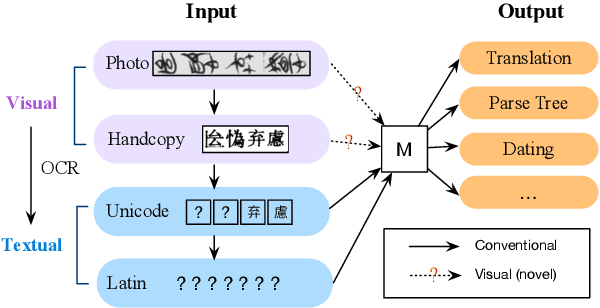

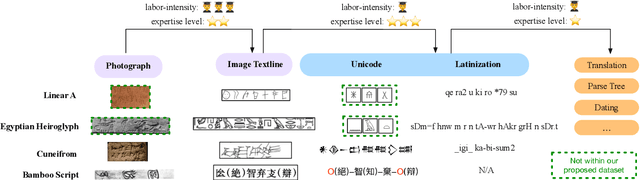
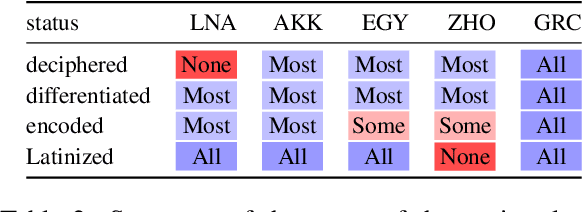
Standard natural language processing (NLP) pipelines operate on symbolic representations of language, which typically consist of sequences of discrete tokens. However, creating an analogous representation for ancient logographic writing systems is an extremely labor intensive process that requires expert knowledge. At present, a large portion of logographic data persists in a purely visual form due to the absence of transcription -- this issue poses a bottleneck for researchers seeking to apply NLP toolkits to study ancient logographic languages: most of the relevant data are images of writing. This paper investigates whether direct processing of visual representations of language offers a potential solution. We introduce LogogramNLP, the first benchmark enabling NLP analysis of ancient logographic languages, featuring both transcribed and visual datasets for four writing systems along with annotations for tasks like classification, translation, and parsing. Our experiments compare systems that employ recent visual and text encoding strategies as backbones. The results demonstrate that visual representations outperform textual representations for some investigated tasks, suggesting that visual processing pipelines may unlock a large amount of cultural heritage data of logographic languages for NLP-based analyses.