 Add to Chrome
 Add to Firefox
 Add to Edge
A Novel AI-Driven System for Real-Time Detection of Mirror Absence, Helmet Non-Compliance, and License Plates Using YOLOv8 and OCR
Nov 15, 2025
Road safety is a critical global concern, with manual enforcement of helmet laws and vehicle safety standards (e.g., rear-view mirror presence) being resource-intensive and inconsistent. This paper presents an AI-powered system to automate traffic violation detection, significantly enhancing enforcement efficiency and road safety. The system leverages YOLOv8 for robust object detection and EasyOCR for license plate recognition. Trained on a custom dataset of annotated images (augmented for diversity), it identifies helmet non-compliance, the absence of rear-view mirrors on motorcycles, an innovative contribution to automated checks, and extracts vehicle registration numbers. A Streamlit-based interface facilitates real-time monitoring and violation logging. Advanced image preprocessing enhances license plate recognition, particularly under challenging conditions. Based on evaluation results, the model achieves an overall precision of 0.9147, a recall of 0.886, and a mean Average Precision (mAP@50) of 0.843. The mAP@50 95 of 0.503 further indicates strong detection capability under stricter IoU thresholds. This work demonstrates a practical and effective solution for automated traffic rule enforcement, with considerations for real-world deployment discussed.
* 6 pages, 4 figures. Published in: Proceedings of the 12th International Conference on Emerging Trends in Engineering Technology Signal and Information Processing (ICETET SIP 2025) Note: The conference proceedings contain an outdated abstract due to a publisher-side error. This arXiv version includes the correct and updated abstract

Quantum Machine Learning with HQC Architectures using non-Classically Simulable Feature Maps
Mar 21, 2021

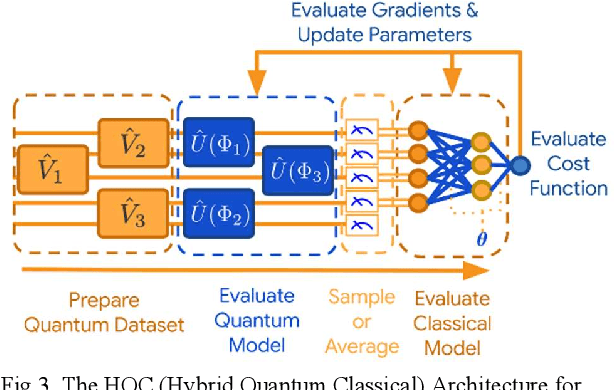
Hybrid Quantum-Classical (HQC) Architectures are used in near-term NISQ Quantum Computers for solving Quantum Machine Learning problems. The quantum advantage comes into picture due to the exponential speedup offered over classical computing. One of the major challenges in implementing such algorithms is the choice of quantum embeddings and the use of a functionally correct quantum variational circuit. In this paper, we present an application of QSVM (Quantum Support Vector Machines) to predict if a person will require mental health treatment in the tech world in the future using the dataset from OSMI Mental Health Tech Surveys. We achieve this with non-classically simulable feature maps and prove that NISQ HQC Architectures for Quantum Machine Learning can be used alternatively to create good performance models in near-term real-world applications.