 Add to Chrome
 Add to Firefox
 Add to Edge
Cooperate to Compete: Strategic Coordination in Multi-Agent Conquest
Apr 28, 2026
Language Model (LM)-based agents remain largely untested in mixed-motive settings where agents must leverage short-term cooperation for long-term competitive goals (e.g., multi-party politics). We introduce Cooperate to Compete (C2C), a multi-agent environment where players can engage in private negotiations while competing to be the first to achieve their secret objective. Players have asymmetric objectives and negotiations are non-binding, allowing alliances to form and break as players' short-term interests align and diverge. We run AI only games and conduct a user study pitting human players against AI opponents. We identify significant differences between human and AI negotiation behaviors, finding that humans favor lower-complexity deals and are significantly less reliable partners compared to LM-based agents. We also find that humans are more aggressive negotiators, accepting deals without a counteroffer only 56.3% of the time compared to 67.6% for LM-based agents. Through targeted prompting inspired by these findings, we modify agents' negotiation behavior and improve win rates from 22.2% to 32.7%. We run over 1,100 games with over 16,000 private conversations totaling 15.2 million tokens and over 150,000 player actions. Our results establish C2C as a testbed for studying and building LM-based agents that can navigate the sophisticated coordination required for real-world deployments. The game, code, and dataset may be found at https://negotiationgame.io/c2c.

DROID: A Large-Scale In-The-Wild Robot Manipulation Dataset
Mar 19, 2024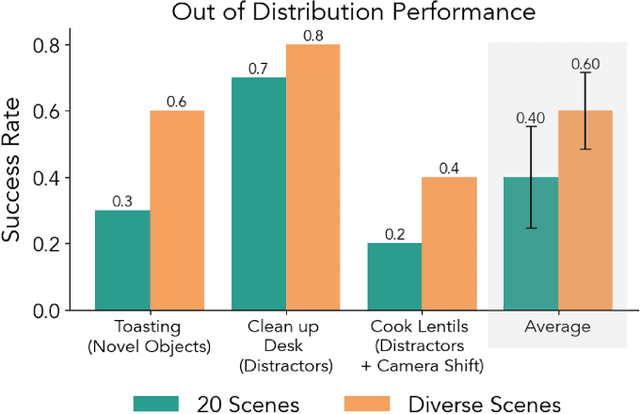
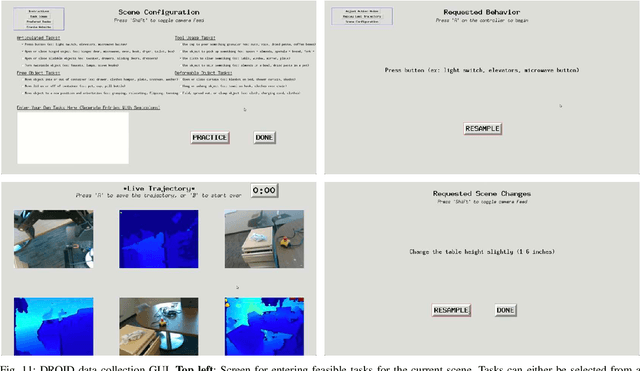
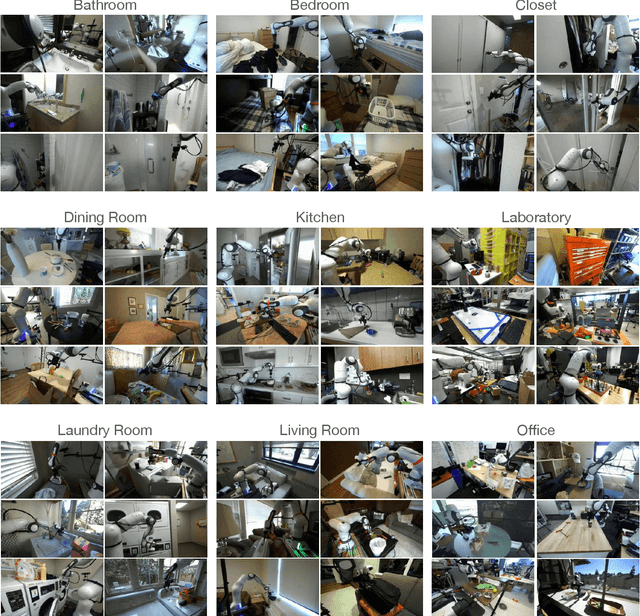
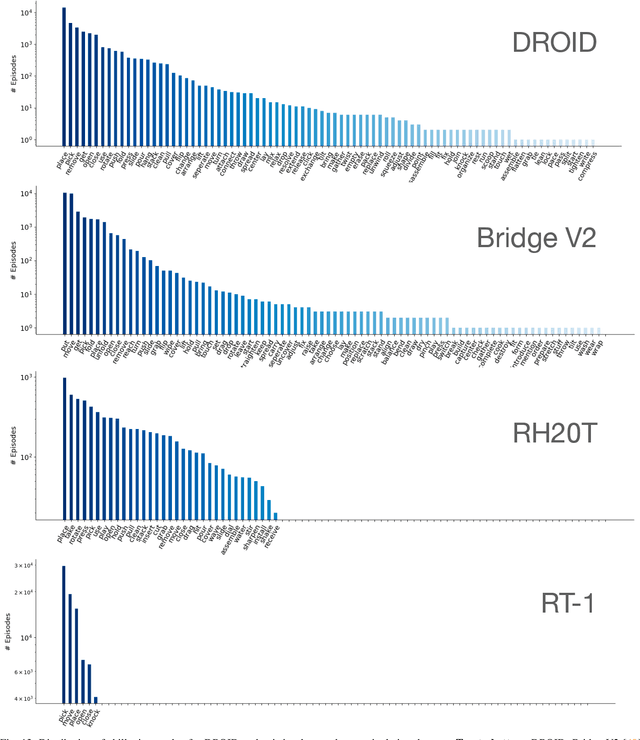
The creation of large, diverse, high-quality robot manipulation datasets is an important stepping stone on the path toward more capable and robust robotic manipulation policies. However, creating such datasets is challenging: collecting robot manipulation data in diverse environments poses logistical and safety challenges and requires substantial investments in hardware and human labour. As a result, even the most general robot manipulation policies today are mostly trained on data collected in a small number of environments with limited scene and task diversity. In this work, we introduce DROID (Distributed Robot Interaction Dataset), a diverse robot manipulation dataset with 76k demonstration trajectories or 350 hours of interaction data, collected across 564 scenes and 84 tasks by 50 data collectors in North America, Asia, and Europe over the course of 12 months. We demonstrate that training with DROID leads to policies with higher performance and improved generalization ability. We open source the full dataset, policy learning code, and a detailed guide for reproducing our robot hardware setup.