 Add to Chrome
 Add to Firefox
 Add to Edge
Less Context, Better Agents: Efficient Context Engineering for Long-Horizon Tool-Using LLM Agents
Jun 08, 2026
Large language models deployed as autonomous agents for enterprise workflows face a key challenge: verbose tool responses from enterprise systems can cause context overflow, stale-state errors, and high inference cost. We study this problem in automated expense itemization in Microsoft Dynamics 365 Finance and Operations using Model Context Protocol tools. We evaluate four GPT-5 configurations on a 50-task hotel expense benchmark: no user model, full conversation history, context pruned to the last 5 tool call/response pairs, and pruning with automated summarization. Results are averaged across 5 independent runs, with the user model held constant for the context-engineering comparison. The no-user-model baseline achieves only 8.0% complete itemization. Full-context retention improves completion to 71.0%, but consumes 1,480,996 tokens and 14.56 hours per benchmark. Pruning to the last 5 tool calls improves completion to 79.0% while reducing token use to 535,274 and runtime to 5.39 hours. Adding summarization achieves the best result: 91.6% complete itemization and 99.64% average amount itemized, with 553,374 tokens and 5.79 hours. We further report confidence intervals, effect-size analysis, sensitivity over pruning and summary windows, failure analysis, results across five expense types grouped into three categories, and cross-model evidence with Claude Sonnet 4.5. These results show that, for this class of enterprise tool-use workflow, selective retention of recent tool interactions plus compact summarization can improve both reliability and efficiency compared with full-history retention.

UMass-BioNLP at MEDIQA-M3G 2024: DermPrompt -- A Systematic Exploration of Prompt Engineering with GPT-4V for Dermatological Diagnosis
Apr 27, 2024


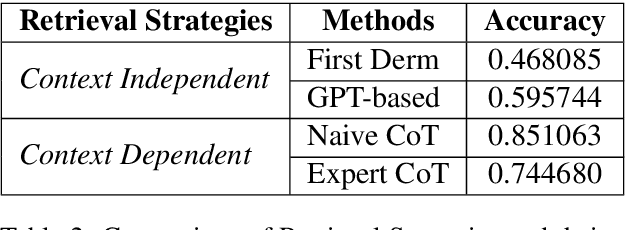
This paper presents our team's participation in the MEDIQA-ClinicalNLP2024 shared task B. We present a novel approach to diagnosing clinical dermatology cases by integrating large multimodal models, specifically leveraging the capabilities of GPT-4V under a retriever and a re-ranker framework. Our investigation reveals that GPT-4V, when used as a retrieval agent, can accurately retrieve the correct skin condition 85% of the time using dermatological images and brief patient histories. Additionally, we empirically show that Naive Chain-of-Thought (CoT) works well for retrieval while Medical Guidelines Grounded CoT is required for accurate dermatological diagnosis. Further, we introduce a Multi-Agent Conversation (MAC) framework and show its superior performance and potential over the best CoT strategy. The experiments suggest that using naive CoT for retrieval and multi-agent conversation for critique-based diagnosis, GPT-4V can lead to an early and accurate diagnosis of dermatological conditions. The implications of this work extend to improving diagnostic workflows, supporting dermatological education, and enhancing patient care by providing a scalable, accessible, and accurate diagnostic tool.
Understanding Code Semantics: An Evaluation of Transformer Models in Summarization
Oct 27, 2023This paper delves into the intricacies of code summarization using advanced transformer-based language models. Through empirical studies, we evaluate the efficacy of code summarization by altering function and variable names to explore whether models truly understand code semantics or merely rely on textual cues. We have also introduced adversaries like dead code and commented code across three programming languages (Python, Javascript, and Java) to further scrutinize the model's understanding. Ultimately, our research aims to offer valuable insights into the inner workings of transformer-based LMs, enhancing their ability to understand code and contributing to more efficient software development practices and maintenance workflows.
On Surgical Fine-tuning for Language Encoders
Oct 25, 2023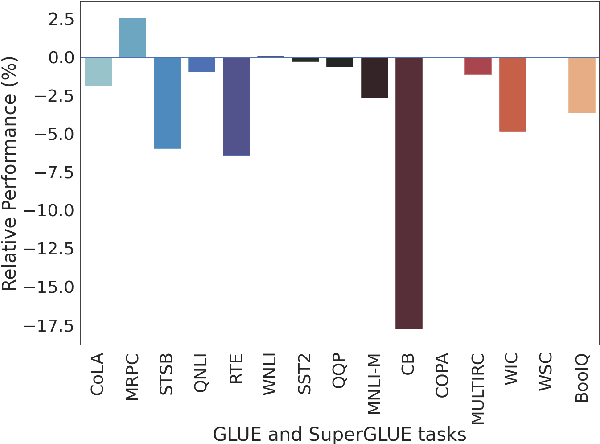

Fine-tuning all the layers of a pre-trained neural language encoder (either using all the parameters or using parameter-efficient methods) is often the de-facto way of adapting it to a new task. We show evidence that for different downstream language tasks, fine-tuning only a subset of layers is sufficient to obtain performance that is close to and often better than fine-tuning all the layers in the language encoder. We propose an efficient metric based on the diagonal of the Fisher information matrix (FIM score), to select the candidate layers for selective fine-tuning. We show, empirically on GLUE and SuperGLUE tasks and across distinct language encoders, that this metric can effectively select layers leading to a strong downstream performance. Our work highlights that task-specific information corresponding to a given downstream task is often localized within a few layers, and tuning only those is sufficient for strong performance. Additionally, we demonstrate the robustness of the FIM score to rank layers in a manner that remains constant during the optimization process.