 Add to Chrome
 Add to Firefox
 Add to Edge
Less Context, Better Agents: Efficient Context Engineering for Long-Horizon Tool-Using LLM Agents
Jun 08, 2026
Large language models deployed as autonomous agents for enterprise workflows face a key challenge: verbose tool responses from enterprise systems can cause context overflow, stale-state errors, and high inference cost. We study this problem in automated expense itemization in Microsoft Dynamics 365 Finance and Operations using Model Context Protocol tools. We evaluate four GPT-5 configurations on a 50-task hotel expense benchmark: no user model, full conversation history, context pruned to the last 5 tool call/response pairs, and pruning with automated summarization. Results are averaged across 5 independent runs, with the user model held constant for the context-engineering comparison. The no-user-model baseline achieves only 8.0% complete itemization. Full-context retention improves completion to 71.0%, but consumes 1,480,996 tokens and 14.56 hours per benchmark. Pruning to the last 5 tool calls improves completion to 79.0% while reducing token use to 535,274 and runtime to 5.39 hours. Adding summarization achieves the best result: 91.6% complete itemization and 99.64% average amount itemized, with 553,374 tokens and 5.79 hours. We further report confidence intervals, effect-size analysis, sensitivity over pruning and summary windows, failure analysis, results across five expense types grouped into three categories, and cross-model evidence with Claude Sonnet 4.5. These results show that, for this class of enterprise tool-use workflow, selective retention of recent tool interactions plus compact summarization can improve both reliability and efficiency compared with full-history retention.

emojiSpace: Spatial Representation of Emojis
Sep 12, 2022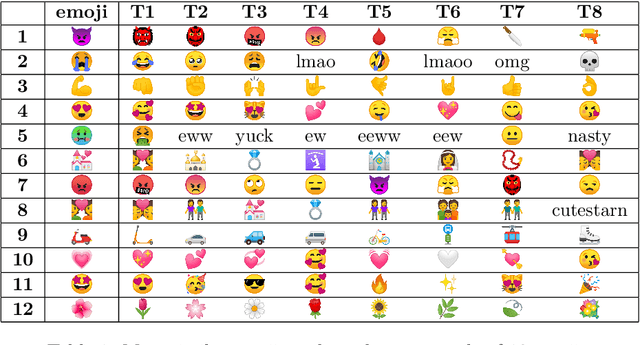
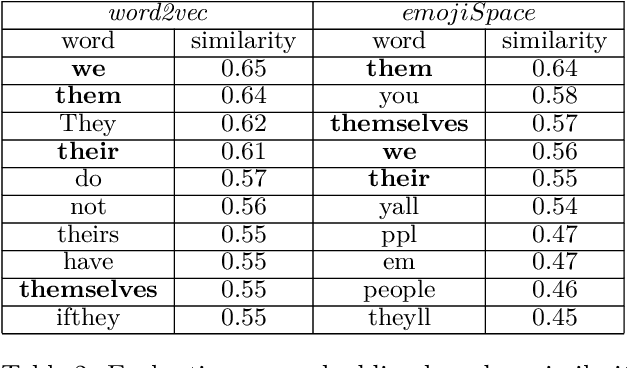

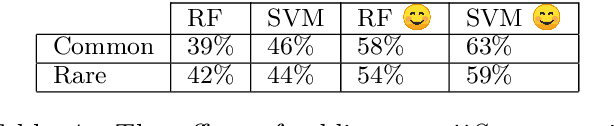
In the absence of nonverbal cues during messaging communication, users express part of their emotions using emojis. Thus, having emojis in the vocabulary of text messaging language models can significantly improve many natural language processing (NLP) applications such as online communication analysis. On the other hand, word embedding models are usually trained on a very large corpus of text such as Wikipedia or Google News datasets that include very few samples with emojis. In this study, we create emojiSpace, which is a combined word-emoji embedding using the word2vec model from the Genism library in Python. We trained emojiSpace on a corpus of more than 4 billion tweets and evaluated it by implementing sentiment analysis on a Twitter dataset containing more than 67 million tweets as an extrinsic task. For this task, we compared the performance of two different classifiers of random forest (RF) and linear support vector machine (SVM). For evaluation, we compared emojiSpace performance with two other pre-trained embeddings and demonstrated that emojiSpace outperforms both.
Using Statistical Models to Detect Occupancy in Buildings through Monitoring VOC, CO$_2$, and other Environmental Factors
Mar 07, 2022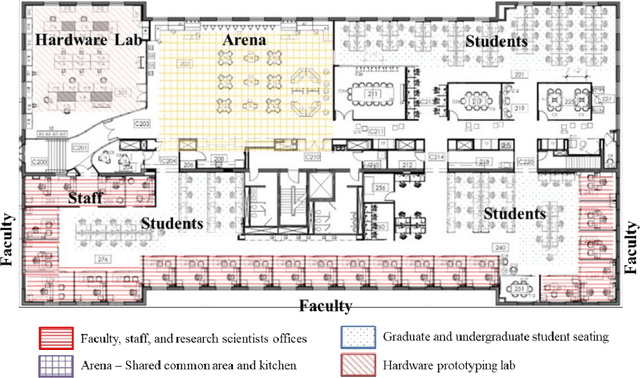
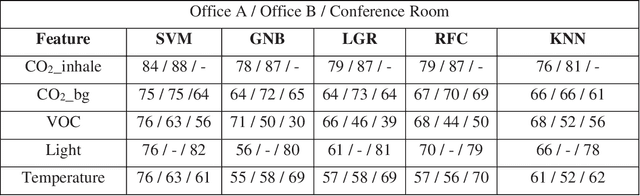
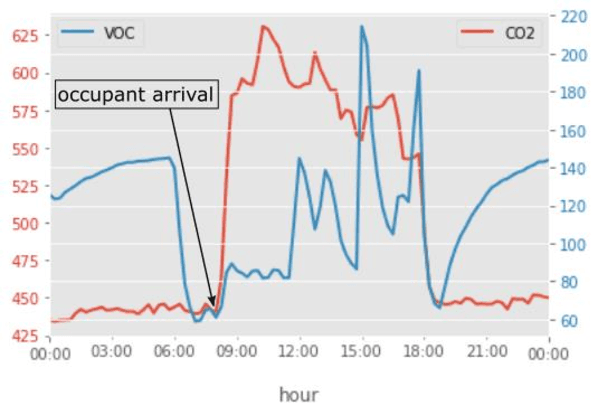
Dynamic models of occupancy patterns have shown to be effective in optimizing building-systems operations. Previous research has relied on CO$_2$ sensors and vision-based techniques to determine occupancy patterns. Vision-based techniques provide highly accurate information; however, they are very intrusive. Therefore, motion or CO$_2$ sensors are more widely adopted worldwide. Volatile Organic Compounds (VOCs) are another pollutant originating from the occupants. However, a limited number of studies have evaluated the impact of occupants on the VOC level. In this paper, continuous measurements of CO$_2$, VOC, light, temperature, and humidity were recorded in a 17,000 sqft open office space for around four months. Using different statistical models (e.g., SVM, K-Nearest Neighbors, and Random Forest) we evaluated which combination of environmental factors provides more accurate insights on occupant presence. Our preliminary results indicate that VOC is a good indicator of occupancy detection in some cases. It is also concluded that proper feature selection and developing appropriate global occupancy detection models can reduce the cost and energy of data collection without a significant impact on accuracy.