 Add to Chrome
 Add to Firefox
 Add to Edge
Remote ID Spoofing-Aware Trajectory Planning for Small Unmanned Aerial Systems
Jul 22, 2026
This work presents a decentralized, spoofing-aware trajectory planning framework for small unmanned aerial systems operating under Remote Identification (RID) location spoofing attacks. Existing planners typically assume RID broadcasts are trustworthy, which can increase the risk of loss of separation and mid-air collisions when spoofing occurs. In contrast, the proposed approach explicitly treats RID information as unverified and incorporates physical-layer observations to assess broadcast credibility. Received signal-strength measurements from neighboring aircraft are used to detect spoofing and probabilistically localize a spoofing agent. The resulting uncertainty is converted into a risk-bounded unsafe region using a chance-constrained formulation and integrated into a per-agent Markov decision process-based planner. This enables real-time, decentralized collision avoidance while preserving mission objectives and scalability. Simulation results in a multi-aircraft package delivery scenario demonstrate reduced near mid-air collision events compared to planners that assume truthful RID data, while maintaining computational efficiency suitable for real-time execution.

Safe and Scalable Real-Time Trajectory Planning Framework for Urban Air Mobility
Jun 20, 2023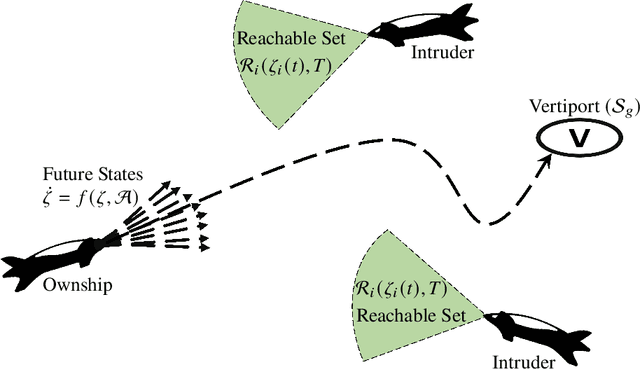

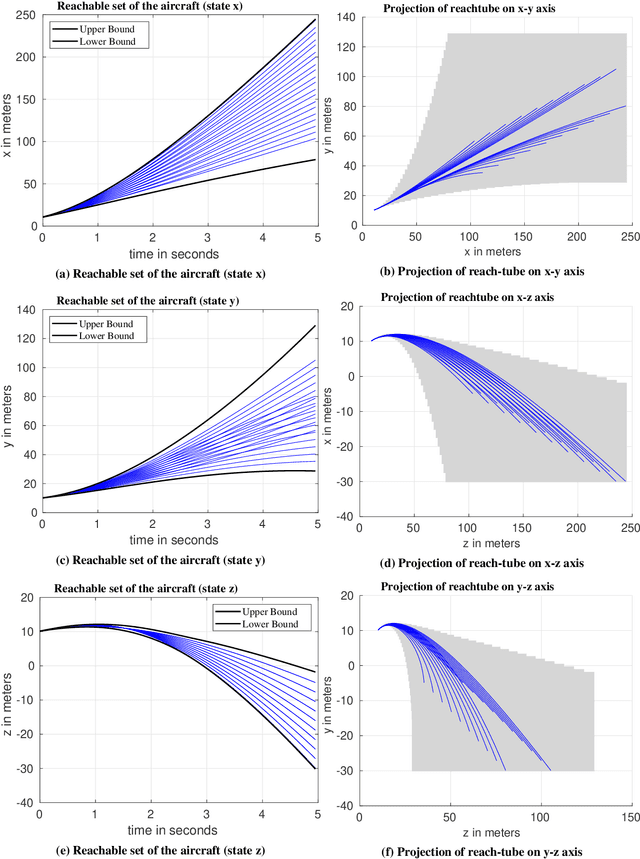
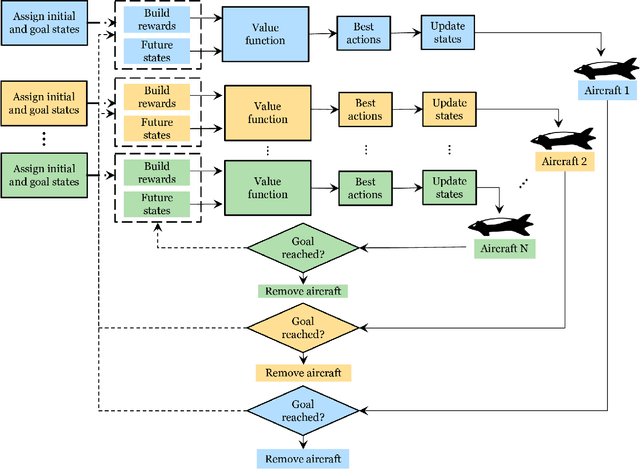
This paper presents a real-time trajectory planning framework for Urban Air Mobility (UAM) that is both safe and scalable. The proposed framework employs a decentralized, free-flight concept of operation in which each aircraft independently performs separation assurance and conflict resolution, generating safe trajectories by accounting for the future states of nearby aircraft. The framework consists of two main components: a data-driven reachability analysis tool and an efficient Markov Decision Process (MDP) based decision maker. The reachability analysis over-approximates the reachable set of each aircraft through a discrepancy function learned online from simulated trajectories. The decision maker, on the other hand, uses a 6-degrees-of-freedom guidance model of fixed-wing aircraft to ensure collision-free trajectory planning. Additionally, the proposed framework incorporates reward shaping and action shielding techniques to enhance safety performance. The proposed framework is evaluated through simulation experiments involving up to 32 aircraft in a UAM setting, with performance measured by the number of Near Mid Air Collisions (NMAC) and computational time. The results demonstrate the safety and scalability of the proposed framework.
A Survey on Reinforcement Learning in Aviation Applications
Nov 03, 2022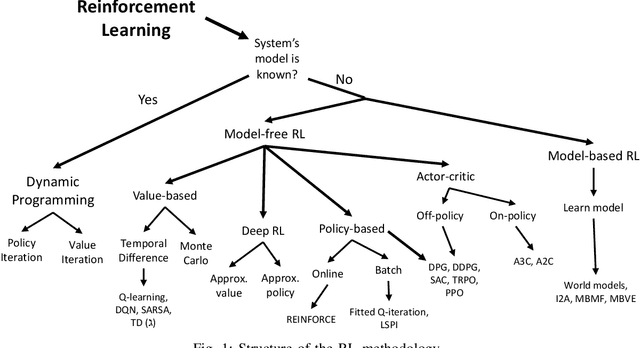
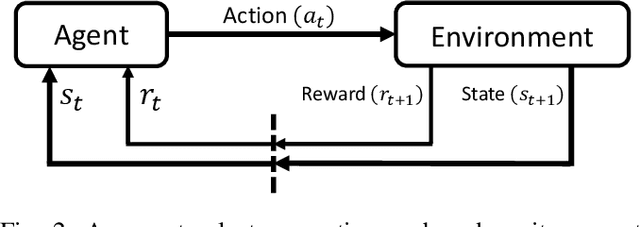
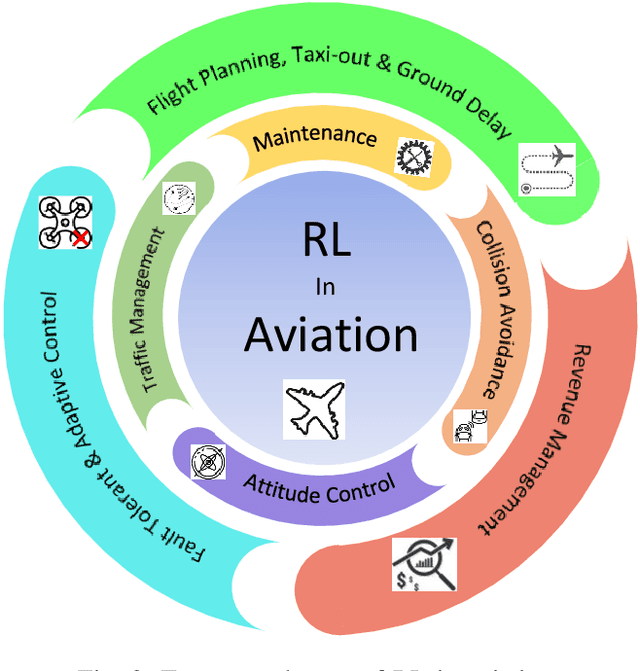
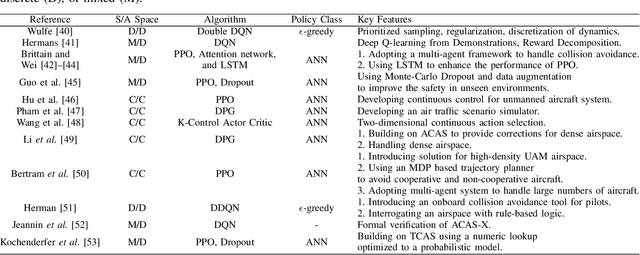
Compared with model-based control and optimization methods, reinforcement learning (RL) provides a data-driven, learning-based framework to formulate and solve sequential decision-making problems. The RL framework has become promising due to largely improved data availability and computing power in the aviation industry. Many aviation-based applications can be formulated or treated as sequential decision-making problems. Some of them are offline planning problems, while others need to be solved online and are safety-critical. In this survey paper, we first describe standard RL formulations and solutions. Then we survey the landscape of existing RL-based applications in aviation. Finally, we summarize the paper, identify the technical gaps, and suggest future directions of RL research in aviation.