 Add to Chrome
 Add to Firefox
 Add to Edge
RSMA-Enabled ISAC Networks with Fluid Antenna Systems: Stochastic Geometry Analysis and Low-Complexity Resource Allocation
Aug 12, 2026
In this paper, we investigate the downlink performance of multi-cell RSMA-enabled ISAC networks in which base stations (BSs), communication users, and sensing targets are spatially distributed according to independent Poisson point processes (PPPs). Each BS simultaneously serves multiple users using RSMA while exploiting the common stream as a dual-functional communication and sensing waveform. The users are equipped with FAS that selects the best antenna port to maximize the received signal quality. Closed-form analytical expressions are derived for the ergodic sum-rates by combining stochastic geometry, order statistics, and Laplace-transform-based interference analysis. Furthermore, a tractable approximation for the average radar SINR is developed by characterizing the statistical properties of the common precoder. Leveraging the derived analytical expressions, a low-complexity analytical resource allocation framework is proposed to jointly optimize the RSMA power allocation, the communication-sensing beam tradeoff, and the number of scheduled users while sat- isfying the sensing quality-of-service constraint. Compared with conventional iterative optimization approaches, the proposed analytical design significantly reduces computational complexity while achieving nearly identical communication performance. Simulation results verify the accuracy of the developed analytical expressions and demonstrate substantial improvements in both RSMA sum-rate and sensing performance over conventional transmission schemes.

Symbiotic FAS Strategies for 6G UAVs Assisted Backscatter Networks
Aug 01, 2026This paper investigates a fluid antenna system (FAS) enabled symbiotic radio (SR) network featuring a UAV mounted FAS communicating through a wireless power transfer (WPT) signal with a remote cluster head and an ambient tag. To evaluate system reliability, we derive the upper (UB) and lower (LB) bounds for both the composite and backscatter (BcS) outage probabilities, formulate the coexistence outage probability (COP), and present an asymptotic analysis that explicitly characterizes the system's spatial diversity and coding gains. We propose three novel symbiotic strategies; maximum backscatter selection (MBS), joint balanced selection (JBS) and threshold aware priority selection (TAPS) and compare them with the conventional maximum composite gain selection (MCGS) and random selection methods. Under a joint optimization framework, the macroscopic UAV 2D spatial placement and microscopic realization - level port selection were formulated. Since the joint outage Pareto frontier is highly non-convex, the computationally expensive epsilon-constraint method identified the optimal knee-point. While the symbiotic novel TAPS strategy demonstrated identical performance in a single step with linear O(MN) complexity. Moreover, an asymptotic closed form mobility analysis under Jakes' fading model proves that the symbiotic FAS tracking protocol consumes under 10% of the channel coherence time. Simulation results and COP heat maps validate the optimal coexistence performance at the ideal UAV coordinates with 60% reduction in the required transmit power.
Fundamental Limits of Localization with Fluid Antenna Systems: A Fisher Information Analysis
Dec 15, 2025In this letter, we investigate the fundamental limits of localization in fluid antenna systems (FAS) utilizing a Fisher-information-theoretic framework. We develop a unified model to quantify the localization information extractable from time-of-arrival (ToA) and angle-of-arrival (AoA) measurements, explicitly capturing the synthetic aperture effects induced by FAS. Closed-form expressions are derived for the equivalent Fisher information matrix (EFIM) and the corresponding positioning error bound (PEB) in both user-side and base-station (BS)-side FAS configurations. Also, we propose optimal port-selection strategies based on greedy algorithms and convex relaxation to maximize the information gain under a constrained number of activated ports. Numerical results demonstrate that the proposed port-selection schemes can substantially tighten the PEB compared with random activation, thereby confirming the strong potential of FAS to enable high-precision localization. These results offer analytical insights and practical design guidelines for FAS-aided positioning in future-generation wireless networks
Secure ISAC with Fluid Antenna Systems: Joint Precoding and Port Selection
Sep 30, 2025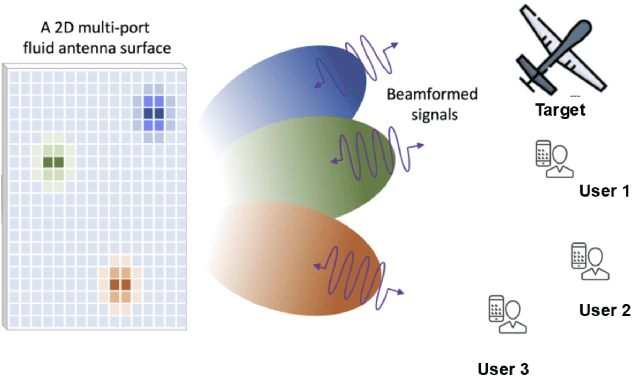
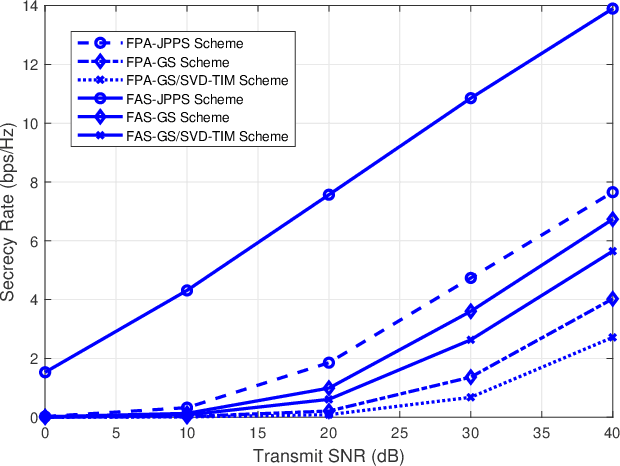
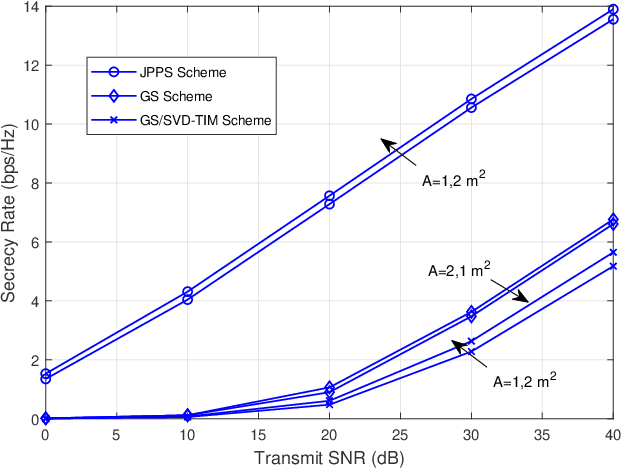
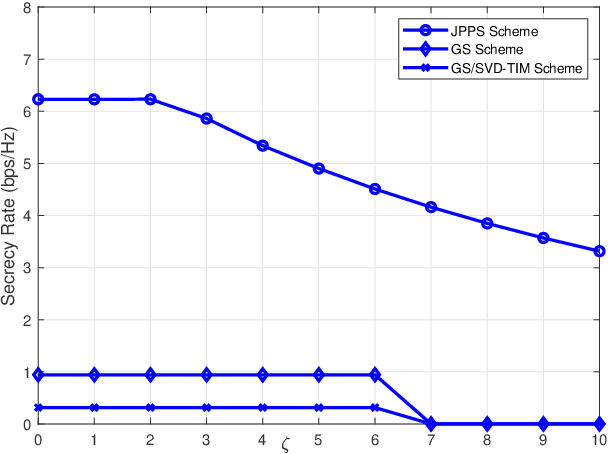
This paper presents a novel framework for enhancing physical-layer security in integrated sensing and communication (ISAC) systems by leveraging the reconfigurability of fluid antenna systems (FAS). We propose a joint precoding and port selection (JPPS) strategy that maximizes the sum secrecy rate while simultaneously ensuring reliable radar sensing. The problem is formulated using fractional programming (FP) and solved through an iterative algorithm that integrates FP transformations with successive convex approximation (SCA). To reduce computational complexity, we further develop low-complexity schemes based on zero-forcing (ZF) precoding, combined with greedy port selection and trace-inverse minimization. Simulation results demonstrate substantial improvements in both secrecy performance and sensing accuracy compared to conventional baselines, across a wide range of FAS ports, user loads, and sensing targets. These findings highlight the critical importance of FAS geometry optimization in enabling secure and efficient joint communication-sensing for next-generation wireless networks.
Secure Communication of UAV-mounted STAR-RIS under Phase Shift Errors
Jul 08, 2025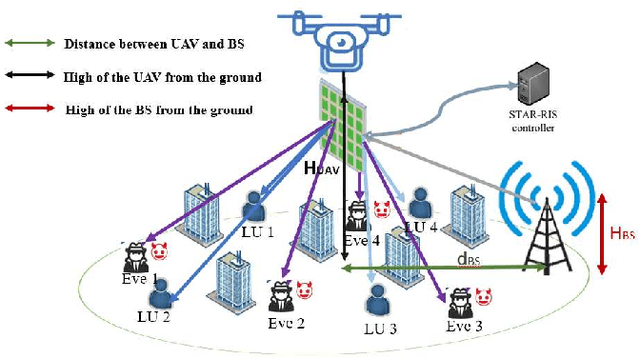
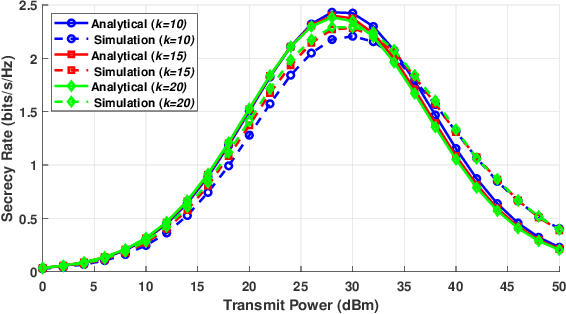
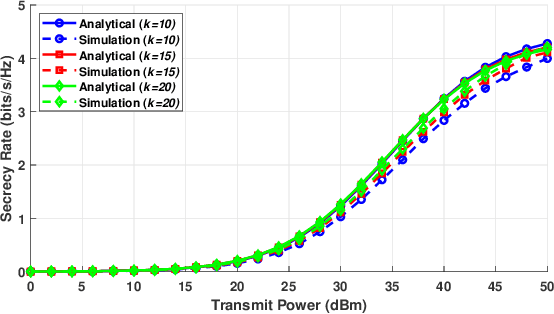
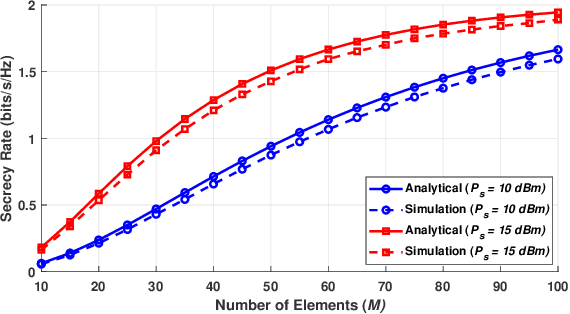
This paper investigates the secure communication capabilities of a non-orthogonal multiple access (NOMA) network supported by a STAR-RIS (simultaneously transmitting and reflecting reconfigurable intelligent surface) deployed on an unmanned aerial vehicle (UAV), in the presence of passive eavesdroppers. The STAR-RIS facilitates concurrent signal reflection and transmission, allowing multiple legitimate users-grouped via NOMA-to be served efficiently, thereby improving spectral utilization. Each user contends with an associated eavesdropper, creating a stringent security scenario. Under Nakagami fading conditions and accounting for phase shift inaccuracies in the STAR-RIS, closed-form expressions for the ergodic secrecy rates of users in both transmission and reflection paths are derived. An optimization framework is then developed to jointly adjust the UAV's positioning and the STAR-RIS power splitting coefficient, aiming to maximize the system's secrecy rate. The proposed approach enhances secure transmission in STAR-RIS-NOMA configurations under realistic hardware constraints and offers valuable guidance for the design of future 6G wireless networks.
A First Look at the Performance Enhancement Potential of Fluid Reconfigurable Intelligent Surface
Feb 24, 2025The fluid antenna concept represents shape-flexible and position-flexible antenna technologies designed to enhance wireless communication applications. In this paper, we apply this concept to reconfigurable intelligent surfaces (RISs), introducing fluid RIS (FRIS), where each tunably reflecting element becomes a fluid element with additional position reconfigurability. This new paradigm is referred to as fluid RIS (FRIS). We investigate an FRIS-programmable wireless channel, where the fluid meta-surface is divided into non-overlapping subareas, each acting as a fluid element that can dynamically adjust both its position and phase shift of the reflected signal. We first analyze the single-user, single-input single-output (SU-SISO) channel, in which a single-antenna transmitter communicates with a single-antenna receiver via an FRIS. The achievable rate is maximized by optimizing the fluid elements using a particle swarm optimization (PSO)- based approach. Next, we extend our analysis to the multi-user, multiple-input single-output (MU-MISO) case, where a multi-antenna base station (BS) transmits individual data streams to multiple single-antenna users via an FRIS. In this case, the joint optimization of the positions and phase shifts of the FRIS element, as well as the BS precoding to maximize the sum-rate is studied. To solve the problem, a combination of techniques including PSO, semi-definite relaxation (SDR), and minimum mean square error (MMSE) is proposed. Numerical results demonstrate that the proposed FRIS approach significantly outperforms conventional RIS configurations in terms of achievable rate performance.
Modeling and Design of RIS-Assisted Multi-cell Multi-band Networks with RSMA
Aug 04, 2024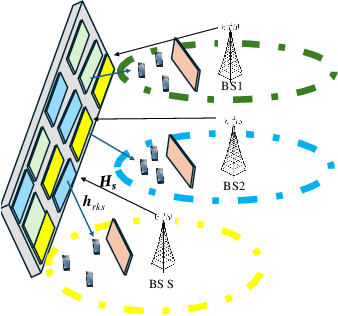

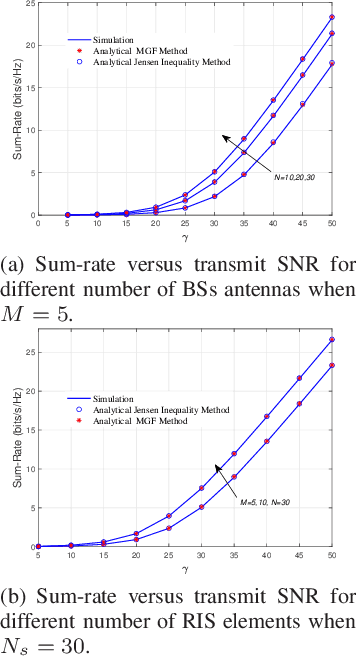

Reconfigurable intelligent surface (RIS) has been identified as a promising technology for future wireless communication systems due to its ability to manipulate the propagation environment intelligently. RIS is a frequency-selective device, thus it can only effectively manipulate the propagation of signals within a specific frequency band. This frequency selective characteristic can make deploying RIS in wireless cellular networks more challenging, as adjacent base stations (BSs) operate on different frequency bands. In addition, rate-splitting multiple access (RSMA) scheme has been shown to enhance the performance of RIS-aided multi-user communication systems. Accordingly, this work considers a more practical reflection model for RIS-aided RSMA communication systems, which accounts for the responses of signals across different frequency bands. To that end, new analytical expressions for the ergodic sum-rate are derived using the moment generating function (MGF) and Jensen inequality. Based on these analytical sum-rate expressions, novel practical RIS reflection designs and power allocation strategies for the RSMA scheme are proposed and investigated to maximize the achievable sum-rate in RIS-assisted multi-cell, multi-band cellular networks. Simple sub-optimal designs are also introduced and discussed. The results validate the significant gains of our proposed reflection design algorithms with RSMA over conventional schemes in terms of achievable sum-rate. Additionally, the power allocation strategy for the RSMA scheme is shown to offer superior performance compared to conventional precoding schemes that do not rely on RSMA.
User Clustering for STAR-RIS Assisted Full-Duplex NOMA Communication Systems
Dec 31, 2023In contrast to conventional reconfigurable intelligent surface (RIS), simultaneous transmitting and reflecting reconfigurable intelligent surface (STAR-RIS) has been proposed recently to enlarge the serving area from 180o to 360o coverage. This work considers the performance of a STAR-RIS aided full-duplex (FD) non-orthogonal multiple access (NOMA) communication systems. The STAR-RIS is implemented at the cell-edge to assist the cell-edge users, while the cell-center users can communicate directly with a FD base station (BS). We first introduce new user clustering schemes for the downlink and uplink transmissions. Then, based on the proposed transmission schemes closed-form expressions of the ergodic rates in the downlink and uplink modes are derived taking into account the system impairments caused by the self interference at the FD-BS and the imperfect successive interference cancellation (SIC). Moreover, an optimization problem to maximize the total sum-rate is formulated and solved by optimizing the amplitudes and the phase-shifts of the STAR-RIS elements and allocating the transmit power efficiently. The performance of the proposed user clustering schemes and the optimal STAR-RIS design are investigated through numerical results
STAR-RIS Assisted Full-Duplex Communication Networks
Sep 26, 2023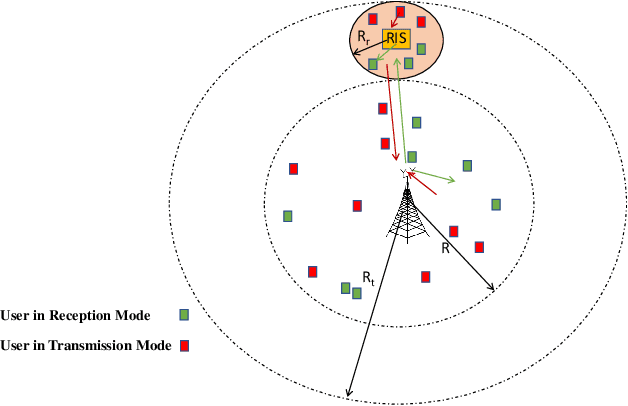
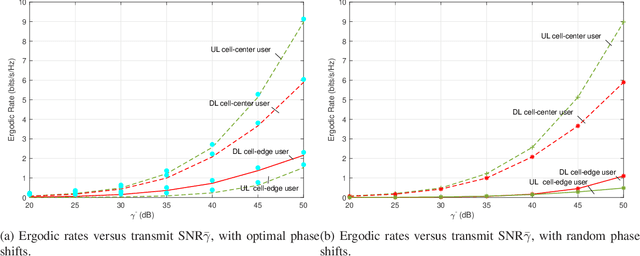
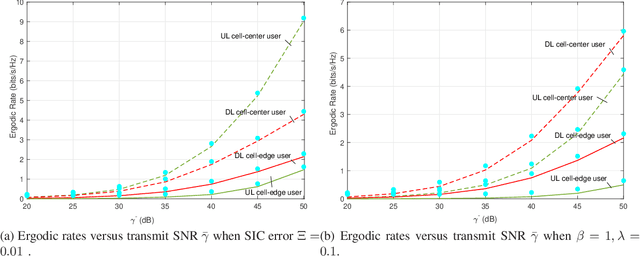
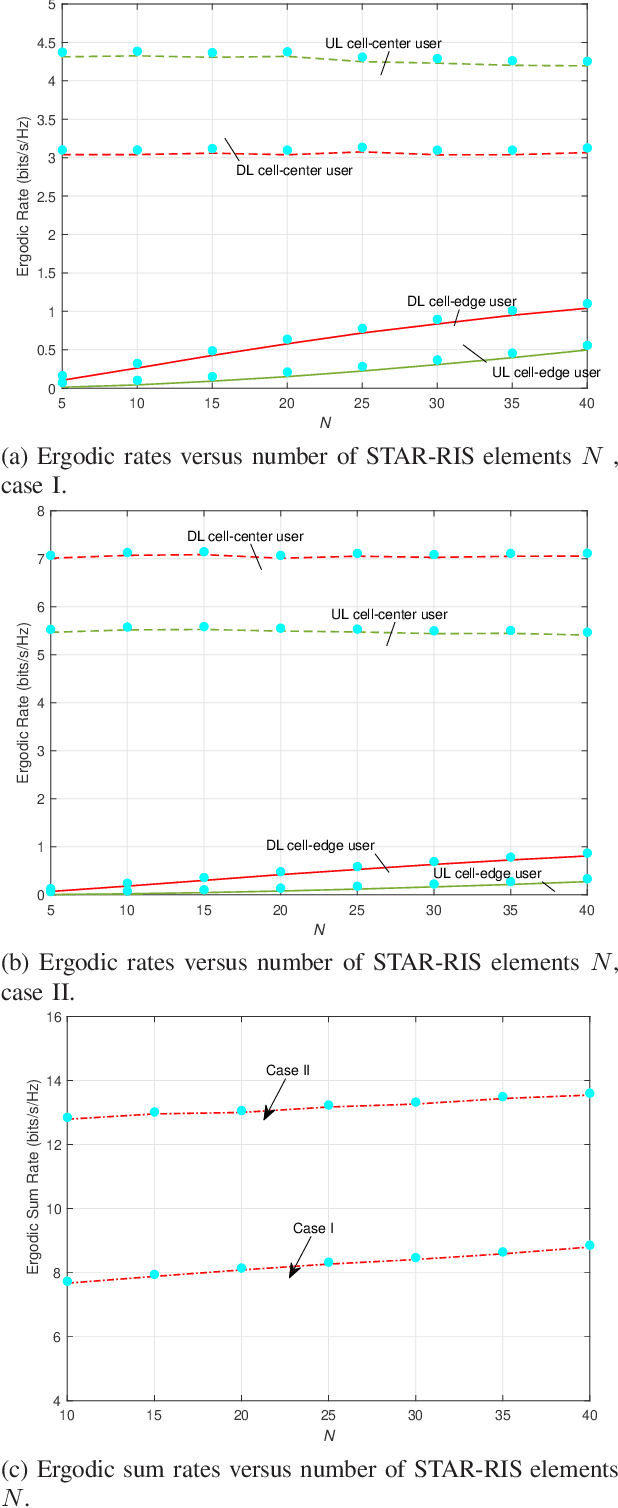
Different from conventional reconfigurable intelligent surfaces (RIS), a recent innovation called simultaneous transmitting and reflecting reconfigurable intelligent surface (STAR-RIS) has emerged, aimed at achieving complete 360-degree coverage in communication networks. Additionally, fullduplex (FD) technology is recognized as a potent approach for enhancing spectral efficiency by enabling simultaneous transmission and reception within the same time and frequency resources. In this study, we investigate the performance of a STAR-RIS-assisted FD communication system. The STAR-RIS is strategically placed at the cell-edge to facilitate communication for users located in this challenging region, while cell-center users can communicate directly with the FD base station (BS). We employ a non-orthogonal multiple access (NOMA) pairing scheme and account for system impairments, such as self-interference at the BS and imperfect successive interference cancellation (SIC). We derive closed-form expressions for the ergodic rates in both the up-link and down-link communications and extend our analysis to bidirectional communication between cell-center and cell-edge users. Furthermore, we formulate an optimization problem aimed at maximizing the ergodic sum-rate. This optimization involves adjusting the amplitudes and phase-shifts of the STAR-RIS elements and allocating total transmit power efficiently. To gain deeper insights into the achievable rates of STAR-RIS-aided FD systems, we explore the impact of various system parameters through numerical results.
Impact of Phase-Shift Error on the Secrecy Performance of Uplink RIS Communication Systems
Dec 31, 2022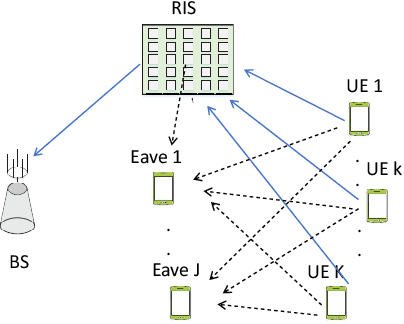
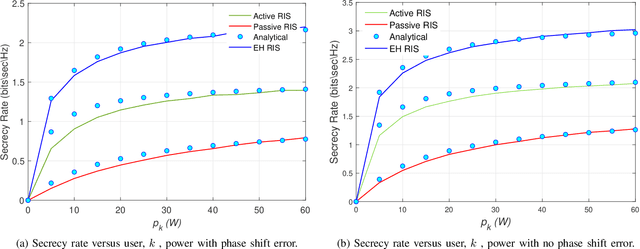
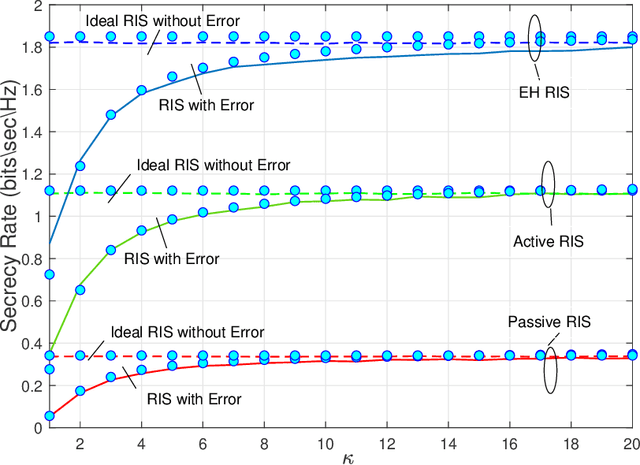
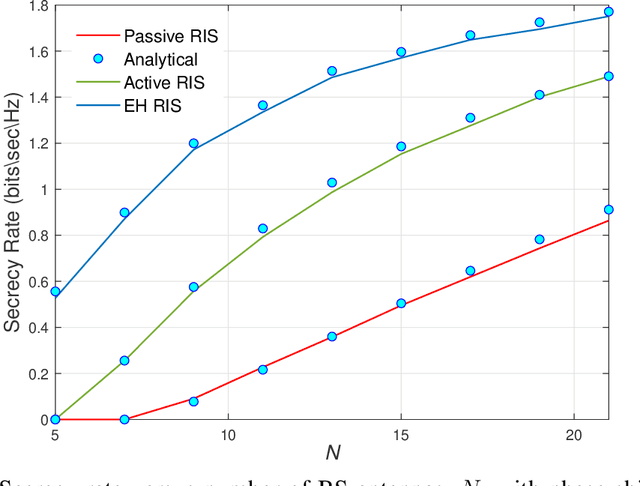
Reconfigurable intelligent surface (RIS) has been recognized as a promising technique for the sixth generation (6G) of mobile communication networks. The key feature of RIS is to reconfigure the propagation environment via smart signal reflections. In addition, active RIS schemes have been recently proposed to overcome the deep path loss attenuation inherent in the RIS-aided communication systems. Accordingly, this paper considers the secrecy performance of up-link RIS-aided multiple users multiple-input single-output (MU-MISO) communication systems, in the presence of multiple passive eavesdroppers. In contrast to the existing works, we investigate the impact of the RIS phase shift errors on the secrecy performance. Taking into account the complex environment, where a general Rician channel model is adopted for all the communication links, closed-form approximate expressions for the ergodic secrecy rate are derived for three RIS configurations, namely, i) passive RIS, ii) active RIS, iii) active RIS with energy harvesting (EH RIS). Then, based on the derived expressions, we optimize the phase shifts at the RIS to enhance the system performance. In addition, the best RIS configuration selection is considered for a given target secrecy rate and amount of the power available at the users. Finally, Monte-Carlo simulations are provided to verify the accuracy of the analysis, and the impact of different system parameters on the secrecy performance is investigated. The results in this paper show that, an active RIS scheme can be implemented to enhance the secrecy performance of RIS-aided communication systems with phase shift errors, especially when the users have limited transmission power.