 Add to Chrome
 Add to Firefox
 Add to Edge
Adaptive UAV Communications for URLLC: From Preplanned Designs to Real-Time Intelligence
May 31, 2026
Unmanned aerial vehicles (UAVs) are emerging as a key enabler of next-generation wireless networks, particularly for applications that require ultra-reliable and low-latency communication (URLLC), such as emergency response, industrial automation, and autonomous systems. In these scenarios, maintaining reliable connectivity under strict transmission time constraints is challenging due to dynamic environments, mobility, and limited onboard energy. In particular, communication performance and energy are closely coupled with UAV movement, making trajectory design a critical component of system operation. Most existing approaches rely on offline joint communication and trajectory optimization, where the UAV trajectory and communication parameters are optimized prior to execution based on assumed system information. Although effective under ideal assumptions, such designs cannot adapt to real-time variations in user demand, channel conditions, or environmental disturbances, which are particularly critical in URLLC settings. To address these challenges, this article investigates model predictive control (MPC) as an adaptive framework for UAV-enabled communications. Using a receding-horizon strategy, MPC enables the UAV to continuously update its trajectory based on real-time information, improving reliability and robustness in dynamic environments. Representative application scenarios are discussed to highlight the role of MPC in UAV-enabled URLLC systems. Furthermore, a case study is presented to illustrate key design trade-offs and performance insights under finite blocklength-based URLLC transmission, followed by a discussion on open challenges and future research directions for practical and scalable MPC-enabled UAV communication systems.

Stacked Intelligent Metasurfaces for Near-Field Multi-User Covert Communications
Mar 29, 2026Reconfigurable intelligent surfaces have emerged as a cutting-edge technology for next-generation wireless communications that are capable of reconfiguring the wireless environment using a large number of cost-effective reflecting elements. However, a significant body of prior studies has focused on single-layer surfaces that lack the capability of significantly mitigating inter-user interference. Moreover, previous studies mostly consider far-field operation and neglect working in the near-field region. In this paper, we propose a stacked intelligent metasurfaces (SIM)-assisted near-field multi-user multiple-input-single-output covert communication system. More specifically, we have a multi-antenna base station that is assisted with a SIM to serve multiple single-antenna users in the presence of multiple single-antenna wardens. We aim at optimizing the beamfocusing vectors at the BS and SIM phase shift matrices to maximize the sum covert rate under maximum transmit power budget constraint, quality-of-service (QoS) constraint for all users, and covertness constraint. Since the formulated problem is highly non-convex due to the coupling between the variables, we adopt alternating optimization to tackle it, where we divide the problem into beamfocusing sub-problem and SIM phase shift sub-problem, which are solved alternately until convergence. We leverage successive convex approximation (SCA) to solve the two sub-problems. Additionally, we formulate the SIM phase shift sub-problem using the widely adopted projected gradient ascent (PGA) method for comparison purposes. The conducted simulations reveal that the SCA-based algorithm outperforms the existing PGA-based algorithm as well as other benchmarks in terms of the achieved sum covert rate, demonstrating its consistent performance and robustness under various system parameter configurations.
Online Model Predictive Control for Trajectory and Beamforming Optimization in UAV-Enabled URLLC
Mar 14, 2026This paper investigates joint trajectory and active beamforming design for unmanned aerial vehicle (UAV)-enabled ultra-reliable low-latency communication (URLLC) systems under finite blocklength (FBL) transmission. Unlike conventional Shannon-capacity formulations, the FBL regime introduces a signal-to-interference-plus-noise ratio (SINR)-dependent dispersion penalty that increases the sensitivity of reliability to mobility-induced channel variations. To address this challenge, we develop a propulsion-aware model predictive control (MPC) framework that performs receding-horizon joint trajectory and multi-user beamforming optimization while enforcing FBL-based rate constraints. The resulting long-horizon nonconvex problem is decomposed into beamforming and trajectory subproblems using alternating optimization. Concave surrogate is constructed for the Shannon-capacity term, while convex approximations are derived for the dispersion term and the nonlinear propulsion power model, yielding tractable convex subproblems solved iteratively. Compared with an offline MPC baseline, where the predictive problem is solved once over the entire mission horizon without feedback updates, and a conventional offline trajectory-beamforming optimization, the proposed closed-loop framework achieves disturbance-resilient mission completion under UAV position disturbances. Simulation results show that, compared with maximum ratio transmission (MRT) and equal-power allocation, the proposed interference-aware design significantly improves URLLC reliability under stringent minimum rate constraints. The results also quantify the impact of antenna scaling, transmit power, and transmission time on FBL performance, providing insights for reliability-centric UAV-enabled wireless networks in 5G and beyond.
STAR-RIS-Aided Secure Communications:Analytical Insights and Performance Comparison
Dec 12, 2025Simultaneously transmitting and reflecting reconfigurable intelligent surfaces (STAR-RISs) have emerged as a promising technology for enabling full-space signal manipulation and enhancing wireless network coverage and capacity. In this article, we present a comprehensive analytical comparison of STAR-RIS-assisted systems with single-input single-output (SISO), conventional RISs, and decode-and-forward (DF) relaying schemes, including both half-duplex (HD) and full-duplex (FD) modes. Closed-form expressions are derived for the achievable secrecy rates of STAR-RIS-aided communications under both the absence and presence of eavesdroppers. Unlike most existing works, the direct source destination link is incorporated in all considered schemes, and optimal transmit power allocation is investigated for HD and FD-DF relaying. Furthermore, we provide the conditions under which STAR-RIS outperforms HD- and FD-DF relaying and quantify the minimum number of STAR-RIS elements required to achieve superior rates. The impacts of key system parameters including transmit power, number of elements, reflection-to-transmission power ratio, element-splitting factor, and deployment positions on both achievable and secrecy performance are investigated. The results reveal that STAR-RIS systems can achieve superior rates and secrecy rates compared to all benchmark schemes.
Outage Performance of Fluid Antenna System (FAS)-aided Terahertz Communication Networks
Jan 21, 2023Millimeter-wave networks have already been successfully rolled out in many countries and now the research direction heads toward new technologies and standards to enable Tbps rates for future sixth-generation (6G) wireless communication systems. This work studies a point-to-point terahertz (THz) communication network exploiting the concept of a fluid antenna system (FAS) over correlated alpha-mu fading channels, nicely fitting the THz communication. Furthermore, the considered system is expanded to the selection-combining-FAS (SC-FAS) and maximum-gain-combining- FAS (MGC-FAS) diversity variates at the receiver side. The proposed FAS and its diversity configuration techniques are aimed to combat the high path loss, blockages, and molecular absorption effect related to the THz band. Our contribution includes comprehensive outage probability (OP) performance analysis for the THz band given the non-diversity and diversity FAS receivers. Moreover, the derived outage probability formulas are verified via Monte Carlo simulations. Numerical results have confirmed the superior performance of the MGC-FAS scheme in terms of OP. Finally, this work justifies that a higher number of antenna ports dramatically improves the system performance, even in the presence of correlation.
IRS-Assisted Millimeter-wave Massive MIMO with Transmit Antenna Selection for IoT Networks
Dec 12, 2022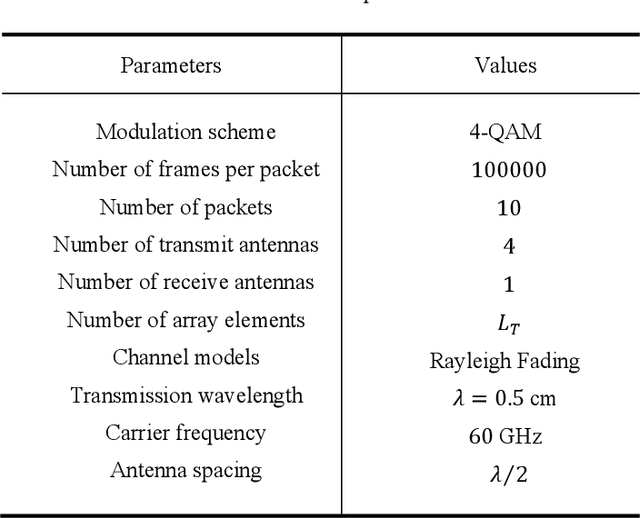
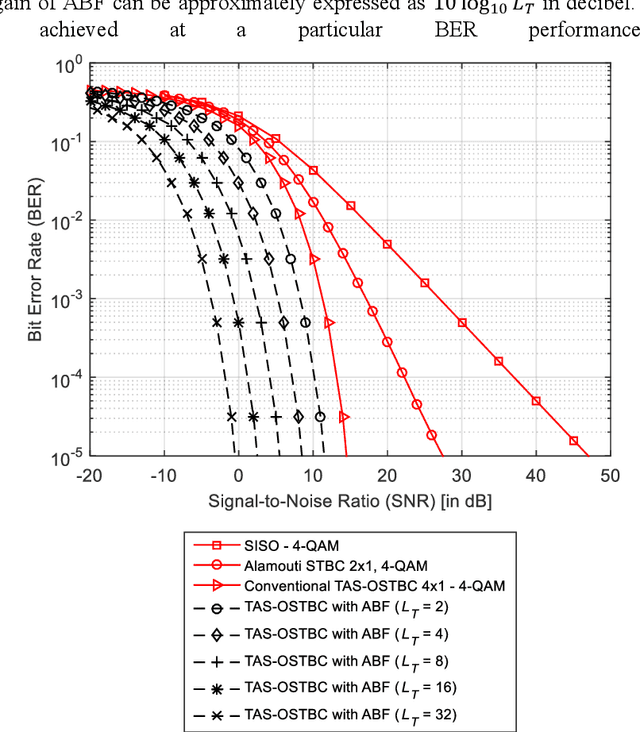
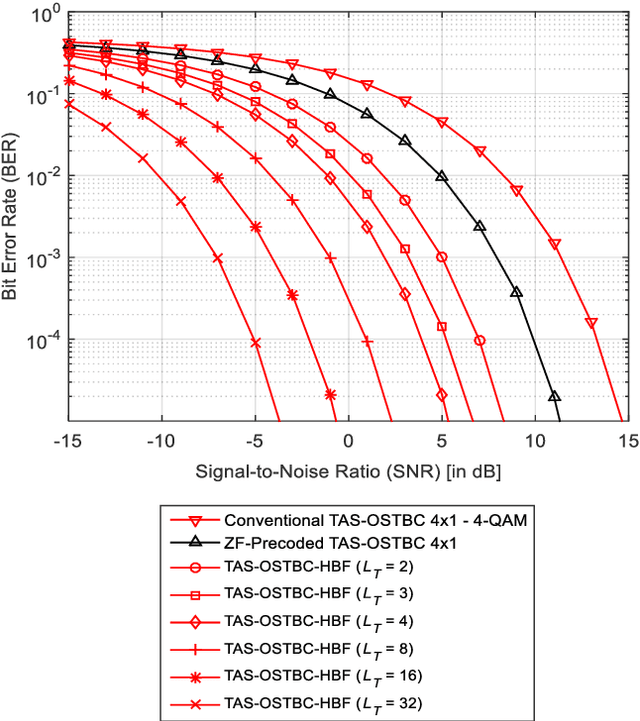
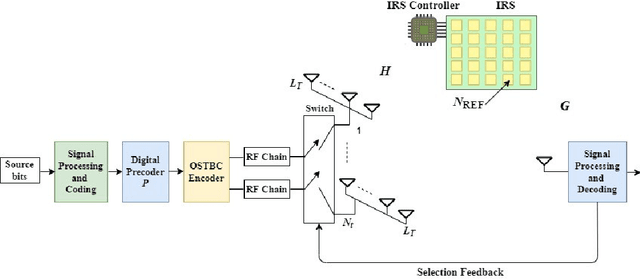
An intelligent reflecting surface (IRS)-assisted millimeter-wave (mmWave) massive multiple input multiple output (MIMO) system with transmit antenna selection (TAS) using orthogonal space-time block codes (OSTBC) scheme is proposed in this paper. This system combines TAS and IRS with hybrid analog-digital beamforming (HBF) for 60 GHz mmWave communications in order to exploit the benefits of TAS, OSTBC, analog beamforming (ABF), and transmit digital precoding techniques. The proposed system, however, benefits from the transmit diversity gain of OSTBC scheme as well as from the signal-to-noise ratio (SNR) gains of both the beamformer and the IRS technology. The simulation results demonstrate that TAS-OSTBC system with zero-forcing precoding technique outperforms the conventional TAS system with OSTBC scheme. Furthermore, the bit error rate (BER) performance significantly im-proves as the number of antenna array elements increases due to providing a beamforming gain. In addition, increasing the number of reflecting elements further enhances the error performance. It is also found from the simulation results that the TAS-OSTBC system with hybrid precoding has better BER performance than that of TAS-OSTBC with ABF, and IRS-assisted systems significantly outperform the conventional systems without the IRS technology. This makes the proposed IRS-assisted system an appealing solution for internet-of-things (IoT) networks.