 Add to Chrome
 Add to Firefox
 Add to Edge
Tumor Segmentation
Tumor segmentation is the task of identifying the spatial location of a tumor. It is a pixel-level prediction where each pixel is classified as a tumor or background. The most popular benchmark for this task is the BraTS dataset. The models are typically evaluated with the Dice Score metric.
Papers and Code
DRBD-Mamba for Robust and Efficient Brain Tumor Segmentation with Analytical Insights
Oct 16, 2025
Accurate brain tumor segmentation is significant for clinical diagnosis and treatment. It is challenging due to the heterogeneity of tumor subregions. Mamba-based State Space Models have demonstrated promising performance. However, they incur significant computational overhead due to sequential feature computation across multiple spatial axes. Moreover, their robustness across diverse BraTS data partitions remains largely unexplored, leaving a critical gap in reliable evaluation. To address these limitations, we propose dual-resolution bi-directional Mamba (DRBD-Mamba), an efficient 3D segmentation model that captures multi-scale long-range dependencies with minimal computational overhead. We leverage a space-filling curve to preserve spatial locality during 3D-to-1D feature mapping, thereby reducing reliance on computationally expensive multi-axial feature scans. To enrich feature representation, we propose a gated fusion module that adaptively integrates forward and reverse contexts, along with a quantization block that discretizes features to improve robustness. In addition, we propose five systematic folds on BraTS2023 for rigorous evaluation of segmentation techniques under diverse conditions and present detailed analysis of common failure scenarios. On the 20\% test set used by recent methods, our model achieves Dice improvements of 0.10\% for whole tumor, 1.75\% for tumor core, and 0.93\% for enhancing tumor. Evaluations on the proposed systematic five folds demonstrate that our model maintains competitive whole tumor accuracy while achieving clear average Dice gains of 0.86\% for tumor core and 1.45\% for enhancing tumor over existing state-of-the-art. Furthermore, our model attains 15 times improvement in efficiency while maintaining high segmentation accuracy, highlighting its robustness and computational advantage over existing approaches.

Demystifying Deep Learning-based Brain Tumor Segmentation with 3D UNets and Explainable AI (XAI): A Comparative Analysis
Oct 09, 2025The current study investigated the use of Explainable Artificial Intelligence (XAI) to improve the accuracy of brain tumor segmentation in MRI images, with the goal of assisting physicians in clinical decision-making. The study focused on applying UNet models for brain tumor segmentation and using the XAI techniques of Gradient-weighted Class Activation Mapping (Grad-CAM) and attention-based visualization to enhance the understanding of these models. Three deep learning models - UNet, Residual UNet (ResUNet), and Attention UNet (AttUNet) - were evaluated to identify the best-performing model. XAI was employed with the aims of clarifying model decisions and increasing physicians' trust in these models. We compared the performance of two UNet variants (ResUNet and AttUNet) with the conventional UNet in segmenting brain tumors from the BraTS2020 public dataset and analyzed model predictions with Grad-CAM and attention-based visualization. Using the latest computer hardware, we trained and validated each model using the Adam optimizer and assessed their performance with respect to: (i) training, validation, and inference times, (ii) segmentation similarity coefficients and loss functions, and (iii) classification performance. Notably, during the final testing phase, ResUNet outperformed the other models with respect to Dice and Jaccard similarity scores, as well as accuracy, recall, and F1 scores. Grad-CAM provided visuospatial insights into the tumor subregions each UNet model focused on while attention-based visualization provided valuable insights into the working mechanisms of AttUNet's attention modules. These results demonstrated ResUNet as the best-performing model and we conclude by recommending its use for automated brain tumor segmentation in future clinical assessments. Our source code and checkpoint are available at https://github.com/ethanong98/MultiModel-XAI-Brats2020
Validation of Various Normalization Methods for Brain Tumor Segmentation: Can Federated Learning Overcome This Heterogeneity?
Oct 08, 2025Deep learning (DL) has been increasingly applied in medical imaging, however, it requires large amounts of data, which raises many challenges related to data privacy, storage, and transfer. Federated learning (FL) is a training paradigm that overcomes these issues, though its effectiveness may be reduced when dealing with non-independent and identically distributed (non-IID) data. This study simulates non-IID conditions by applying different MRI intensity normalization techniques to separate data subsets, reflecting a common cause of heterogeneity. These subsets are then used for training and testing models for brain tumor segmentation. The findings provide insights into the influence of the MRI intensity normalization methods on segmentation models, both training and inference. Notably, the FL methods demonstrated resilience to inconsistently normalized data across clients, achieving the 3D Dice score of 92%, which is comparable to a centralized model (trained using all data). These results indicate that FL is a solution to effectively train high-performing models without violating data privacy, a crucial concern in medical applications. The code is available at: https://github.com/SanoScience/fl-varying-normalization.
Mitigating Spurious Correlations in Patch-wise Tumor Classification on High-Resolution Multimodal Images
Nov 17, 2025Patch-wise multi-label classification provides an efficient alternative to full pixel-wise segmentation on high-resolution images, particularly when the objective is to determine the presence or absence of target objects within a patch rather than their precise spatial extent. This formulation substantially reduces annotation cost, simplifies training, and allows flexible patch sizing aligned with the desired level of decision granularity. In this work, we focus on a special case, patch-wise binary classification, applied to the detection of a single class of interest (tumor) on high-resolution multimodal nonlinear microscopy images. We show that, although this simplified formulation enables efficient model development, it can introduce spurious correlations between patch composition and labels: tumor patches tend to contain larger tissue regions, whereas non-tumor patches often consist mostly of background with small tissue areas. We further quantify the bias in model predictions caused by this spurious correlation, and propose to use a debiasing strategy to mitigate its effect. Specifically, we apply GERNE, a debiasing method that can be adapted to maximize worst-group accuracy (WGA). Our results show an improvement in WGA by approximately 7% compared to ERM for two different thresholds used to binarize the spurious feature. This enhancement boosts model performance on critical minority cases, such as tumor patches with small tissues and non-tumor patches with large tissues, and underscores the importance of spurious correlation-aware learning in patch-wise classification problems.
Fine-tuning Segment Anything for Real-Time Tumor Tracking in Cine-MRI
Oct 29, 2025In this work, we address the TrackRAD2025 challenge of real-time tumor tracking in cine-MRI sequences of the thoracic and abdominal regions under strong data scarcity constraints. Two complementary strategies were explored: (i) unsupervised registration with the IMPACT similarity metric and (ii) foundation model-based segmentation leveraging SAM 2.1 and its recent variants through prompt-based interaction. Due to the one-second runtime constraint, the SAM-based method was ultimately selected. The final configuration used SAM2.1 b+ with mask-based prompts from the first annotated slice, fine-tuned solely on the small labeled subset from TrackRAD2025. Training was configured to minimize overfitting, using 1024x1024 patches (batch size 1), standard augmentations, and a balanced Dice + IoU loss. A low uniform learning rate (0.0001) was applied to all modules (prompt encoder, decoder, Hiera backbone) to preserve generalization while adapting to annotator-specific styles. Training lasted 300 epochs (~12h on RTX A6000, 48GB). The same inference strategy was consistently applied across all anatomical sites and MRI field strengths. Test-time augmentation was considered but ultimately discarded due to negligible performance gains. The final model was selected based on the highest Dice Similarity Coefficient achieved on the validation set after fine-tuning. On the hidden test set, the model reached a Dice score of 0.8794, ranking 6th overall in the TrackRAD2025 challenge. These results highlight the strong potential of foundation models for accurate and real-time tumor tracking in MRI-guided radiotherapy.
Navigated hepatic tumor resection using intraoperative ultrasound imaging
Oct 31, 2025Purpose: This proof-of-concept study evaluates feasibility and accuracy of an ultrasound-based navigation system for open liver surgery. Unlike most conventional systems that rely on registration to preoperative imaging, the proposed system provides navigation-guided resection using 3D models generated from intraoperative ultrasound. Methods: A pilot study was conducted in 25 patients undergoing resection of liver metastases. The first five cases served to optimize the workflow. Intraoperatively, an electromagnetic sensor compensated for organ motion, after which an ultrasound volume was acquired. Vasculature was segmented automatically and tumors semi-automatically using region-growing (n=15) or a deep learning algorithm (n=5). The resulting 3D model was visualized alongside tracked surgical instruments. Accuracy was assessed by comparing the distance between surgical clips and tumors in the navigation software with the same distance on a postoperative CT of the resected specimen. Results: Navigation was successfully established in all 20 patients. However, four cases were excluded from accuracy assessment due to intraoperative sensor detachment (n=3) or incorrect data recording (n=1). The complete navigation workflow was operational within 5-10 minutes. In 16 evaluable patients, 78 clip-to-tumor distances were analyzed. The median navigation accuracy was 3.2 mm [IQR: 2.8-4.8 mm], and an R0 resection was achieved in 15/16 (93.8%) patients and one patient had an R1 vascular resection. Conclusion: Navigation based solely on intra-operative ultrasound is feasible and accurate for liver surgery. This registration-free approach paves the way for simpler and more accurate image guidance systems.
SENCA-st: Integrating Spatial Transcriptomics and Histopathology with Cross Attention Shared Encoder for Region Identification in Cancer Pathology
Nov 11, 2025Spatial transcriptomics is an emerging field that enables the identification of functional regions based on the spatial distribution of gene expression. Integrating this functional information present in transcriptomic data with structural data from histopathology images is an active research area with applications in identifying tumor substructures associated with cancer drug resistance. Current histopathology-spatial-transcriptomic region segmentation methods suffer due to either making spatial transcriptomics prominent by using histopathology features just to assist processing spatial transcriptomics data or using vanilla contrastive learning that make histopathology images prominent due to only promoting common features losing functional information. In both extremes, the model gets either lost in the noise of spatial transcriptomics or overly smoothed, losing essential information. Thus, we propose our novel architecture SENCA-st (Shared Encoder with Neighborhood Cross Attention) that preserves the features of both modalities. More importantly, it emphasizes regions that are structurally similar in histopathology but functionally different on spatial transcriptomics using cross-attention. We demonstrate the superior performance of our model that surpasses state-of-the-art methods in detecting tumor heterogeneity and tumor micro-environment regions, a clinically crucial aspect.
VGDM: Vision-Guided Diffusion Model for Brain Tumor Detection and Segmentation
Oct 02, 2025Accurate detection and segmentation of brain tumors from magnetic resonance imaging (MRI) are essential for diagnosis, treatment planning, and clinical monitoring. While convolutional architectures such as U-Net have long been the backbone of medical image segmentation, their limited capacity to capture long-range dependencies constrains performance on complex tumor structures. Recent advances in diffusion models have demonstrated strong potential for generating high-fidelity medical images and refining segmentation boundaries. In this work, we propose VGDM: Vision-Guided Diffusion Model for Brain Tumor Detection and Segmentation framework, a transformer-driven diffusion framework for brain tumor detection and segmentation. By embedding a vision transformer at the core of the diffusion process, the model leverages global contextual reasoning together with iterative denoising to enhance both volumetric accuracy and boundary precision. The transformer backbone enables more effective modeling of spatial relationships across entire MRI volumes, while diffusion refinement mitigates voxel-level errors and recovers fine-grained tumor details. This hybrid design provides a pathway toward improved robustness and scalability in neuro-oncology, moving beyond conventional U-Net baselines. Experimental validation on MRI brain tumor datasets demonstrates consistent gains in Dice similarity and Hausdorff distance, underscoring the potential of transformer-guided diffusion models to advance the state of the art in tumor segmentation.
Dark-Field X-Ray Imaging Significantly Improves Deep-Learning based Detection of Synthetic Early-Stage Lung Tumors in Preclinical Models
Oct 31, 2025Low-dose computed tomography (LDCT) is the current standard for lung cancer screening, yet its adoption and accessibility remain limited. Many regions lack LDCT infrastructure, and even among those screened, early-stage cancer detection often yield false positives, as shown in the National Lung Screening Trial (NLST) with a sensitivity of 93.8 percent and a false-positive rate of 26.6 percent. We aim to investigate whether X-ray dark-field imaging (DFI) radiograph, a technique sensitive to small-angle scatter from alveolar microstructure and less susceptible to organ shadowing, can significantly improve early-stage lung tumor detection when coupled with deep-learning segmentation. Using paired attenuation (ATTN) and DFI radiograph images of euthanized mouse lungs, we generated realistic synthetic tumors with irregular boundaries and intensity profiles consistent with physical lung contrast. A U-Net segmentation network was trained on small patches using either ATTN, DFI, or a combination of ATTN and DFI channels. Results show that the DFI-only model achieved a true-positive detection rate of 83.7 percent, compared with 51 percent for ATTN-only, while maintaining comparable specificity (90.5 versus 92.9 percent). The combined ATTN and DFI input achieved 79.6 percent sensitivity and 97.6 percent specificity. In conclusion, DFI substantially improves early-tumor detectability in comparison to standard attenuation radiography and shows potential as an accessible, low-cost, low-dose alternative for pre-clinical or limited-resource screening where LDCT is unavailable.
No Modality Left Behind: Adapting to Missing Modalities via Knowledge Distillation for Brain Tumor Segmentation
Sep 18, 2025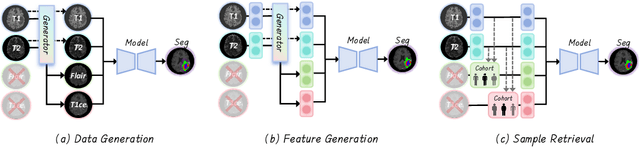
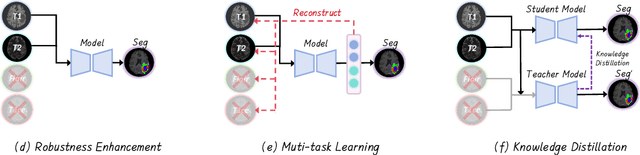
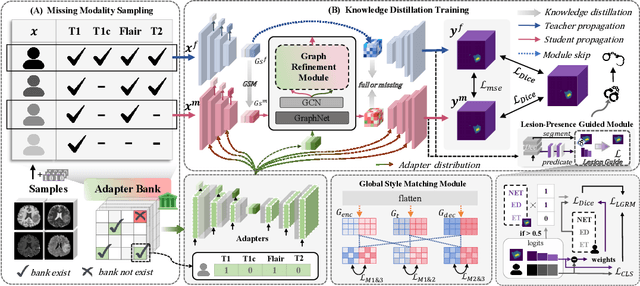
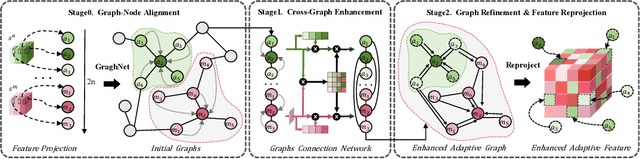
Accurate brain tumor segmentation is essential for preoperative evaluation and personalized treatment. Multi-modal MRI is widely used due to its ability to capture complementary tumor features across different sequences. However, in clinical practice, missing modalities are common, limiting the robustness and generalizability of existing deep learning methods that rely on complete inputs, especially under non-dominant modality combinations. To address this, we propose AdaMM, a multi-modal brain tumor segmentation framework tailored for missing-modality scenarios, centered on knowledge distillation and composed of three synergistic modules. The Graph-guided Adaptive Refinement Module explicitly models semantic associations between generalizable and modality-specific features, enhancing adaptability to modality absence. The Bi-Bottleneck Distillation Module transfers structural and textural knowledge from teacher to student models via global style matching and adversarial feature alignment. The Lesion-Presence-Guided Reliability Module predicts prior probabilities of lesion types through an auxiliary classification task, effectively suppressing false positives under incomplete inputs. Extensive experiments on the BraTS 2018 and 2024 datasets demonstrate that AdaMM consistently outperforms existing methods, exhibiting superior segmentation accuracy and robustness, particularly in single-modality and weak-modality configurations. In addition, we conduct a systematic evaluation of six categories of missing-modality strategies, confirming the superiority of knowledge distillation and offering practical guidance for method selection and future research. Our source code is available at https://github.com/Quanato607/AdaMM.