 Add to Chrome
 Add to Firefox
 Add to Edge
Video Saliency Prediction
Papers and Code
SalFormer360: a transformer-based saliency estimation model for 360-degree videos
Feb 04, 2026
Saliency estimation has received growing attention in recent years due to its importance in a wide range of applications. In the context of 360-degree video, it has been particularly valuable for tasks such as viewport prediction and immersive content optimization. In this paper, we propose SalFormer360, a novel saliency estimation model for 360-degree videos built on a transformer-based architecture. Our approach is based on the combination of an existing encoder architecture, SegFormer, and a custom decoder. The SegFormer model was originally developed for 2D segmentation tasks, and it has been fine-tuned to adapt it to 360-degree content. To further enhance prediction accuracy in our model, we incorporated Viewing Center Bias to reflect user attention in 360-degree environments. Extensive experiments on the three largest benchmark datasets for saliency estimation demonstrate that SalFormer360 outperforms existing state-of-the-art methods. In terms of Pearson Correlation Coefficient, our model achieves 8.4% higher performance on Sport360, 2.5% on PVS-HM, and 18.6% on VR-EyeTracking compared to previous state-of-the-art.

Conditional Flow Matching for Visually-Guided Acoustic Highlighting
Feb 03, 2026Visually-guided acoustic highlighting seeks to rebalance audio in alignment with the accompanying video, creating a coherent audio-visual experience. While visual saliency and enhancement have been widely studied, acoustic highlighting remains underexplored, often leading to misalignment between visual and auditory focus. Existing approaches use discriminative models, which struggle with the inherent ambiguity in audio remixing, where no natural one-to-one mapping exists between poorly-balanced and well-balanced audio mixes. To address this limitation, we reframe this task as a generative problem and introduce a Conditional Flow Matching (CFM) framework. A key challenge in iterative flow-based generation is that early prediction errors -- in selecting the correct source to enhance -- compound over steps and push trajectories off-manifold. To address this, we introduce a rollout loss that penalizes drift at the final step, encouraging self-correcting trajectories and stabilizing long-range flow integration. We further propose a conditioning module that fuses audio and visual cues before vector field regression, enabling explicit cross-modal source selection. Extensive quantitative and qualitative evaluations show that our method consistently surpasses the previous state-of-the-art discriminative approach, establishing that visually-guided audio remixing is best addressed through generative modeling.
Gaze Prediction in Virtual Reality Without Eye Tracking Using Visual and Head Motion Cues
Jan 26, 2026Gaze prediction plays a critical role in Virtual Reality (VR) applications by reducing sensor-induced latency and enabling computationally demanding techniques such as foveated rendering, which rely on anticipating user attention. However, direct eye tracking is often unavailable due to hardware limitations or privacy concerns. To address this, we present a novel gaze prediction framework that combines Head-Mounted Display (HMD) motion signals with visual saliency cues derived from video frames. Our method employs UniSal, a lightweight saliency encoder, to extract visual features, which are then fused with HMD motion data and processed through a time-series prediction module. We evaluate two lightweight architectures, TSMixer and LSTM, for forecasting future gaze directions. Experiments on the EHTask dataset, along with deployment on commercial VR hardware, show that our approach consistently outperforms baselines such as Center-of-HMD and Mean Gaze. These results demonstrate the effectiveness of predictive gaze modeling in reducing perceptual lag and enhancing natural interaction in VR environments where direct eye tracking is constrained.
Not all Blends are Equal: The BLEMORE Dataset of Blended Emotion Expressions with Relative Salience Annotations
Jan 19, 2026Humans often experience not just a single basic emotion at a time, but rather a blend of several emotions with varying salience. Despite the importance of such blended emotions, most video-based emotion recognition approaches are designed to recognize single emotions only. The few approaches that have attempted to recognize blended emotions typically cannot assess the relative salience of the emotions within a blend. This limitation largely stems from the lack of datasets containing a substantial number of blended emotion samples annotated with relative salience. To address this shortcoming, we introduce BLEMORE, a novel dataset for multimodal (video, audio) blended emotion recognition that includes information on the relative salience of each emotion within a blend. BLEMORE comprises over 3,000 clips from 58 actors, performing 6 basic emotions and 10 distinct blends, where each blend has 3 different salience configurations (50/50, 70/30, and 30/70). Using this dataset, we conduct extensive evaluations of state-of-the-art video classification approaches on two blended emotion prediction tasks: (1) predicting the presence of emotions in a given sample, and (2) predicting the relative salience of emotions in a blend. Our results show that unimodal classifiers achieve up to 29% presence accuracy and 13% salience accuracy on the validation set, while multimodal methods yield clear improvements, with ImageBind + WavLM reaching 35% presence accuracy and HiCMAE 18% salience accuracy. On the held-out test set, the best models achieve 33% presence accuracy (VideoMAEv2 + HuBERT) and 18% salience accuracy (HiCMAE). In sum, the BLEMORE dataset provides a valuable resource to advancing research on emotion recognition systems that account for the complexity and significance of blended emotion expressions.
Convolutions Need Registers Too: HVS-Inspired Dynamic Attention for Video Quality Assessment
Jan 16, 2026No-reference video quality assessment (NR-VQA) estimates perceptual quality without a reference video, which is often challenging. While recent techniques leverage saliency or transformer attention, they merely address global context of the video signal by using static maps as auxiliary inputs rather than embedding context fundamentally within feature extraction of the video sequence. We present Dynamic Attention with Global Registers for Video Quality Assessment (DAGR-VQA), the first framework integrating register-token directly into a convolutional backbone for spatio-temporal, dynamic saliency prediction. By embedding learnable register tokens as global context carriers, our model enables dynamic, HVS-inspired attention, producing temporally adaptive saliency maps that track salient regions over time without explicit motion estimation. Our model integrates dynamic saliency maps with RGB inputs, capturing spatial data and analyzing it through a temporal transformer to deliver a perceptually consistent video quality assessment. Comprehensive tests conducted on the LSVQ, KonVid-1k, LIVE-VQC, and YouTube-UGC datasets show that the performance is highly competitive, surpassing the majority of top baselines. Research on ablation studies demonstrates that the integration of register tokens promotes the development of stable and temporally consistent attention mechanisms. Achieving an efficiency of 387.7 FPS at 1080p, DAGR-VQA demonstrates computational performance suitable for real-time applications like multimedia streaming systems.
Moment and Highlight Detection via MLLM Frame Segmentation
Dec 13, 2025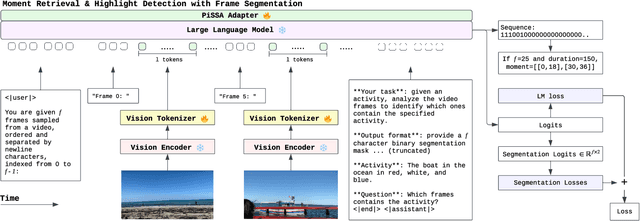
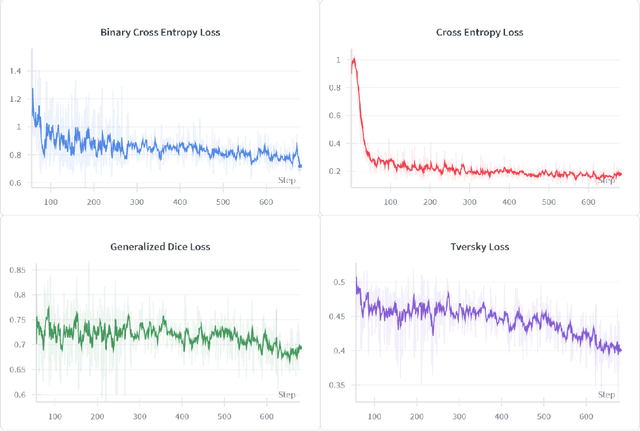
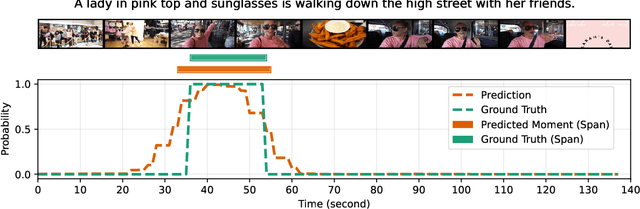
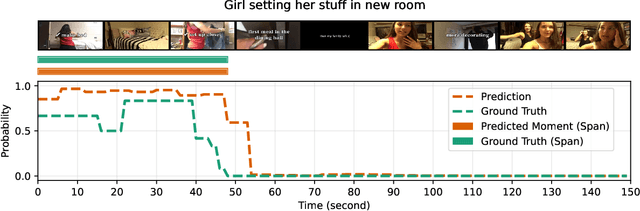
Detecting video moments and highlights from natural-language queries have been unified by transformer-based methods. Other works use generative Multimodal LLM (MLLM) to predict moments and/or highlights as text timestamps, utilizing its reasoning capability. While effective, text-based generation cannot provide direct gradients for frame-level predictions because the model only emits language tokens. Although recent Reinforcement Learning (RL) methods attempt to address the issue, we propose a novel approach by applying segmentation objectives directly on the LLM's output tokens. The LLM is fed with a fixed number of frames alongside a prompt that enforces it to output a sequence of continuous "0" and/or "1" characters, with one character per frame. The "0"/"1" characters benefit from the LLM's inherent language capability while also acting as background and foreground probabilities, respectively. Training employs segmentation losses on the probabilities alongside a normal causal LM loss. At inference, beam search generates sequence and logits, acting as moments and saliency scores, respectively. Despite sampling only 25 frames -- less than half of comparable methods -- our method achieved strong highlight detection (56.74 HIT@1) on QVHighlights. Additionally, our efficient method scores above the baseline (35.28 MAP) for moment retrieval. Empirically, segmentation losses provide a stable complementary learning signal even when the causal LM loss plateaus.
Disentangled Concepts Speak Louder Than Words:Explainable Video Action Recognition
Nov 05, 2025Effective explanations of video action recognition models should disentangle how movements unfold over time from the surrounding spatial context. However, existing methods based on saliency produce entangled explanations, making it unclear whether predictions rely on motion or spatial context. Language-based approaches offer structure but often fail to explain motions due to their tacit nature -- intuitively understood but difficult to verbalize. To address these challenges, we propose Disentangled Action aNd Context concept-based Explainable (DANCE) video action recognition, a framework that predicts actions through disentangled concept types: motion dynamics, objects, and scenes. We define motion dynamics concepts as human pose sequences. We employ a large language model to automatically extract object and scene concepts. Built on an ante-hoc concept bottleneck design, DANCE enforces prediction through these concepts. Experiments on four datasets -- KTH, Penn Action, HAA500, and UCF-101 -- demonstrate that DANCE significantly improves explanation clarity with competitive performance. We validate the superior interpretability of DANCE through a user study. Experimental results also show that DANCE is beneficial for model debugging, editing, and failure analysis.
Text-Audio-Visual-conditioned Diffusion Model for Video Saliency Prediction
Apr 19, 2025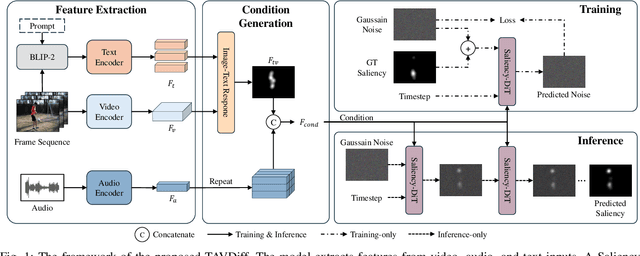
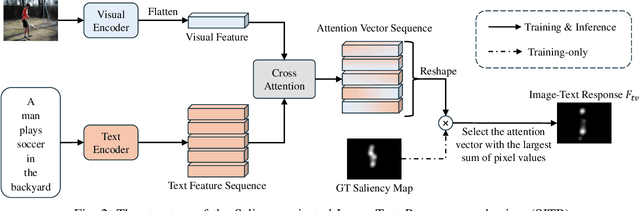
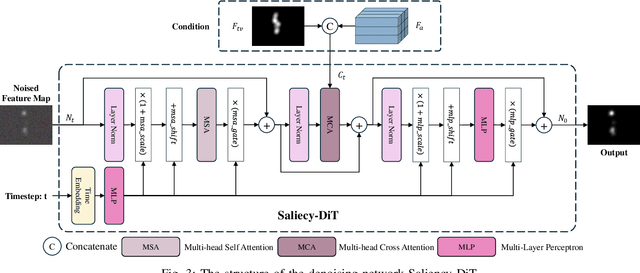
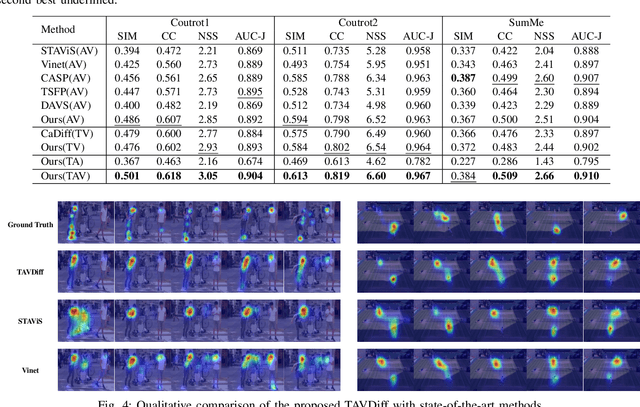
Video saliency prediction is crucial for downstream applications, such as video compression and human-computer interaction. With the flourishing of multimodal learning, researchers started to explore multimodal video saliency prediction, including audio-visual and text-visual approaches. Auditory cues guide the gaze of viewers to sound sources, while textual cues provide semantic guidance for understanding video content. Integrating these complementary cues can improve the accuracy of saliency prediction. Therefore, we attempt to simultaneously analyze visual, auditory, and textual modalities in this paper, and propose TAVDiff, a Text-Audio-Visual-conditioned Diffusion Model for video saliency prediction. TAVDiff treats video saliency prediction as an image generation task conditioned on textual, audio, and visual inputs, and predicts saliency maps through stepwise denoising. To effectively utilize text, a large multimodal model is used to generate textual descriptions for video frames and introduce a saliency-oriented image-text response (SITR) mechanism to generate image-text response maps. It is used as conditional information to guide the model to localize the visual regions that are semantically related to the textual description. Regarding the auditory modality, it is used as another conditional information for directing the model to focus on salient regions indicated by sounds. At the same time, since the diffusion transformer (DiT) directly concatenates the conditional information with the timestep, which may affect the estimation of the noise level. To achieve effective conditional guidance, we propose Saliency-DiT, which decouples the conditional information from the timestep. Experimental results show that TAVDiff outperforms existing methods, improving 1.03\%, 2.35\%, 2.71\% and 0.33\% on SIM, CC, NSS and AUC-J metrics, respectively.
Saliency-guided Emotion Modeling: Predicting Viewer Reactions from Video Stimuli
May 25, 2025Understanding the emotional impact of videos is crucial for applications in content creation, advertising, and Human-Computer Interaction (HCI). Traditional affective computing methods rely on self-reported emotions, facial expression analysis, and biosensing data, yet they often overlook the role of visual saliency -- the naturally attention-grabbing regions within a video. In this study, we utilize deep learning to introduce a novel saliency-based approach to emotion prediction by extracting two key features: saliency area and number of salient regions. Using the HD2S saliency model and OpenFace facial action unit analysis, we examine the relationship between video saliency and viewer emotions. Our findings reveal three key insights: (1) Videos with multiple salient regions tend to elicit high-valence, low-arousal emotions, (2) Videos with a single dominant salient region are more likely to induce low-valence, high-arousal responses, and (3) Self-reported emotions often misalign with facial expression-based emotion detection, suggesting limitations in subjective reporting. By leveraging saliency-driven insights, this work provides a computationally efficient and interpretable alternative for emotion modeling, with implications for content creation, personalized media experiences, and affective computing research.
Shallow Features Matter: Hierarchical Memory with Heterogeneous Interaction for Unsupervised Video Object Segmentation
Jul 30, 2025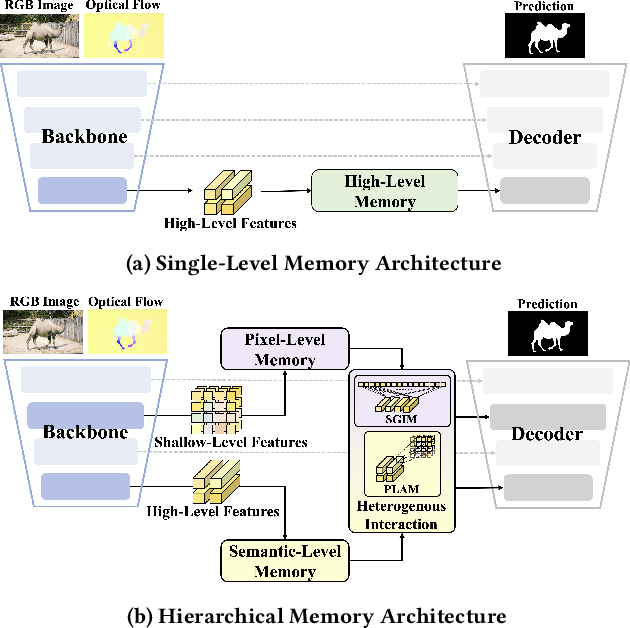
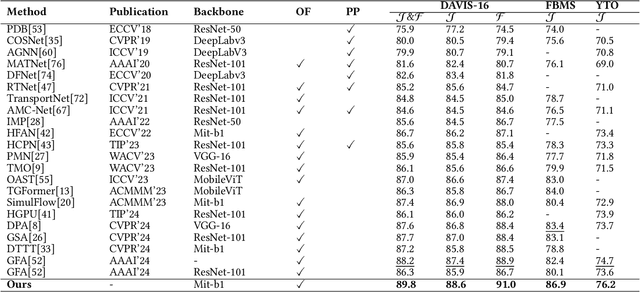
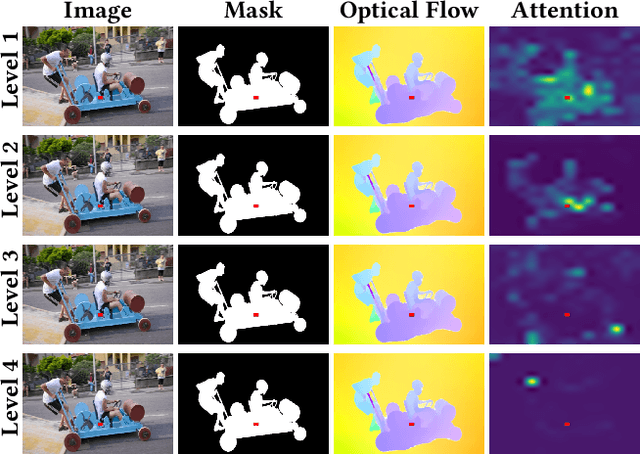
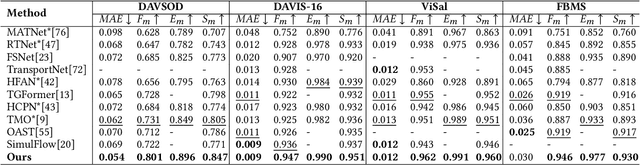
Unsupervised Video Object Segmentation (UVOS) aims to predict pixel-level masks for the most salient objects in videos without any prior annotations. While memory mechanisms have been proven critical in various video segmentation paradigms, their application in UVOS yield only marginal performance gains despite sophisticated design. Our analysis reveals a simple but fundamental flaw in existing methods: over-reliance on memorizing high-level semantic features. UVOS inherently suffers from the deficiency of lacking fine-grained information due to the absence of pixel-level prior knowledge. Consequently, memory design relying solely on high-level features, which predominantly capture abstract semantic cues, is insufficient to generate precise predictions. To resolve this fundamental issue, we propose a novel hierarchical memory architecture to incorporate both shallow- and high-level features for memory, which leverages the complementary benefits of pixel and semantic information. Furthermore, to balance the simultaneous utilization of the pixel and semantic memory features, we propose a heterogeneous interaction mechanism to perform pixel-semantic mutual interactions, which explicitly considers their inherent feature discrepancies. Through the design of Pixel-guided Local Alignment Module (PLAM) and Semantic-guided Global Integration Module (SGIM), we achieve delicate integration of the fine-grained details in shallow-level memory and the semantic representations in high-level memory. Our Hierarchical Memory with Heterogeneous Interaction Network (HMHI-Net) consistently achieves state-of-the-art performance across all UVOS and video saliency detection benchmarks. Moreover, HMHI-Net consistently exhibits high performance across different backbones, further demonstrating its superiority and robustness. Project page: https://github.com/ZhengxyFlow/HMHI-Net .