 Add to Chrome
 Add to Firefox
 Add to Edge
Stylegan2
Papers and Code
Localized Latent Editing for Dose-Response Modeling in Botulinum Toxin Injection Planning
Jan 27, 2026
Botulinum toxin (Botox) injections are the gold standard for managing facial asymmetry and aesthetic rejuvenation, yet determining the optimal dosage remains largely intuitive, often leading to suboptimal outcomes. We propose a localized latent editing framework that simulates Botulinum Toxin injection effects for injection planning through dose-response modeling. Our key contribution is a Region-Specific Latent Axis Discovery method that learns localized muscle relaxation trajectories in StyleGAN2's latent space, enabling precise control over specific facial regions without global side effects. By correlating these localized latent trajectories with injected toxin units, we learn a predictive dose-response model. We rigorously compare two approaches: direct metric regression versus image-based generative simulation on a clinical dataset of N=360 images from 46 patients. On a hold-out test set, our framework demonstrates moderate-to-strong structural correlations for geometric asymmetry metrics, confirming that the generative model correctly captures the direction of morphological changes. While biological variability limits absolute precision, we introduce a hybrid "Human-in-the-Loop" workflow where clinicians interactively refine simulations, bridging the gap between pathological reconstruction and cosmetic planning.

Mitigating Longitudinal Performance Degradation in Child Face Recognition Using Synthetic Data
Jan 04, 2026Longitudinal face recognition in children remains challenging due to rapid and nonlinear facial growth, which causes template drift and increasing verification errors over time. This work investigates whether synthetic face data can act as a longitudinal stabilizer by improving temporal robustness of child face recognition models. Using an identity disjoint protocol on the Young Face Aging (YFA) dataset, we evaluate three settings: (i) pretrained MagFace embeddings without dataset specific fine-tuning, (ii) MagFace fine-tuned using authentic training faces only, and (iii) MagFace fine-tuned using a combination of authentic and synthetically generated training faces. Synthetic data is generated using StyleGAN2 ADA and incorporated exclusively within the training identities; a post generation filtering step is applied to mitigate identity leakage and remove artifact affected samples. Experimental results across enrollment verification gaps from 6 to 36 months show that synthetic-augmented fine tuning substantially reduces error rates relative to both the pretrained baseline and real only fine tuning. These findings provide a risk aware assessment of synthetic augmentation for improving identity persistence in pediatric face recognition.
Training-Free Disentangled Text-Guided Image Editing via Sparse Latent Constraints
Dec 25, 2025Text-driven image manipulation often suffers from attribute entanglement, where modifying a target attribute (e.g., adding bangs) unintentionally alters other semantic properties such as identity or appearance. The Predict, Prevent, and Evaluate (PPE) framework addresses this issue by leveraging pre-trained vision-language models for disentangled editing. In this work, we analyze the PPE framework, focusing on its architectural components, including BERT-based attribute prediction and StyleGAN2-based image generation on the CelebA-HQ dataset. Through empirical analysis, we identify a limitation in the original regularization strategy, where latent updates remain dense and prone to semantic leakage. To mitigate this issue, we introduce a sparsity-based constraint using L1 regularization on latent space manipulation. Experimental results demonstrate that the proposed approach enforces more focused and controlled edits, effectively reducing unintended changes in non-target attributes while preserving facial identity.
SkinGenBench: Generative Model and Preprocessing Effects for Synthetic Dermoscopic Augmentation in Melanoma Diagnosis
Dec 19, 2025This work introduces SkinGenBench, a systematic biomedical imaging benchmark that investigates how preprocessing complexity interacts with generative model choice for synthetic dermoscopic image augmentation and downstream melanoma diagnosis. Using a curated dataset of 14,116 dermoscopic images from HAM10000 and MILK10K across five lesion classes, we evaluate the two representative generative paradigms: StyleGAN2-ADA and Denoising Diffusion Probabilistic Models (DDPMs) under basic geometric augmentation and advanced artifact removal pipelines. Synthetic melanoma images are assessed using established perceptual and distributional metrics (FID, KID, IS), feature space analysis, and their impact on diagnostic performance across five downstream classifiers. Experimental results demonstrate that generative architecture choice has a stronger influence on both image fidelity and diagnostic utility than preprocessing complexity. StyleGAN2-ADA consistently produced synthetic images more closely aligned with real data distributions, achieving the lowest FID (~65.5) and KID (~0.05), while diffusion models generated higher variance samples at the cost of reduces perceptual fidelity and class anchoring. Advanced artifact removal yielded only marginal improvements in generative metrics and provided limited downstream diagnostic gains, suggesting possible suppression of clinically relevant texture cues. In contrast, synthetic data augmentation substantially improved melanoma detection with 8-15% absolute gains in melanoma F1-score, and ViT-B/16 achieving F1~0.88 and ROC-AUC~0.98, representing an improvement of approximately 14% over non-augmented baselines. Our code can be found at https://github.com/adarsh-crafts/SkinGenBench
Identity-Preserving Aging and De-Aging of Faces in the StyleGAN Latent Space
Aug 12, 2025Face aging or de-aging with generative AI has gained significant attention for its applications in such fields like forensics, security, and media. However, most state of the art methods rely on conditional Generative Adversarial Networks (GANs), Diffusion-based models, or Visual Language Models (VLMs) to age or de-age faces based on predefined age categories and conditioning via loss functions, fine-tuning, or text prompts. The reliance on such conditioning leads to complex training requirements, increased data needs, and challenges in generating consistent results. Additionally, identity preservation is rarely taken into accountor evaluated on a single face recognition system without any control or guarantees on whether identity would be preserved in a generated aged/de-aged face. In this paper, we propose to synthesize aged and de-aged faces via editing latent space of StyleGAN2 using a simple support vector modeling of aging/de-aging direction and several feature selection approaches. By using two state-of-the-art face recognition systems, we empirically find the identity preserving subspace within the StyleGAN2 latent space, so that an apparent age of a given face can changed while preserving the identity. We then propose a simple yet practical formula for estimating the limits on aging/de-aging parameters that ensures identity preservation for a given input face. Using our method and estimated parameters we have generated a public dataset of synthetic faces at different ages that can be used for benchmarking cross-age face recognition, age assurance systems, or systems for detection of synthetic images. Our code and dataset are available at the project page https://www.idiap.ch/paper/agesynth/
Deepfake Forensic Analysis: Source Dataset Attribution and Legal Implications of Synthetic Media Manipulation
May 16, 2025Synthetic media generated by Generative Adversarial Networks (GANs) pose significant challenges in verifying authenticity and tracing dataset origins, raising critical concerns in copyright enforcement, privacy protection, and legal compliance. This paper introduces a novel forensic framework for identifying the training dataset (e.g., CelebA or FFHQ) of GAN-generated images through interpretable feature analysis. By integrating spectral transforms (Fourier/DCT), color distribution metrics, and local feature descriptors (SIFT), our pipeline extracts discriminative statistical signatures embedded in synthetic outputs. Supervised classifiers (Random Forest, SVM, XGBoost) achieve 98-99% accuracy in binary classification (real vs. synthetic) and multi-class dataset attribution across diverse GAN architectures (StyleGAN, AttGAN, GDWCT, StarGAN, and StyleGAN2). Experimental results highlight the dominance of frequency-domain features (DCT/FFT) in capturing dataset-specific artifacts, such as upsampling patterns and spectral irregularities, while color histograms reveal implicit regularization strategies in GAN training. We further examine legal and ethical implications, showing how dataset attribution can address copyright infringement, unauthorized use of personal data, and regulatory compliance under frameworks like GDPR and California's AB 602. Our framework advances accountability and governance in generative modeling, with applications in digital forensics, content moderation, and intellectual property litigation.
LAV: Audio-Driven Dynamic Visual Generation with Neural Compression and StyleGAN2
May 15, 2025This paper introduces LAV (Latent Audio-Visual), a system that integrates EnCodec's neural audio compression with StyleGAN2's generative capabilities to produce visually dynamic outputs driven by pre-recorded audio. Unlike previous works that rely on explicit feature mappings, LAV uses EnCodec embeddings as latent representations, directly transformed into StyleGAN2's style latent space via randomly initialized linear mapping. This approach preserves semantic richness in the transformation, enabling nuanced and semantically coherent audio-visual translations. The framework demonstrates the potential of using pretrained audio compression models for artistic and computational applications.
Pose and Facial Expression Transfer by using StyleGAN
Apr 17, 2025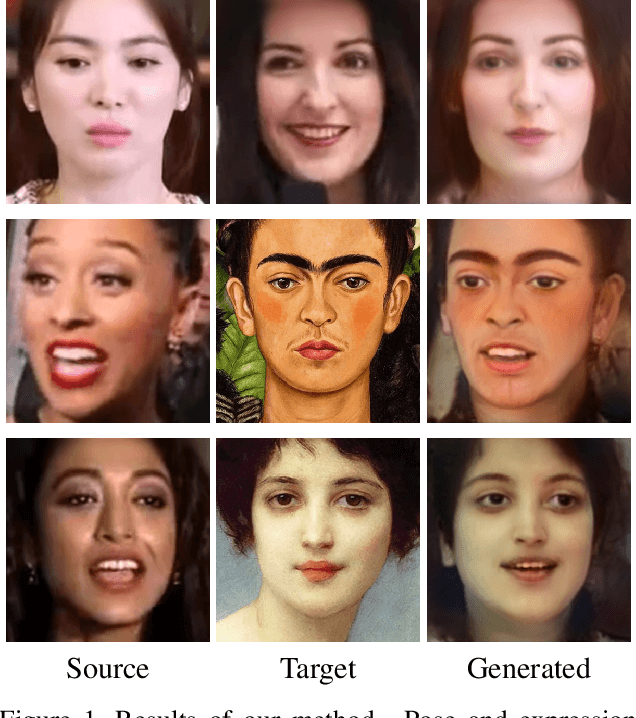
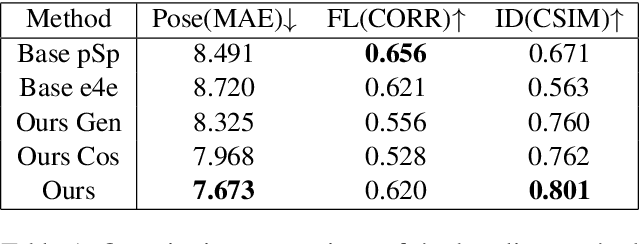
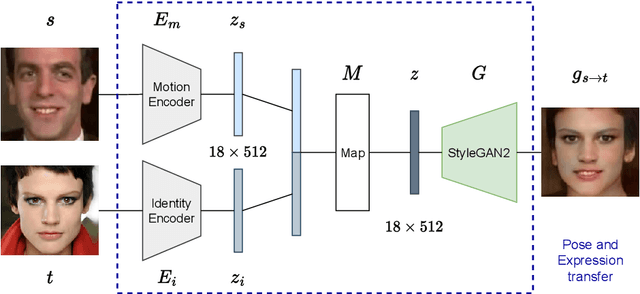
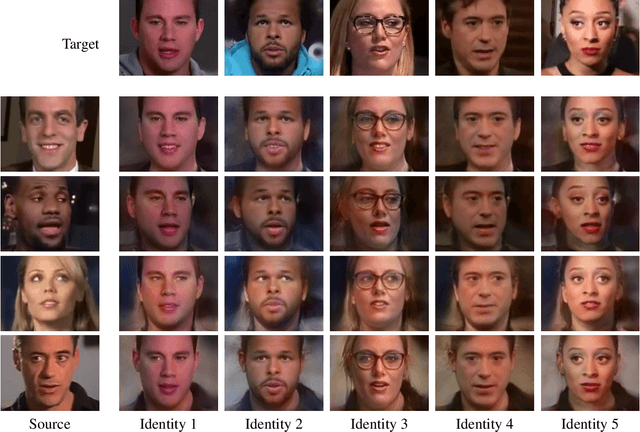
We propose a method to transfer pose and expression between face images. Given a source and target face portrait, the model produces an output image in which the pose and expression of the source face image are transferred onto the target identity. The architecture consists of two encoders and a mapping network that projects the two inputs into the latent space of StyleGAN2, which finally generates the output. The training is self-supervised from video sequences of many individuals. Manual labeling is not required. Our model enables the synthesis of random identities with controllable pose and expression. Close-to-real-time performance is achieved.
* Accepted at CVWW 2024. Presented in Terme Olimia, Slovenia
Using Synthetic Images to Augment Small Medical Image Datasets
Mar 02, 2025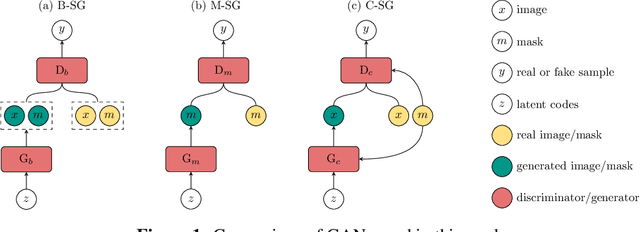
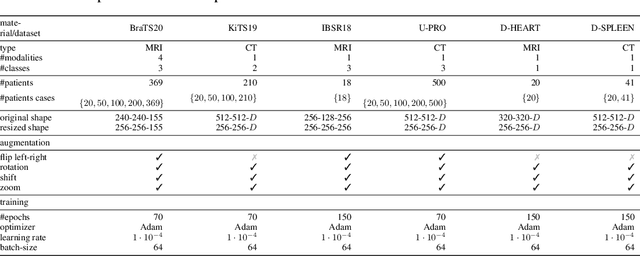
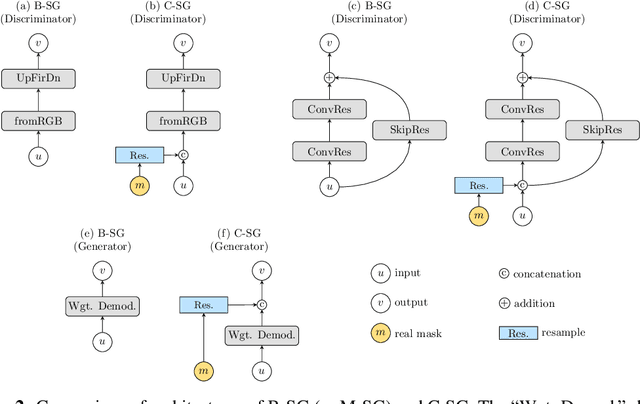
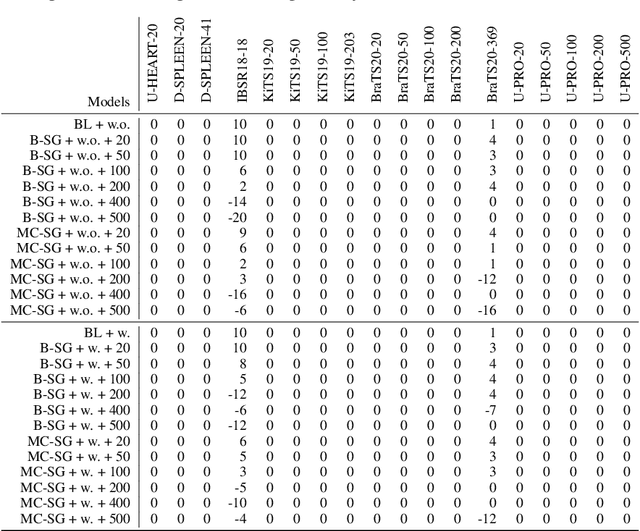
Recent years have witnessed a growing academic and industrial interest in deep learning (DL) for medical imaging. To perform well, DL models require very large labeled datasets. However, most medical imaging datasets are small, with a limited number of annotated samples. The reason they are small is usually because delineating medical images is time-consuming and demanding for oncologists. There are various techniques that can be used to augment a dataset, for example, to apply affine transformations or elastic transformations to available images, or to add synthetic images generated by a Generative Adversarial Network (GAN). In this work, we have developed a novel conditional variant of a current GAN method, the StyleGAN2, to generate multi-modal high-resolution medical images with the purpose to augment small medical imaging datasets with these synthetic images. We use the synthetic and real images from six datasets to train models for the downstream task of semantic segmentation. The quality of the generated medical images and the effect of this augmentation on the segmentation performance were evaluated afterward. Finally, the results indicate that the downstream segmentation models did not benefit from the generated images. Further work and analyses are required to establish how this augmentation affects the segmentation performance.
The GAN is dead; long live the GAN! A Modern GAN Baseline
Jan 09, 2025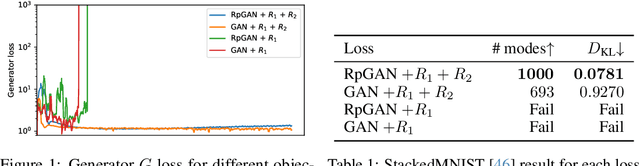
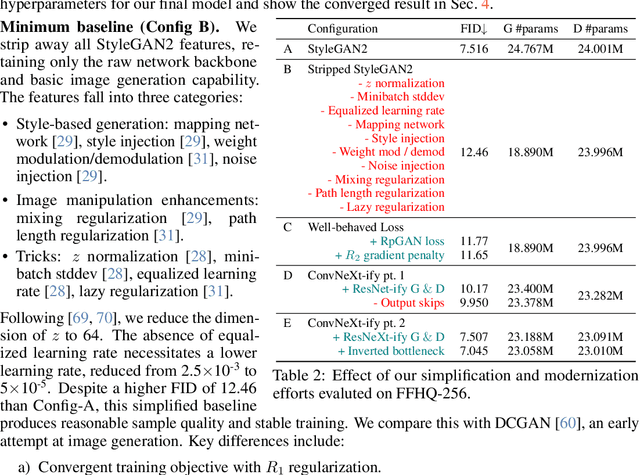

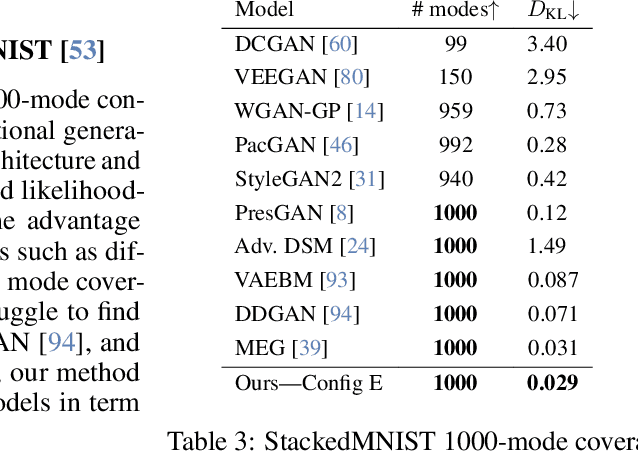
There is a widely-spread claim that GANs are difficult to train, and GAN architectures in the literature are littered with empirical tricks. We provide evidence against this claim and build a modern GAN baseline in a more principled manner. First, we derive a well-behaved regularized relativistic GAN loss that addresses issues of mode dropping and non-convergence that were previously tackled via a bag of ad-hoc tricks. We analyze our loss mathematically and prove that it admits local convergence guarantees, unlike most existing relativistic losses. Second, our new loss allows us to discard all ad-hoc tricks and replace outdated backbones used in common GANs with modern architectures. Using StyleGAN2 as an example, we present a roadmap of simplification and modernization that results in a new minimalist baseline -- R3GAN. Despite being simple, our approach surpasses StyleGAN2 on FFHQ, ImageNet, CIFAR, and Stacked MNIST datasets, and compares favorably against state-of-the-art GANs and diffusion models.