 Add to Chrome
 Add to Firefox
 Add to Edge
HexMIL: Hierarchical Attention MIL for Ante-Hoc Explainable Detection of AI-Manipulated CT Volumes
Aug 05, 2026
The emergence of medical deepfakes, i.e., medical images manipulated by deep generative models, poses a significant threat to clinical workflows. However, existing detectors suffer from two critical limitations: poor generalization to unseen generative architectures for manipulation detection and lack of interpretability. In this context, we present HexMIL (Hierarchical EXplainable Multiple Instance Learning), a mask-free medical deepfake detector that simultaneously addresses both limitations using only binary volume-level supervision. HexMIL decomposes each CT volume into a two-level hierarchy of patches and slices, aggregated via independent Gated Attention modules whose weights are directly combined into a full-resolution 3D attention volume that localizes the manipulated sub-region without any pixel-level annotation. Unlike post-hoc methods such as Grad-CAM, HexMIL's attention weights constitute the exact forward computation driving the classification decision, providing ante-hoc and structurally faithful spatial attribution. We evaluate HexMIL on M3DSynth and CT-GAN datasets under a rigorous cross-generator generalization protocol, training on a single generative architecture and testing on unseen ones. HexMIL outperforms all baselines by $+9.1$ AUC and $+9.4$ F1 in out-of-domain classification, and achieves the best average IoU and Pointing Game score in localization. Project page: opontorno.github.io/hexmil.
* Accepted at ACM Multimedia 2026 (MM '26)

The K-Space Signature: Frequency-Domain Representation Learning for Medical Deepfake Detection
Aug 03, 2026In medical imaging, generative models are increasingly deployed to synthesize realistic data and augment limited datasets. Unfortunately, while beneficial for privacy-preserving data sharing, these synthesized images can be repurposed for malicious intents, threatening public health through the creation of Medical Deepfakes. To address this threat, we introduce the K-Space Signature (KSS), a novel forensic framework that isolates hardware and generative traces within the spectral domain. By shifting analysis to the frequency domain, the KSS suppresses macroscopic anatomical variance by subtracting an empirical global anatomical prior computed in the Logarithmic Power Spectral Density (Log-PSD) space. To effectively process these globally distributed spectral artifacts without the local spatial bias inherent to Convolutional Neural Networks, we pair the KSS representation with a novel 3D MLP-Mixer architecture equipped with an ArcFace metric-learning head. Extensive experiments on multi-center 3D MRI datasets demonstrate that this combined approach achieves exceptional detection performance, exceeding 0.99 Accuracy and ROC-AUC on multi-generator synthetic datasets. Furthermore, the framework exhibits robust zero-shot generalization, maintaining strong discriminative power (up to 0.93 Accuracy) on independent datasets acquired from entirely unseen scanners. To ensure full reproducibility, the complete source code and pre-trained models will be made publicly available upon acceptance.
$μ$Flow: Leveraging Average Images for Improving Generalisation of Deepfake Faces Detectors
Jun 29, 2026Current generative models, including GANs and diffusion models, have reached an outstanding level of photorealism, posing significant risks to privacy and security. To ensure real-world applicability, deepfake detectors must generalise effectively to unseen generators. However, most existing approaches rely on supervised training with both real and fake images, which limits their generalisation especially across generators categories (e.g. GANs vs DMs). In this work, we introduce $μ$Flow, a one-class deepfake detector trained only on real images without relying on pseudo-deepfakes or synthetic artifacts. Our approach builds on the observation that averaging multiple images amplifies consistent generative traces, producing highly discriminative feature representations. We leverage this property by modelling the distribution of features extracted from averaged images and training a normalizing flow to align the feature space of individual images with this distribution. This alignment yields a likelihood-based criterion that separates real and fake samples while promoting strong generalisation. We evaluate $μ$Flow on a fully out-of-distribution setting, where both real and fake datasets are unseen during training. Experimental results show that our method significantly outperforms SOTA detectors. Project page: https://opontorno.github.io/MuFlow.
Reinforcing the Weakest Links: Modernizing SIENA with Targeted Deep Learning Integration
Mar 13, 2026Percentage Brain Volume Change (PBVC) derived from Magnetic Resonance Imaging (MRI) is a widely used biomarker of brain atrophy, with SIENA among the most established methods for its estimation. However, SIENA relies on classical image processing steps, particularly skull stripping and tissue segmentation, whose failures can propagate through the pipeline and bias atrophy estimates. In this work, we examine whether targeted deep learning substitutions can improve SIENA while preserving its established and interpretable framework. To this end, we integrate SynthStrip and SynthSeg into SIENA and evaluate three pipeline variants on the ADNI and PPMI longitudinal cohorts. Performance is assessed using three complementary criteria: correlation with longitudinal clinical and structural decline, scan-order consistency, and end-to-end runtime. Replacing the skull-stripping module yields the most consistent gains: in ADNI, it substantially strengthens associations between PBVC and multiple measures of disease progression relative to the standard SIENA pipeline, while across both datasets it markedly improves robustness under scan reversal. The fully integrated pipeline achieves the strongest scan-order consistency, reducing the error by up to 99.1%. In addition, GPU-enabled variants reduce execution time by up to 46% while maintaining CPU runtimes comparable to standard SIENA. Overall, these findings show that deep learning can meaningfully strengthen established longitudinal atrophy pipelines when used to reinforce their weakest image processing steps. More broadly, this study highlights the value of modularly modernizing clinically trusted neuroimaging tools without sacrificing their interpretability. Code is publicly available at https://github.com/Raciti/Enhanced-SIENA.git.
Proto-LeakNet: Towards Signal-Leak Aware Attribution in Synthetic Human Face Imagery
Nov 15, 2025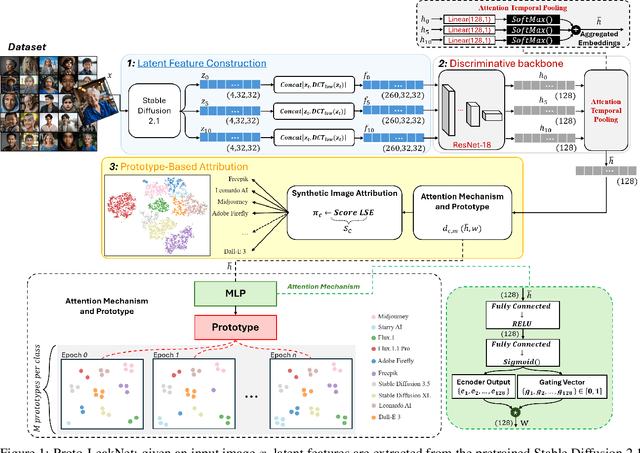
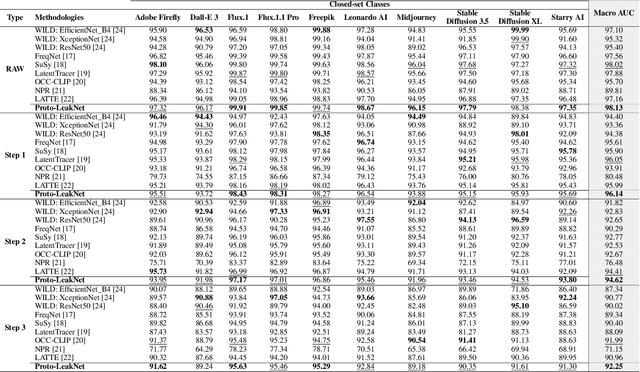
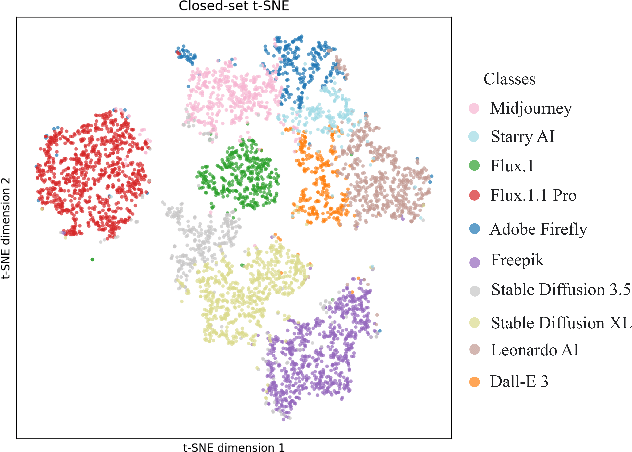
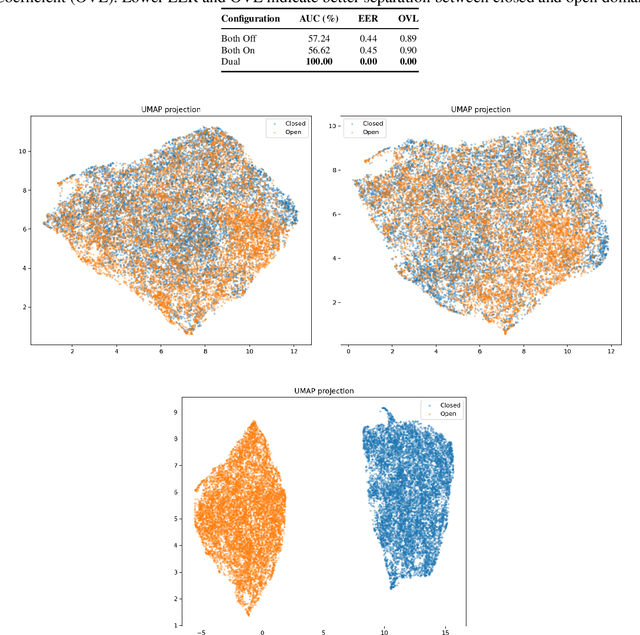
The growing sophistication of synthetic image and deepfake generation models has turned source attribution and authenticity verification into a critical challenge for modern computer vision systems. Recent studies suggest that diffusion pipelines unintentionally imprint persistent statistical traces, known as signal-leaks, within their outputs, particularly in latent representations. Building on this observation, we propose Proto-LeakNet, a signal-leak-aware and interpretable attribution framework that integrates closed-set classification with a density-based open-set evaluation on the learned embeddings, enabling analysis of unseen generators without retraining. Acting in the latent domain of diffusion models, our method re-simulates partial forward diffusion to expose residual generator-specific cues. A temporal attention encoder aggregates multi-step latent features, while a feature-weighted prototype head structures the embedding space and enables transparent attribution. Trained solely on closed data and achieving a Macro AUC of 98.13%, Proto-LeakNet learns a latent geometry that remains robust under post-processing, surpassing state-of-the-art methods, and achieves strong separability both between real images and known generators, and between known and unseen ones. The codebase will be available after acceptance.
TRUST: Leveraging Text Robustness for Unsupervised Domain Adaptation
Aug 08, 2025Recent unsupervised domain adaptation (UDA) methods have shown great success in addressing classical domain shifts (e.g., synthetic-to-real), but they still suffer under complex shifts (e.g. geographical shift), where both the background and object appearances differ significantly across domains. Prior works showed that the language modality can help in the adaptation process, exhibiting more robustness to such complex shifts. In this paper, we introduce TRUST, a novel UDA approach that exploits the robustness of the language modality to guide the adaptation of a vision model. TRUST generates pseudo-labels for target samples from their captions and introduces a novel uncertainty estimation strategy that uses normalised CLIP similarity scores to estimate the uncertainty of the generated pseudo-labels. Such estimated uncertainty is then used to reweight the classification loss, mitigating the adverse effects of wrong pseudo-labels obtained from low-quality captions. To further increase the robustness of the vision model, we propose a multimodal soft-contrastive learning loss that aligns the vision and language feature spaces, by leveraging captions to guide the contrastive training of the vision model on target images. In our contrastive loss, each pair of images acts as both a positive and a negative pair and their feature representations are attracted and repulsed with a strength proportional to the similarity of their captions. This solution avoids the need for hardly determining positive and negative pairs, which is critical in the UDA setting. Our approach outperforms previous methods, setting the new state-of-the-art on classical (DomainNet) and complex (GeoNet) domain shifts. The code will be available upon acceptance.
Deepfake Forensic Analysis: Source Dataset Attribution and Legal Implications of Synthetic Media Manipulation
May 16, 2025Synthetic media generated by Generative Adversarial Networks (GANs) pose significant challenges in verifying authenticity and tracing dataset origins, raising critical concerns in copyright enforcement, privacy protection, and legal compliance. This paper introduces a novel forensic framework for identifying the training dataset (e.g., CelebA or FFHQ) of GAN-generated images through interpretable feature analysis. By integrating spectral transforms (Fourier/DCT), color distribution metrics, and local feature descriptors (SIFT), our pipeline extracts discriminative statistical signatures embedded in synthetic outputs. Supervised classifiers (Random Forest, SVM, XGBoost) achieve 98-99% accuracy in binary classification (real vs. synthetic) and multi-class dataset attribution across diverse GAN architectures (StyleGAN, AttGAN, GDWCT, StarGAN, and StyleGAN2). Experimental results highlight the dominance of frequency-domain features (DCT/FFT) in capturing dataset-specific artifacts, such as upsampling patterns and spectral irregularities, while color histograms reveal implicit regularization strategies in GAN training. We further examine legal and ethical implications, showing how dataset attribution can address copyright infringement, unauthorized use of personal data, and regulatory compliance under frameworks like GDPR and California's AB 602. Our framework advances accountability and governance in generative modeling, with applications in digital forensics, content moderation, and intellectual property litigation.
End-to-end Audio Deepfake Detection from RAW Waveforms: a RawNet-Based Approach with Cross-Dataset Evaluation
Apr 30, 2025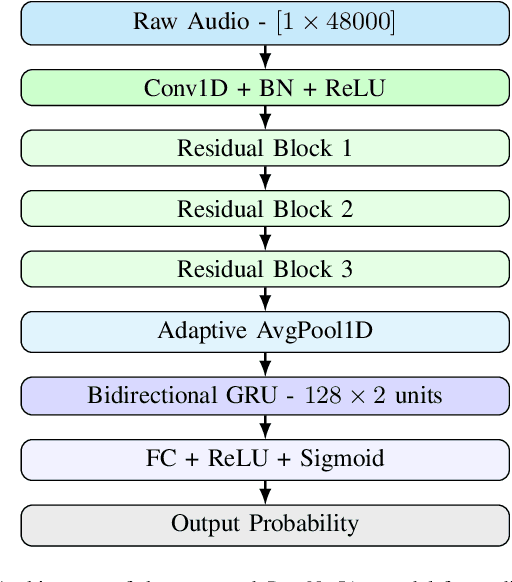
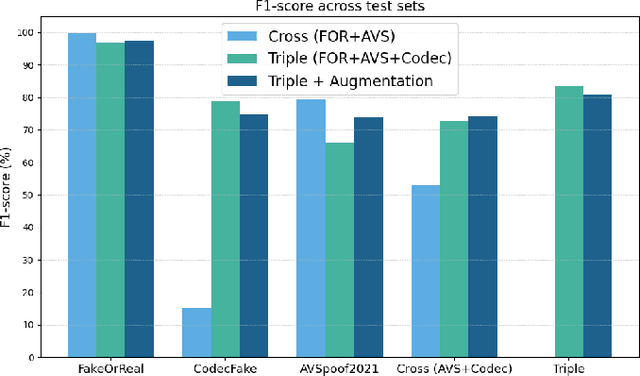
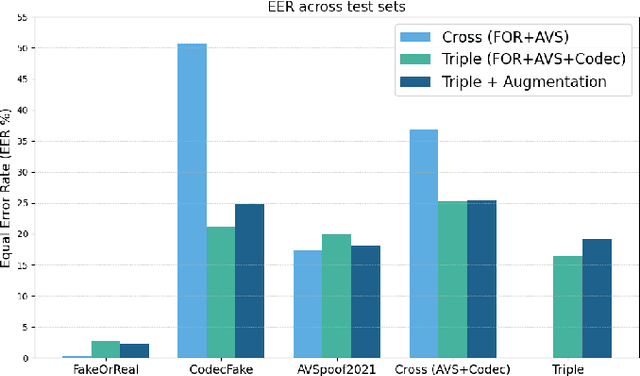
Audio deepfakes represent a growing threat to digital security and trust, leveraging advanced generative models to produce synthetic speech that closely mimics real human voices. Detecting such manipulations is especially challenging under open-world conditions, where spoofing methods encountered during testing may differ from those seen during training. In this work, we propose an end-to-end deep learning framework for audio deepfake detection that operates directly on raw waveforms. Our model, RawNetLite, is a lightweight convolutional-recurrent architecture designed to capture both spectral and temporal features without handcrafted preprocessing. To enhance robustness, we introduce a training strategy that combines data from multiple domains and adopts Focal Loss to emphasize difficult or ambiguous samples. We further demonstrate that incorporating codec-based manipulations and applying waveform-level audio augmentations (e.g., pitch shifting, noise, and time stretching) leads to significant generalization improvements under realistic acoustic conditions. The proposed model achieves over 99.7% F1 and 0.25% EER on in-domain data (FakeOrReal), and up to 83.4% F1 with 16.4% EER on a challenging out-of-distribution test set (AVSpoof2021 + CodecFake). These findings highlight the importance of diverse training data, tailored objective functions and audio augmentations in building resilient and generalizable audio forgery detectors. Code and pretrained models are available at https://iplab.dmi.unict.it/mfs/Deepfakes/PaperRawNet2025/.
WILD: a new in-the-Wild Image Linkage Dataset for synthetic image attribution
Apr 29, 2025Synthetic image source attribution is an open challenge, with an increasing number of image generators being released yearly. The complexity and the sheer number of available generative techniques, as well as the scarcity of high-quality open source datasets of diverse nature for this task, make training and benchmarking synthetic image source attribution models very challenging. WILD is a new in-the-Wild Image Linkage Dataset designed to provide a powerful training and benchmarking tool for synthetic image attribution models. The dataset is built out of a closed set of 10 popular commercial generators, which constitutes the training base of attribution models, and an open set of 10 additional generators, simulating a real-world in-the-wild scenario. Each generator is represented by 1,000 images, for a total of 10,000 images in the closed set and 10,000 images in the open set. Half of the images are post-processed with a wide range of operators. WILD allows benchmarking attribution models in a wide range of tasks, including closed and open set identification and verification, and robust attribution with respect to post-processing and adversarial attacks. Models trained on WILD are expected to benefit from the challenging scenario represented by the dataset itself. Moreover, an assessment of seven baseline methodologies on closed and open set attribution is presented, including robustness tests with respect to post-processing.
ICPR 2024 Competition on Multiple Sclerosis Lesion Segmentation -- Methods and Results
Oct 10, 2024
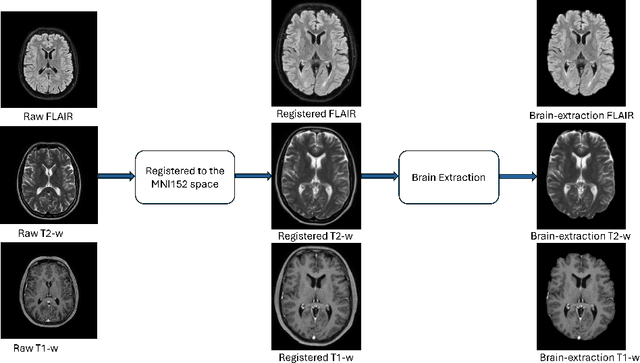
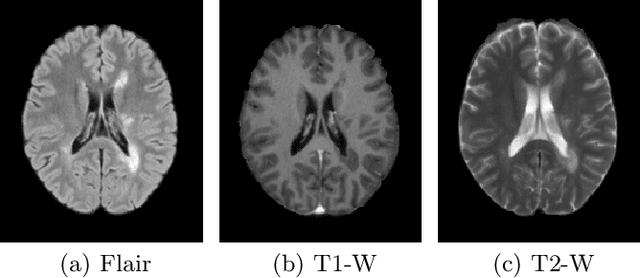
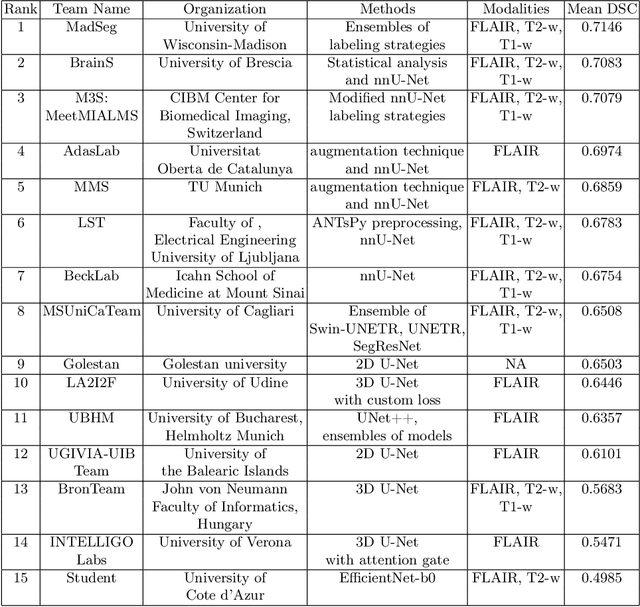
This report summarizes the outcomes of the ICPR 2024 Competition on Multiple Sclerosis Lesion Segmentation (MSLesSeg). The competition aimed to develop methods capable of automatically segmenting multiple sclerosis lesions in MRI scans. Participants were provided with a novel annotated dataset comprising a heterogeneous cohort of MS patients, featuring both baseline and follow-up MRI scans acquired at different hospitals. MSLesSeg focuses on developing algorithms that can independently segment multiple sclerosis lesions of an unexamined cohort of patients. This segmentation approach aims to overcome current benchmarks by eliminating user interaction and ensuring robust lesion detection at different timepoints, encouraging innovation and promoting methodological advances.