 Add to Chrome
 Add to Firefox
 Add to Edge
Satire Dataset
Papers and Code
Detecting Hate and Inflammatory Content in Bengali Memes: A New Multimodal Dataset and Co-Attention Framework
Feb 25, 2026
Internet memes have become a dominant form of expression on social media, including within the Bengali-speaking community. While often humorous, memes can also be exploited to spread offensive, harmful, and inflammatory content targeting individuals and groups. Detecting this type of content is excep- tionally challenging due to its satirical, subtle, and culturally specific nature. This problem is magnified for low-resource lan- guages like Bengali, as existing research predominantly focuses on high-resource languages. To address this critical research gap, we introduce Bn-HIB (Bangla Hate Inflammatory Benign), a novel dataset containing 3,247 manually annotated Bengali memes categorized as Benign, Hate, or Inflammatory. Significantly, Bn- HIB is the first dataset to distinguish inflammatory content from direct hate speech in Bengali memes. Furthermore, we propose the MCFM (Multi-Modal Co-Attention Fusion Model), a simple yet effective architecture that mutually analyzes both the visual and textual elements of a meme. MCFM employs a co-attention mechanism to identify and fuse the most critical features from each modality, leading to a more accurate classification. Our experiments show that MCFM significantly outperforms several state-of-the-art models on the Bn-HIB dataset, demonstrating its effectiveness in this nuanced task.Warning: This work contains material that may be disturbing to some audience members. Viewer discretion is advised.

WISE: Web Information Satire and Fakeness Evaluation
Dec 30, 2025Distinguishing fake or untrue news from satire or humor poses a unique challenge due to their overlapping linguistic features and divergent intent. This study develops WISE (Web Information Satire and Fakeness Evaluation) framework which benchmarks eight lightweight transformer models alongside two baseline models on a balanced dataset of 20,000 samples from Fakeddit, annotated as either fake news or satire. Using stratified 5-fold cross-validation, we evaluate models across comprehensive metrics including accuracy, precision, recall, F1-score, ROC-AUC, PR-AUC, MCC, Brier score, and Expected Calibration Error. Our evaluation reveals that MiniLM, a lightweight model, achieves the highest accuracy (87.58%) among all models, while RoBERTa-base achieves the highest ROC-AUC (95.42%) and strong accuracy (87.36%). DistilBERT offers an excellent efficiency-accuracy trade-off with 86.28\% accuracy and 93.90\% ROC-AUC. Statistical tests confirm significant performance differences between models, with paired t-tests and McNemar tests providing rigorous comparisons. Our findings highlight that lightweight models can match or exceed baseline performance, offering actionable insights for deploying misinformation detection systems in real-world, resource-constrained settings.
Yes FLoReNce, I Will Do Better Next Time! Agentic Feedback Reasoning for Humorous Meme Detection
Jan 12, 2026Humorous memes blend visual and textual cues to convey irony, satire, or social commentary, posing unique challenges for AI systems that must interpret intent rather than surface correlations. Existing multimodal or prompting-based models generate explanations for humor but operate in an open loop,lacking the ability to critique or refine their reasoning once a prediction is made. We propose FLoReNce, an agentic feedback reasoning framework that treats meme understanding as a closed-loop process during learning and an open-loop process during inference. In the closed loop, a reasoning agent is critiqued by a judge; the error and semantic feedback are converted into control signals and stored in a feedback-informed, non-parametric knowledge base. At inference, the model retrieves similar judged experiences from this KB and uses them to modulate its prompt, enabling better, self-aligned reasoning without finetuning. On the PrideMM dataset, FLoReNce improves both predictive performance and explanation quality over static multimodal baselines, showing that feedback-regulated prompting is a viable path to adaptive meme humor understanding.
MuSaRoNews: A Multidomain, Multimodal Satire Dataset from Romanian News Articles
Apr 10, 2025
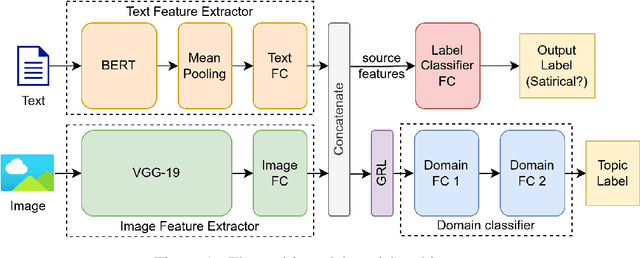
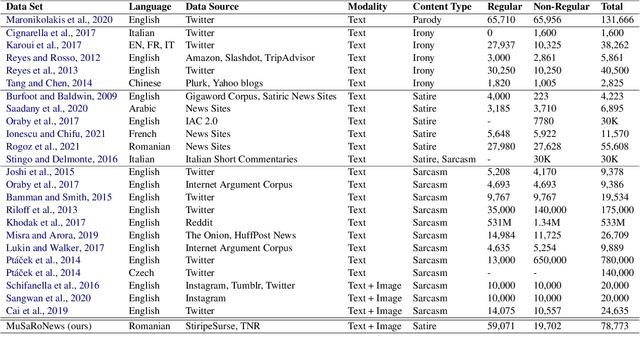
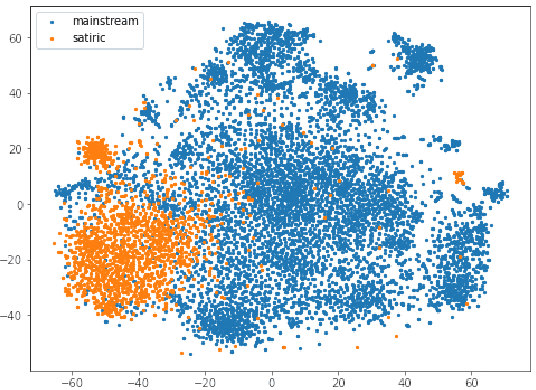
Satire and fake news can both contribute to the spread of false information, even though both have different purposes (one if for amusement, the other is to misinform). However, it is not enough to rely purely on text to detect the incongruity between the surface meaning and the actual meaning of the news articles, and, often, other sources of information (e.g., visual) provide an important clue for satire detection. This work introduces a multimodal corpus for satire detection in Romanian news articles named MuSaRoNews. Specifically, we gathered 117,834 public news articles from real and satirical news sources, composing the first multimodal corpus for satire detection in the Romanian language. We conducted experiments and showed that the use of both modalities improves performance.
SaRoHead: A Dataset for Satire Detection in Romanian Multi-Domain News Headlines
Apr 10, 2025The headline is an important part of a news article, influenced by expressiveness and connection to the exposed subject. Although most news outlets aim to present reality objectively, some publications prefer a humorous approach in which stylistic elements of satire, irony, and sarcasm blend to cover specific topics. Satire detection can be difficult because a headline aims to expose the main idea behind a news article. In this paper, we propose SaRoHead, the first corpus for satire detection in Romanian multi-domain news headlines. Our findings show that the clickbait used in some non-satirical headlines significantly influences the model.
Deceptive Humor: A Synthetic Multilingual Benchmark Dataset for Bridging Fabricated Claims with Humorous Content
Mar 20, 2025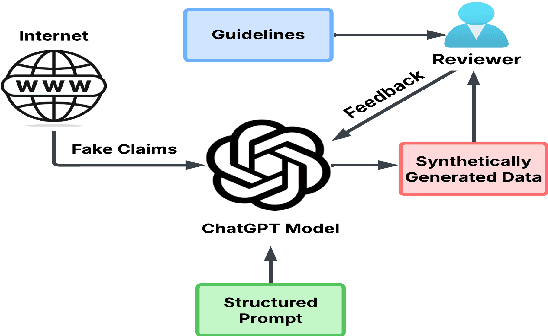
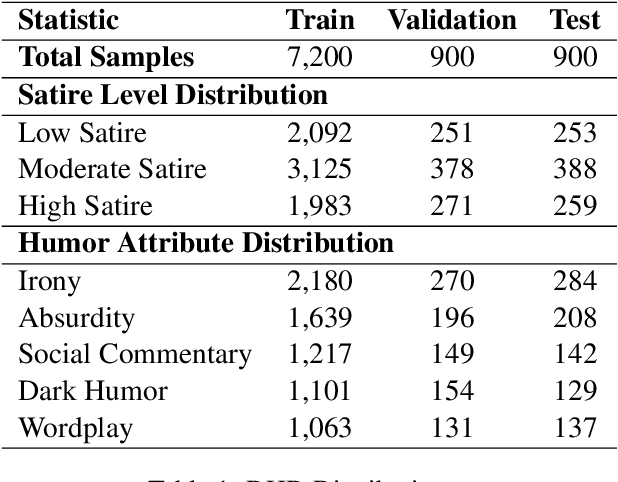
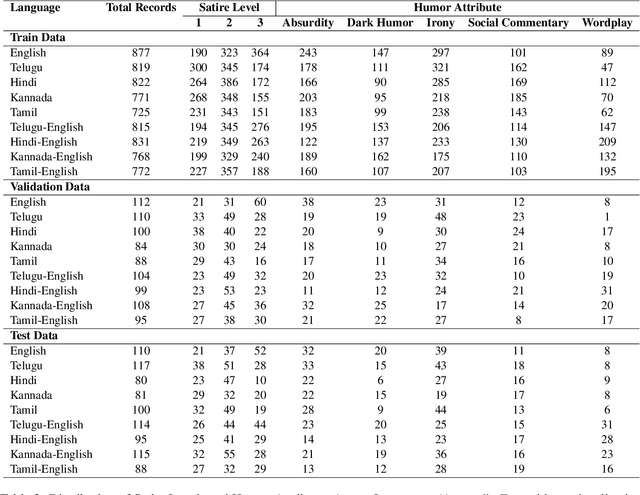
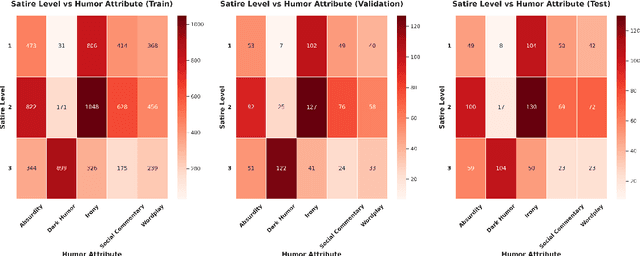
This paper presents the Deceptive Humor Dataset (DHD), a novel resource for studying humor derived from fabricated claims and misinformation. In an era of rampant misinformation, understanding how humor intertwines with deception is essential. DHD consists of humor-infused comments generated from false narratives, incorporating fabricated claims and manipulated information using the ChatGPT-4o model. Each instance is labeled with a Satire Level, ranging from 1 for subtle satire to 3 for high-level satire and classified into five distinct Humor Categories: Dark Humor, Irony, Social Commentary, Wordplay, and Absurdity. The dataset spans multiple languages including English, Telugu, Hindi, Kannada, Tamil, and their code-mixed variants (Te-En, Hi-En, Ka-En, Ta-En), making it a valuable multilingual benchmark. By introducing DHD, we establish a structured foundation for analyzing humor in deceptive contexts, paving the way for a new research direction that explores how humor not only interacts with misinformation but also influences its perception and spread. We establish strong baselines for the proposed dataset, providing a foundation for future research to benchmark and advance deceptive humor detection models.
Make Satire Boring Again: Reducing Stylistic Bias of Satirical Corpus by Utilizing Generative LLMs
Dec 12, 2024Satire detection is essential for accurately extracting opinions from textual data and combating misinformation online. However, the lack of diverse corpora for satire leads to the problem of stylistic bias which impacts the models' detection performances. This study proposes a debiasing approach for satire detection, focusing on reducing biases in training data by utilizing generative large language models. The approach is evaluated in both cross-domain (irony detection) and cross-lingual (English) settings. Results show that the debiasing method enhances the robustness and generalizability of the models for satire and irony detection tasks in Turkish and English. However, its impact on causal language models, such as Llama-3.1, is limited. Additionally, this work curates and presents the Turkish Satirical News Dataset with detailed human annotations, with case studies on classification, debiasing, and explainability.
InsightVision: A Comprehensive, Multi-Level Chinese-based Benchmark for Evaluating Implicit Visual Semantics in Large Vision Language Models
Feb 19, 2025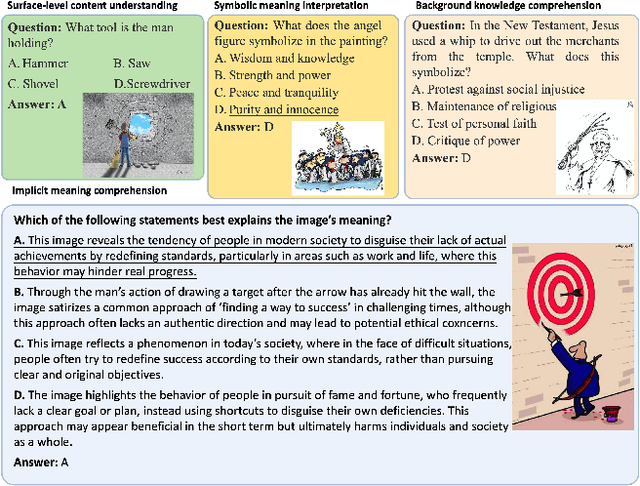
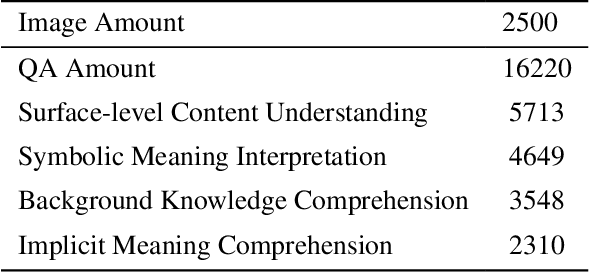
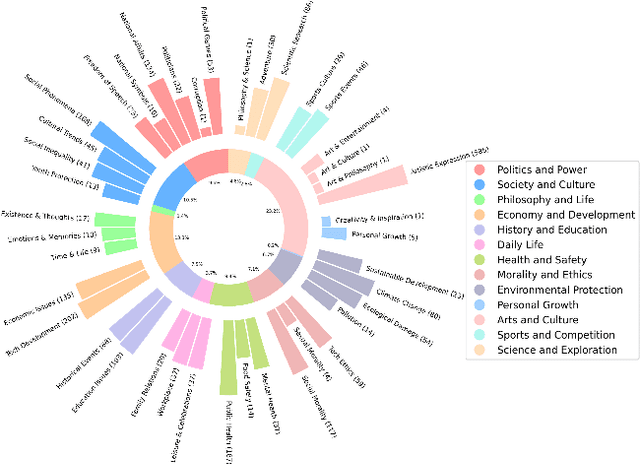
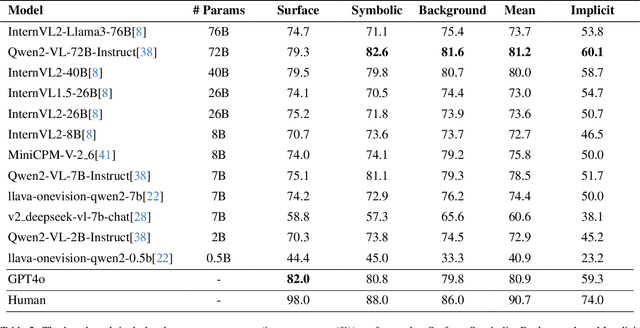
In the evolving landscape of multimodal language models, understanding the nuanced meanings conveyed through visual cues - such as satire, insult, or critique - remains a significant challenge. Existing evaluation benchmarks primarily focus on direct tasks like image captioning or are limited to a narrow set of categories, such as humor or satire, for deep semantic understanding. To address this gap, we introduce, for the first time, a comprehensive, multi-level Chinese-based benchmark designed specifically for evaluating the understanding of implicit meanings in images. This benchmark is systematically categorized into four subtasks: surface-level content understanding, symbolic meaning interpretation, background knowledge comprehension, and implicit meaning comprehension. We propose an innovative semi-automatic method for constructing datasets, adhering to established construction protocols. Using this benchmark, we evaluate 15 open-source large vision language models (LVLMs) and GPT-4o, revealing that even the best-performing model lags behind human performance by nearly 14% in understanding implicit meaning. Our findings underscore the intrinsic challenges current LVLMs face in grasping nuanced visual semantics, highlighting significant opportunities for future research and development in this domain. We will publicly release our InsightVision dataset, code upon acceptance of the paper.
Large Vision-Language Models for Knowledge-Grounded Data Annotation of Memes
Jan 23, 2025Memes have emerged as a powerful form of communication, integrating visual and textual elements to convey humor, satire, and cultural messages. Existing research has focused primarily on aspects such as emotion classification, meme generation, propagation, interpretation, figurative language, and sociolinguistics, but has often overlooked deeper meme comprehension and meme-text retrieval. To address these gaps, this study introduces ClassicMemes-50-templates (CM50), a large-scale dataset consisting of over 33,000 memes, centered around 50 popular meme templates. We also present an automated knowledge-grounded annotation pipeline leveraging large vision-language models to produce high-quality image captions, meme captions, and literary device labels overcoming the labor intensive demands of manual annotation. Additionally, we propose a meme-text retrieval CLIP model (mtrCLIP) that utilizes cross-modal embedding to enhance meme analysis, significantly improving retrieval performance. Our contributions include:(1) a novel dataset for large-scale meme study, (2) a scalable meme annotation framework, and (3) a fine-tuned CLIP for meme-text retrieval, all aimed at advancing the understanding and analysis of memes at scale.
NYK-MS: A Well-annotated Multi-modal Metaphor and Sarcasm Understanding Benchmark on Cartoon-Caption Dataset
Sep 02, 2024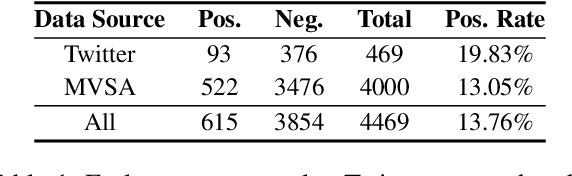

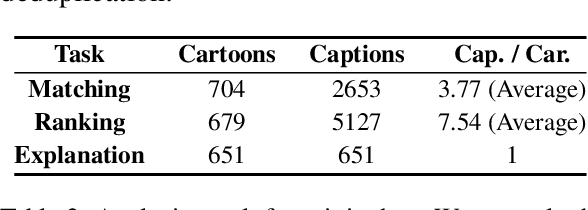
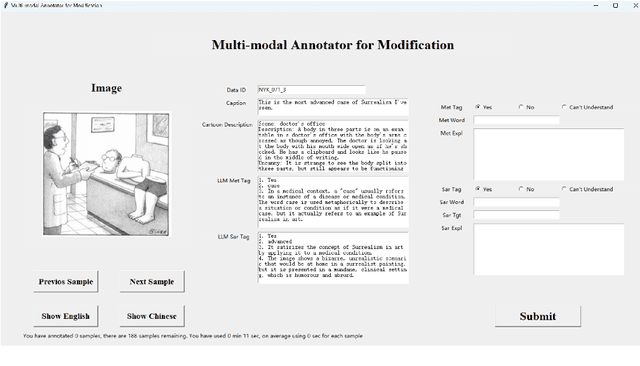
Metaphor and sarcasm are common figurative expressions in people's communication, especially on the Internet or the memes popular among teenagers. We create a new benchmark named NYK-MS (NewYorKer for Metaphor and Sarcasm), which contains 1,583 samples for metaphor understanding tasks and 1,578 samples for sarcasm understanding tasks. These tasks include whether it contains metaphor/sarcasm, which word or object contains metaphor/sarcasm, what does it satirize and why does it contains metaphor/sarcasm, all of the 7 tasks are well-annotated by at least 3 annotators. We annotate the dataset for several rounds to improve the consistency and quality, and use GUI and GPT-4V to raise our efficiency. Based on the benchmark, we conduct plenty of experiments. In the zero-shot experiments, we show that Large Language Models (LLM) and Large Multi-modal Models (LMM) can't do classification task well, and as the scale increases, the performance on other 5 tasks improves. In the experiments on traditional pre-train models, we show the enhancement with augment and alignment methods, which prove our benchmark is consistent with previous dataset and requires the model to understand both of the two modalities.