 Add to Chrome
 Add to Firefox
 Add to Edge
When the Chain of Thought Knows Better: Failure Modes in Multi-Turn Reasoning Models
Jun 09, 2026
Failures in multi-turn reasoning models are largely invisible to terminal-score evaluation. A model can lock onto an unsafe stance early in a long dialogue, yet its final-turn refusal rate may appear indistinguishable from a robustly aligned baseline. To expose these hidden temporal dynamics, we propose a trace-level diagnostic - the CoT-Output 2x2 safety matrix. This framework labels every turn along two independent axes (internal reasoning and visible output), yielding four operationally defined failure cells: robust alignment, alignment faking, overt jailbreak, and a distinct failure mode we term context-injection failure (where the CoT maintains safe reasoning, but the visible output produces harm, highlighting a multi-turn manifestation of reasoning unfaithfulness). We evaluate three distilled reasoning targets against a fixed attacker across five oversight conditions, collecting 6750 turn-level observations on the Information-Hazard scenario. Our analysis reveals two reproducible vulnerabilities: an oversight paradox where explicit monitoring cues paradoxically increase alignment-faking rates rather than suppress them, and a context-injection failure where models lock onto unsafe external outputs despite safe internal states. We release the full dataset of multi-turn dialogues and CoT traces to support follow-up trace-diagnostic research.

HateMirage: An Explainable Multi-Dimensional Dataset for Decoding Faux Hate and Subtle Online Abuse
Mar 03, 2026Subtle and indirect hate speech remains an underexplored challenge in online safety research, particularly when harmful intent is embedded within misleading or manipulative narratives. Existing hate speech datasets primarily capture overt toxicity, underrepresenting the nuanced ways misinformation can incite or normalize hate. To address this gap, we present HateMirage, a novel dataset of Faux Hate comments designed to advance reasoning and explainability research on hate emerging from fake or distorted narratives. The dataset was constructed by identifying widely debunked misinformation claims from fact-checking sources and tracing related YouTube discussions, resulting in 4,530 user comments. Each comment is annotated along three interpretable dimensions: Target (who is affected), Intent (the underlying motivation or goal behind the comment), and Implication (its potential social impact). Unlike prior explainability datasets such as HateXplain and HARE, which offer token-level or single-dimensional reasoning, HateMirage introduces a multi-dimensional explanation framework that captures the interplay between misinformation, harm, and social consequence. We benchmark multiple open-source language models on HateMirage using ROUGE-L F1 and Sentence-BERT similarity to assess explanation coherence. Results suggest that explanation quality may depend more on pretraining diversity and reasoning-oriented data rather than on model scale alone. By coupling misinformation reasoning with harm attribution, HateMirage establishes a new benchmark for interpretable hate detection and responsible AI research.
X-MuTeST: A Multilingual Benchmark for Explainable Hate Speech Detection and A Novel LLM-consulted Explanation Framework
Jan 06, 2026Hate speech detection on social media faces challenges in both accuracy and explainability, especially for underexplored Indic languages. We propose a novel explainability-guided training framework, X-MuTeST (eXplainable Multilingual haTe Speech deTection), for hate speech detection that combines high-level semantic reasoning from large language models (LLMs) with traditional attention-enhancing techniques. We extend this research to Hindi and Telugu alongside English by providing benchmark human-annotated rationales for each word to justify the assigned class label. The X-MuTeST explainability method computes the difference between the prediction probabilities of the original text and those of unigrams, bigrams, and trigrams. Final explanations are computed as the union between LLM explanations and X-MuTeST explanations. We show that leveraging human rationales during training enhances both classification performance and explainability. Moreover, combining human rationales with our explainability method to refine the model attention yields further improvements. We evaluate explainability using Plausibility metrics such as Token-F1 and IOU-F1 and Faithfulness metrics such as Comprehensiveness and Sufficiency. By focusing on under-resourced languages, our work advances hate speech detection across diverse linguistic contexts. Our dataset includes token-level rationale annotations for 6,004 Hindi, 4,492 Telugu, and 6,334 English samples. Data and code are available on https://github.com/ziarehman30/X-MuTeST
* Accepted in the proceedings of AAAI 2026
Deceptive Humor: A Synthetic Multilingual Benchmark Dataset for Bridging Fabricated Claims with Humorous Content
Mar 20, 2025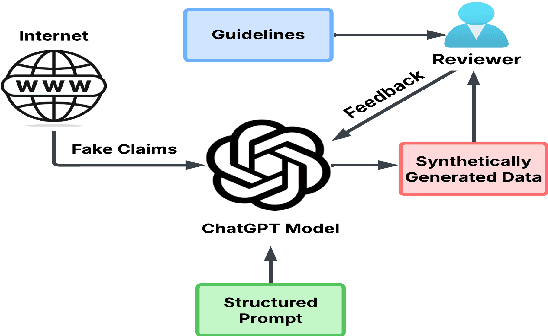
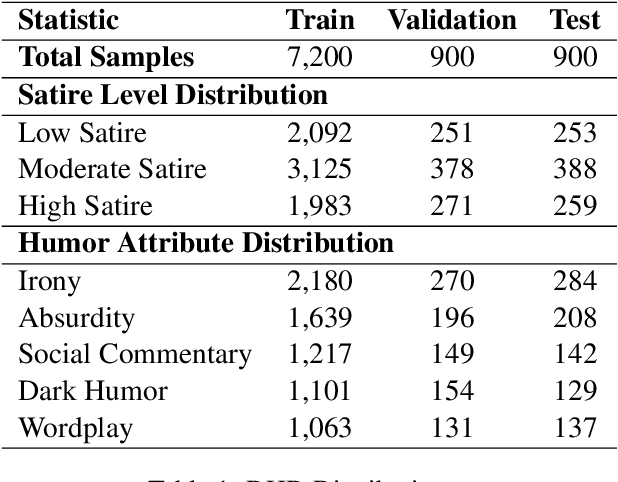
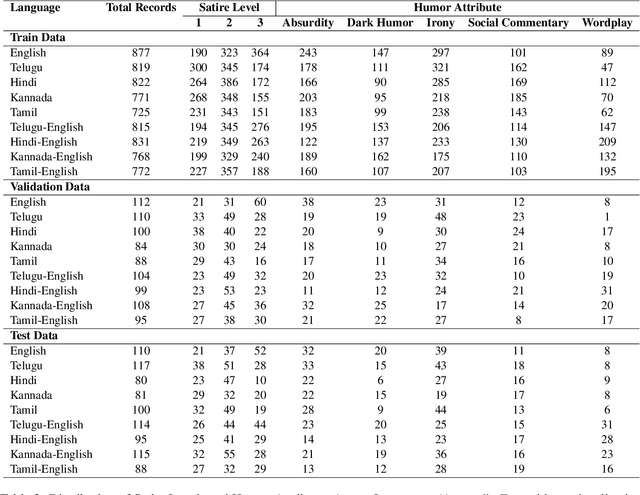
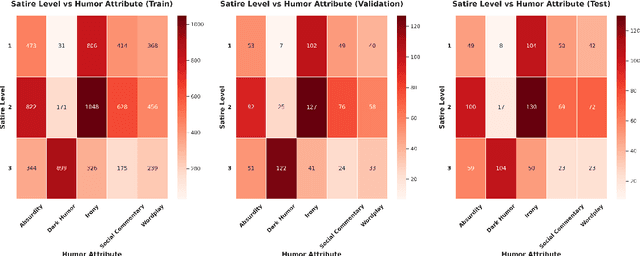
This paper presents the Deceptive Humor Dataset (DHD), a novel resource for studying humor derived from fabricated claims and misinformation. In an era of rampant misinformation, understanding how humor intertwines with deception is essential. DHD consists of humor-infused comments generated from false narratives, incorporating fabricated claims and manipulated information using the ChatGPT-4o model. Each instance is labeled with a Satire Level, ranging from 1 for subtle satire to 3 for high-level satire and classified into five distinct Humor Categories: Dark Humor, Irony, Social Commentary, Wordplay, and Absurdity. The dataset spans multiple languages including English, Telugu, Hindi, Kannada, Tamil, and their code-mixed variants (Te-En, Hi-En, Ka-En, Ta-En), making it a valuable multilingual benchmark. By introducing DHD, we establish a structured foundation for analyzing humor in deceptive contexts, paving the way for a new research direction that explores how humor not only interacts with misinformation but also influences its perception and spread. We establish strong baselines for the proposed dataset, providing a foundation for future research to benchmark and advance deceptive humor detection models.